




For most of the Chinese world, the Mid-Autumn Festival is a festival of mooncakes and lanterns and gazing at the full moon. For Hokkien families it is also, and I don’t think anyone in mine would argue with this, a night of “gambling.” Or at least that’s what the name says.
We call it Pua Tiong Chiu. Tiong-chhiu is 中秋, mid-autumn, the fifteenth night of the eighth lunar month, when the moon is supposed to be at its fullest and roundest of the year. Pua is 跋, poa̍h, which is harder to translate politely. It’s the verb to fall, or for letting something fall where it falls. It’s the same word you use for gambling, 跋筊, and the same word for casting the red wooden moon blocks at a temple to ask the gods a yes-or-no question, 跋桮. That’s a fair summary of the whole evening: part celebration, part wager, and part asking the universe how your year is going to go.
I should admit something before I explain any of it. I played this game most years as a child, and nobody really told us why. We didn’t know where it came from or what the prizes were named after. We didn’t know why it was played on that night, but just chalked it up to tradition. We just played it because it was fun, and quite often chaotic fun, and then we grew up and did exactly the same thing with the following generation, without ever explaining it to them either. On Saturday the twenty-sixth, the day after the festival itself and, as it happens, the day of this year’s actual full moon, I’m hosting it for six friends, most of whom are not Hokkien and some of whom aren’t Chinese at all, and I realized I couldn’t explain it to them without first finding out for myself.
So, the festival. It is very old. People in China were giving thanks for the harvest under the autumn full moon more than three thousand years ago, and the name itself turns up in a Zhou dynasty book of rites. By the Tang dynasty it was something poets and emperors did, moon-gazing with wine, and by the Song it had become a festival for everybody. That is also when the mooncake attached itself to the night for good. The stories arrived along the way. There is Chang’e, who swallowed the elixir of immortality and floated up to the moon, where she still lives with a jade rabbit pounding medicine beside her. And there is the story every child in China is eventually told: that rebels hid messages inside mooncakes to coordinate an uprising against the Mongol Yuan dynasty on the fifteenth night of the eighth month. It’s a wonderful story. Historians tend to treat it as a legend rather than a record, and I think it’s more fun to know that and tell it anyway.
What all of it comes back to is roundness. A full moon, a round cake, a family gathered round a table. The festival is really about reunion, which is why it has sometimes been called Chinese Thanksgiving, and why the thing most people in China actually do that night is go home and spend time with their family.
Where it goes after that depends on who you are. In Hong Kong they carry a sixty-seven-metre dragon stuck with twelve thousand burning incense sticks through the streets of Tai Hang. In Taiwan, for reasons that seem to involve a soy sauce advertisement, everyone has a barbecue. In Vietnam it’s a children’s festival of lanterns. In Korea, on the same full moon, it’s Chuseok.
And in Xiamen, the port city in southern Fujian where so many Chinese-Filipino families trace their roots, and then everywhere Hokkien people went from there, including Manila, they roll dice.
The story goes that the game was invented in the seventeenth century by Hong Xu, an officer serving under Koxinga, the Ming loyalist general who held Xiamen against the Qing and later took Taiwan from the Dutch. The army was far from home at Mid-Autumn, the soldiers were homesick, and Hong Xu came up with a game to lift their spirits. Even the general’s name comes to English through Hokkien: Koxinga is 國姓爺, Kok-sèng-iâ, “lord of the imperial surname.” I can’t tell you how much of the story is true, and I’m not sure anyone can. But in Xiamen the game is now recognized as national intangible cultural heritage, played in homes and offices and on street corners. In Manila it moved through Binondo family dining rooms and into schools and later even company parties, the way ours did.
I’ve played it at the big end of that scale too. In 2019, at OmniPay, we held a Mid-Autumn Harvest Festival celebration for our clients in a ballroom at Shangri-La The Fort in Bonifacio Global City, with paper lanterns hung from the ceiling and each round table carrying its own bowl, its own six dice and its own pile of prizes wrapped in cellophane. The prizes there were tagged 1st to 6th rather than with the old exam titles, which made it simpler for our guests to comprehend.

I’ve played it with my family and extended family in Manila and in Vancouver, though I couldn’t tell you which came first. From what I recall, the prizes were paid for by the eldest in the family: my grandparents, and later my parents. What I remember most isn’t the rules, which I absorbed without anyone ever sitting me down to explain them, the way you learn most things in a family. It’s the sound. Six dice thrown into a porcelain bowl make a bright, rattling, ringing noise that is not like any other sound in the house, and then a half-second of silence while everyone leans in to count.
Here is how it works, for anyone who has only ever watched.
There are six dice and one wide porcelain bowl, and the players take turns throwing all six dice into it, one throw each, round and round the table. The only number that really matters is four. On our dice the four was painted red, and so was the one, and I didn’t know why until this year. As far as I can tell, the one isn’t doing anything in this game at all. A red one and a red four is typically how Chinese dice come, the same dice that turn up in a mahjong set, and dice with only the four in red are hard to find, if they exist at all. The story behind them, as I’ve since found it, is that the Tang emperor Xuanzong was playing dice with his consort, Yang Guifei, who had rolled a pair of ones. He needed a pair of fours to come back, shouted for them as the dice tumbled, and got them, and he was so delighted that he had it proclaimed that every die in the empire should carry its four, and its one, in red. At the Tang court red was the colour of official rank, so it was quite an honour to hand to a pair of dice. It’s a legend rather than a record, but it at least explains why the dice look the way they do. Whether or not it’s true, in this game red is lucky and four is everything.
Which is a strange thing for a Chinese family to be cheering for. Four is about as unlucky as numbers get, because 四, sì, sounds so close to 死, sí, death. That’s as true in Hokkien as anywhere, and it’s why so many buildings skip their fourth floors. And yet for one night a year, four is the number everybody at our table wants to see. Even the mooncakes seem to have made their peace with it: they often come four to a box, and the most prized have four yolks inside. In my family they tended to arrive two boxes at a time, because gifts, like good things, are meant to come in pairs. Or was it a way for our family to turn an unlucky four into a prosperous eight?
The prizes are named after the ranks of the old imperial examinations, the civil service tests that for more than a thousand years decided who in China got to govern. At the bottom is Siu Tsai 秀才, the scholar who had passed the county exam, and you win one of those by rolling a single four. Two fours is Ki Din 舉人, a provincial graduate. Four of any other number is Tsin Si 進士, a graduate of the highest exam. Three fours is Tam Hue 探花, the man who came third in the palace examination. A straight, one through six, is Pong Gan 榜眼, who came second. And at the very top is Tsiong Guan 狀元, the one who came first in the whole empire, which takes four or more fours, or five of a kind.

The prizes come in a pyramid that doubles as it goes down: one Tsiong Guan, two Pong Gan, four Tam Hue, eight Tsin Si, sixteen Ki Din and thirty-two Siu Tsai, sixty-three in all. The lower ranks are won on the spot, and once a rank’s prizes are gone, rolling it wins you nothing.
It took me until this year to notice the joke at the centre of the game. It takes the most famously merit-based system in Chinese history, an exam you studied your whole youth to sit, and hands the results to a bowl of dice. The youngest person at the table can outrank the eldest, and in my family the eldest had paid for every prize on it. Nobody seemed to mind much.
And the Tsiong Guan is rarely safe. The first person to roll a champion hand holds the title, but only until somebody rolls a better one. Six of a kind beats five fours, five fours beats five of a kind, five of a kind with a four beats five of a kind without, and all of them beat a plain four fours. So the title can change hands three or four times in a night, and the prize only goes home with whoever is holding it when the last of the other sixty-two is gone.
In our house there is one exception, in theory. Roll six fours and the game ends there and then, and you take everything still on the table. Once, within the first three rounds, one of us actually did it. It was one of my brothers or me, and I no longer remember which. My mother didn’t like that at all, and wouldn’t let us collect the prizes, so that the game could go on. Which tells you most of what you need to know about what the game is really for.
We play by a few other house rules, which is something most families have and few agree on. One throw wins one prize, the highest it qualifies for, never two. If a die jumps out of the bowl, or lands tilted against the side or stacked on another, the throw is void and you lose your turn, which sounds harsh and teaches you very quickly to throw like you mean it without throwing like you’re angry.
The prizes are the part that changes most from table to table. In Xiamen the prizes were traditionally mooncakes, sixty-three of them in graded sizes, the champion’s the size of a dinner plate. Growing up, though, we mostly played for snacks and household goods. We did play for mooncakes once, the year we played with my extended family on my mother’s side and somebody decided to be creative, with Fujian-style cakes: flaky lard pastry and mung bean filling. They looked and tasted like the hopia we had grown up eating in the Philippines, the same pastry you find in almost every Filipino bakery, and we took them for a kind of hopia. It never occurred to us that it was the other way round, and that hopia had come from the mooncake. I respect those cakes enormously. I also have to report that those of us at the table did not want to win multiple mooncakes. You can only eat so many mung bean mooncakes, and when it came to actual mooncakes, most of us grew up on the Hong Kong style instead. The mooncakes we knew were Cantonese: lotus seed paste and salted egg yolks, and the more yolks the better. A four-yolk mooncake, cut into quarters so there’s a full yolk in every piece, is what we’d actually fight each other for.

The mooncake itself hasn’t stood still either. The one many people I know hold up as the benchmark is the mini egg custard mooncake from the Peninsula’s Michelin-starred Spring Moon in Hong Kong, first made in 1986 and still one of the most sought-after boxes of the season.
Snow skin is a different thing altogether, and these days you’ll find it from bakeries, restaurants and hotels of every kind. It’s made without baking and kept chilled, sometimes even frozen, and it turns up in pastel colours with a flake of gold leaf on top. It’s a long way from lotus paste and egg yolk to look at, and still, underneath, a Cantonese idea.

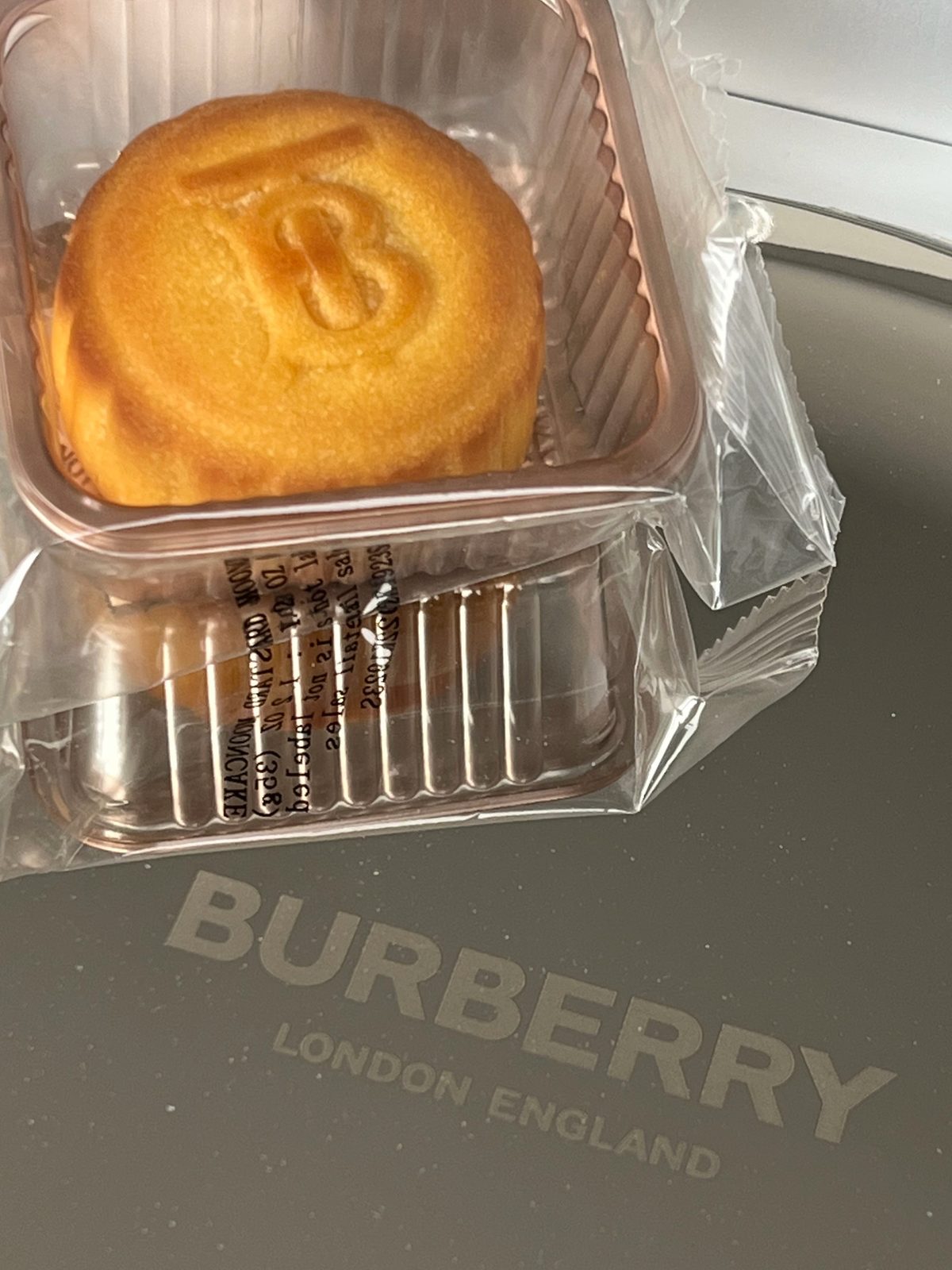
And the season’s gifting has travelled well beyond Chinese bakeries. One year a few small custard mooncakes, stamped with Burberry’s TB monogram, were brought to us in Toronto. I suspect they began as a client gift from Burberry somewhere in Asia rather than in Canada, which tells you how far the festival has reached, and who has noticed.
We played for money once too, in red envelopes, ang pao 紅包, and the kids loved that, though I’m under no illusion that it was the envelopes they loved.
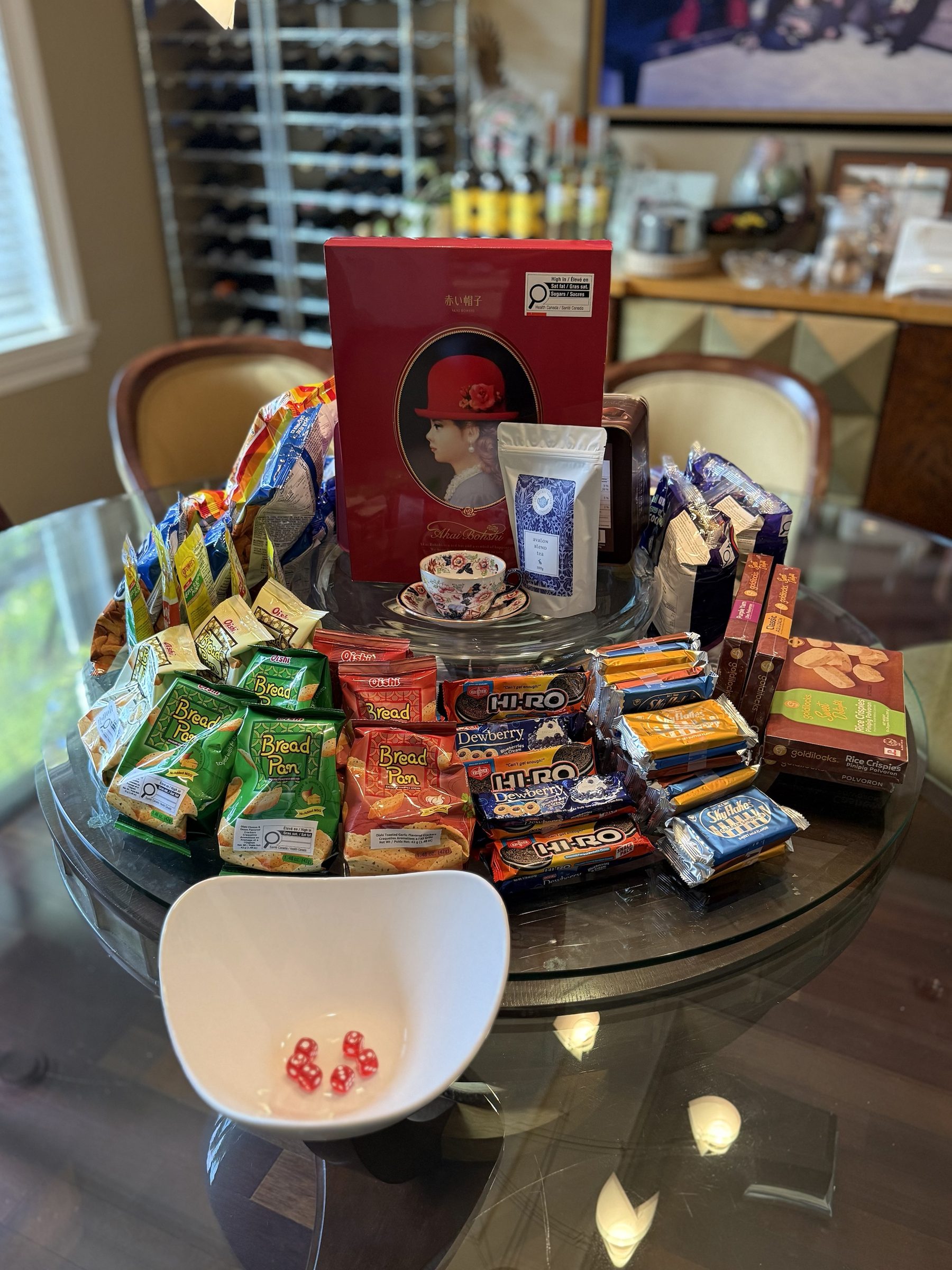
In most of the games I remember, the pile looked something like this. Snacks for the lower ranks: chips and Pocky and egg rolls and packets of pancit canton. A little further up, the things a household actually runs on: sesame oil, a big bottle of soy sauce, a bag of rice. Something nicer at Tam Hue, something nicer again at Pong Gan. And at the very top, one prize worth wanting, sitting at the peak of the pile where everybody can see it for the whole of the evening.
There’s an argument that playing for anything other than mooncakes makes the game less traditional. I don’t think it does, especially since we are all adults now and would sooner win almost anything else. The Xiamen game was played for mooncakes because a mooncake was the precious thing you had at Mid-Autumn. In Manila it became soy sauce and detergent and rice because those were useful, and a prize that is useful is a prize nobody resents winning multiples of. The bowl and the dice and the ranks have stayed exactly as they were. What’s on the table has long been a family’s handwriting.
Which brings me back to the gambling. As my family spread out across the world, it got harder and harder to get everyone round one table. Outside the Philippines especially, the game has been kept going by Fujianese communities playing among friends as much as relatives, and those games traditionally have a buy-in: you pay to join, and the money pays for the prizes. That’s gambling in a sense anyone would recognize. Ours generally wasn’t. Nobody I remember paid to sit down; the eldest bought everything on the table and gave it away one throw at a time. So whether Pua Tiong Chiu is a wager or a gift handed out by dice depends on who paid for the prizes, and I suppose it depends too on what you think makes gambling gambling.
What tends to happen, whoever is playing and whoever paid, is that it’s fun. It’s one of the very few things I know of that gets every single person gathered round a table and paying attention to the same thing at the same time. Prizes get traded across the table, or opened and shared on the spot, or eaten before the game is even over. Dinner usually follows. And it is almost always, at some point, chaos.
The festival falls on Friday the twenty-fifth this year, the fifteenth day of the eighth lunar month. In English it’s the Harvest Moon, the full moon nearest the autumn equinox, which suits a festival that began as a thanksgiving for the harvest. There’s also an old saying, 十五的月亮十六圓: the moon of the fifteenth is roundest on the sixteenth. This year it reaches full on the morning of the sixteenth, so a game on the Saturday night is, if anything, right on time. There will be six friends round the table with us, and for most of them it will be the first time. That turns out to be plenty. The pyramid is always sixty-three prizes whether there are six players or sixty, and fewer players just means more throws each. On average it takes something like two hundred and twenty throws to clear the table, which I’d guess is about an hour of rolling before dinner. And with sixty-three prizes and six to eight players, the chance of anyone going home empty-handed is roughly one in two thousand. I’ll report back on who ends up holding the Tsiong Guan, and on whether any of my friends’ prizes survive to the end of the game.
I didn’t set out to be anybody’s teacher on this. I was handed a game without instructions, and I spent most of my life happy with that. But part of why I keep this journal now is to share the traditions of Chinese-Filipino families, Tsinoy as we call ourselves, more openly with people who didn’t grow up inside them, and with those who did and, like me, played for years without really knowing why, or even what all the rules were. This is one of the best of them: cheap to host, easy to learn in a round or two, and impossible to play without the whole table getting involved. It’s also the most honest description of Mid-Autumn I know. A full moon, a round bowl, and everybody you’ve managed to gather, waiting to see how the dice land.
If you’d like to host one: you need a wide porcelain bowl, six dice, and sixty-three prizes in a pyramid of one, two, four, eight, sixteen and thirty-two, with the one at the top worth wanting. Decide who’s paying for the prizes, one generous host or everybody chipping in. Settle your house rules before the first throw, not after the first argument. And put the prizes where everybody can see them, because watching the pile shrink is half the game.
Download the host’s rule book: the full rules, the ranks, a guide to choosing prizes, and a score sheet to print for the table.
Update, 1 October 2026
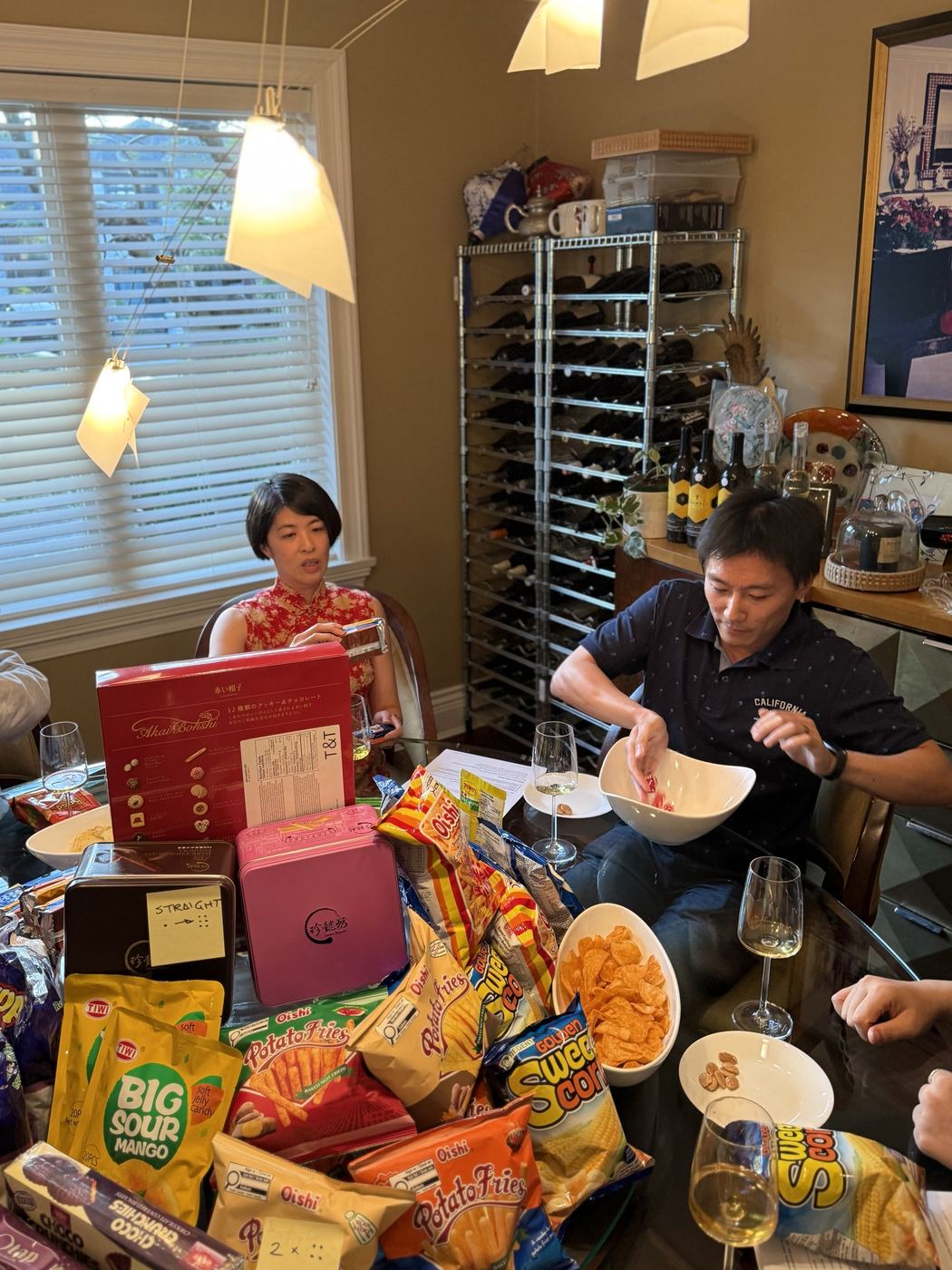
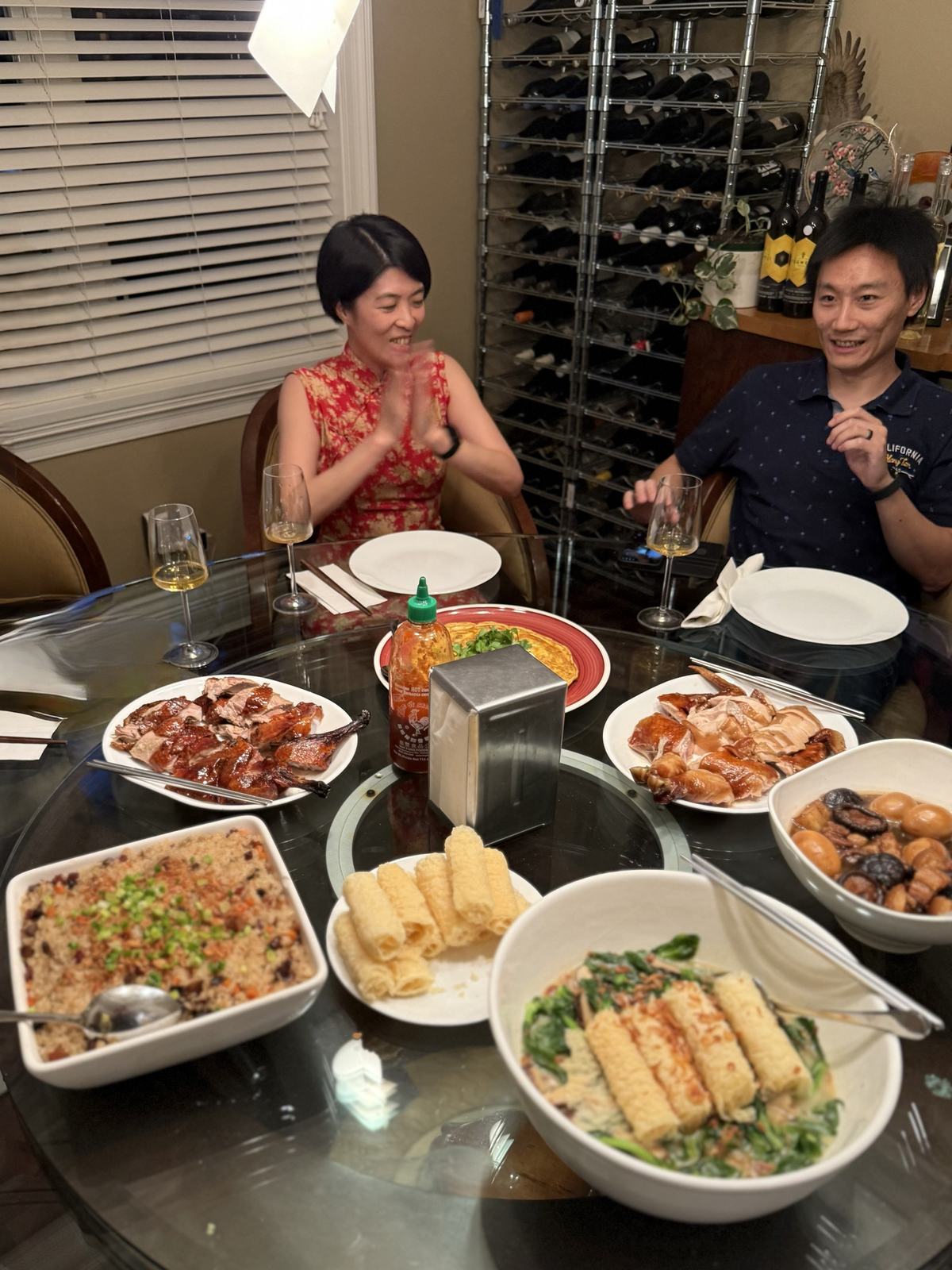
So, the night. There were eight of us at the table. Karen and I are Chinese from the Philippines; Vivian and her husband Lee are from Taiwan; Ann is from Hong Kong, her husband sadly unable to make it; Yaeko is from Japan; and Steve and Mina are from Korea. Between them they knew mooncakes, moon-viewing and Chuseok, but none of them had ever played the game, so we really were teaching it from the first throw, with the ranks on sticky notes on the prizes.
I decided to play for snacks, the way we mostly did growing up, and the pile ended up travelling about as far as the guests had. The four lower tiers were Filipino, the snacks of a Manila childhood that are now easy to find in Richmond: Oishi, SkyFlakes, Goldilocks and plenty more, with a bag of sour mango jelly candy that seemed to be what everybody really wanted. Pong Gan was two tins of Hong Kong egg rolls, one chocolate and one strawberry. The Tsiong Guan was a beautiful red box of Akai Bohshi cookies from Japan. Karen took one look at it and decided it was lacking, so the top prize gained a floral teacup and saucer and a bag of Avalon Blend from Secret Garden Tea in Kerrisdale. She was right, as she usually is about these things.
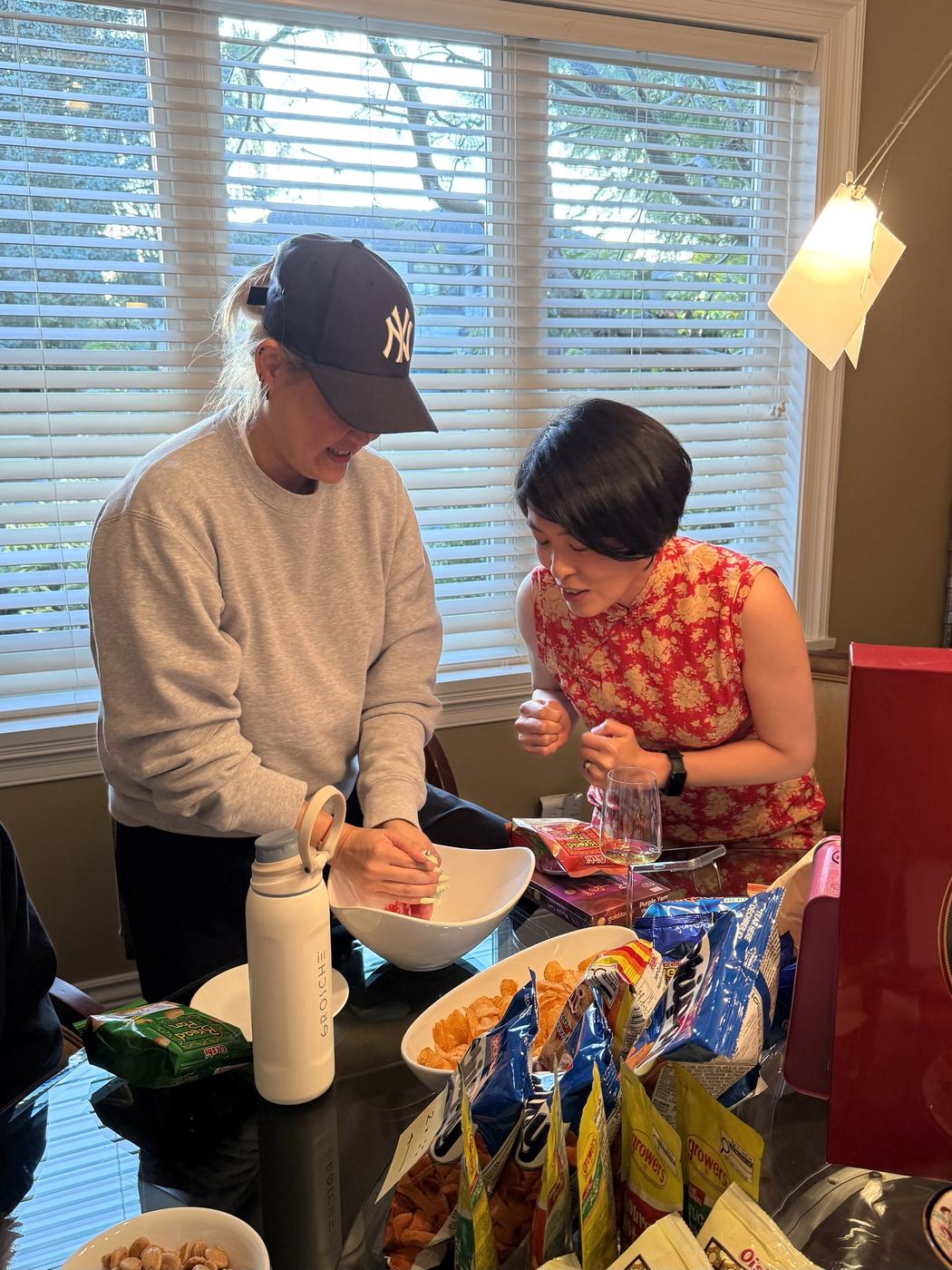
In the first few rounds, a few people had their dice leap out of the bowl, which under our house rules voids the throw. Those turns were lost, and everyone soon learned to curb their excitement and stop throwing quite so hard.
The Tsiong Guan went early. In the fourth round Karen rolled four fours, with a six and a three beside them. By then I hadn’t won a single prize, which didn’t go unnoticed. She spent the rest of the night hoping someone would take the title from her. Steve, sitting beside me, nearly did. Later in the evening he rolled four fours of his own, but with a two and a one. When two hands of four fours meet, we look at the next highest die, and Karen’s six beat his two. So at the end, with every other prize gone, she offered him rock-paper-scissors for it. She won that too. Then, because we were the hosts and she wanted it to go to a guest, she handed the top prize to Steve anyway.
Everyone found it fun, though once the smaller prizes were gone, the table was keen to hurry things along and get to dinner. They were at least as interested in the snacks as in the dice, since most of the Filipino ones were new to them. By the very end of the night, I’m told, the duplicates had drifted across the table to Yaeko, the only single guest. I was already in the kitchen by then, but it’s about as good a summary of the evening as I can give.
Dinner followed, as it usually does. I cooked Hong Bah, Oh Ah Chian, and Pea Tips with Milky Soup, and Karen and I made Kiam Peng together, the Hokkien salty sticky rice. The roast duck and soy chicken came from HK BBQ Master in Richmond, one of this year’s Chinese Restaurant Awards Elite 30. (I’m the COO of the Awards, so read that as a disclosure as well as a credential.)
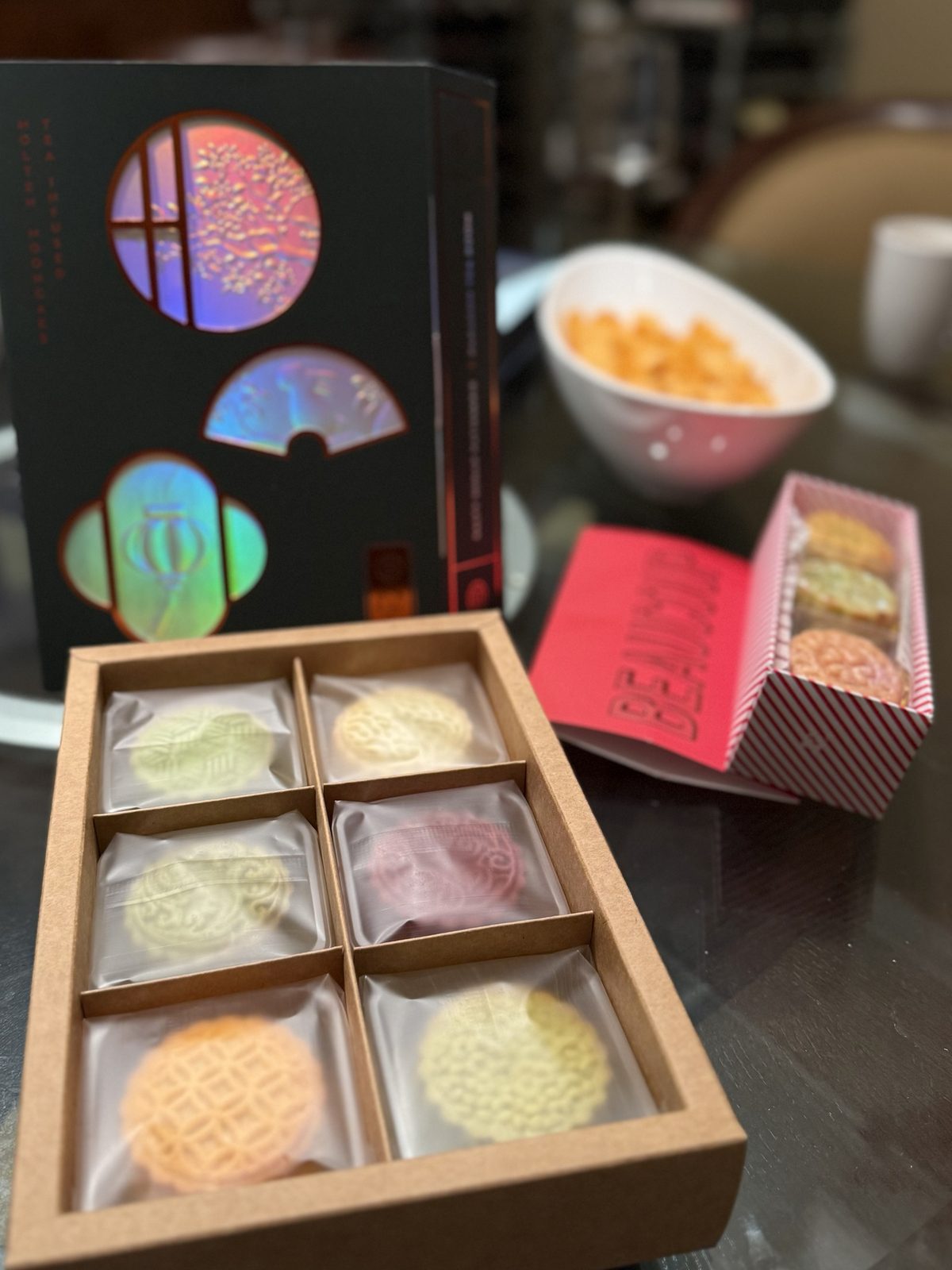
Then came the mooncakes, which Vivian brought, and which made the case better than I did for how far the mooncake has travelled. In front was a box of Paragon Tea Room’s tea-infused lava mooncakes, made with Salty Sugar Patisserie: one each of matcha black sesame, genmaicha cheesecake, osmanthus jasmine, rose oolong, tangerine pu-erh chocolate and pandan Thai tea. Behind it was Beaucoup Bakery’s Mooncake Maison, three mooncakes on a French sablé crust: pandan lychee, purple mango with coconut purple rice, and kabocha with sesame marzipan. There wasn’t a lotus seed or a salted yolk between them. I may have been the only one who missed them.



The Newsletter
New pieces, plus what’s on my table next. Every few weeks.

An error has occurred somewhere and it is not possible to submit the form. Please try again later or contact us.


