


Maido and Astrid y Gastón, Lima: Ten Hours, Fifty-Two Courses

Jacob Ung
September 15, 2026

21 min read
One full day in Lima in 2015, two restaurants, fifty-two courses — reconstructed a decade later from the photographs I happened to take.
I did not set out to eat fifty-two courses in a day. We had landed in Lima at half past midnight that morning, off an overnight flight from Toronto, and we would fly on to Cusco the next. One free day in between. I made two reservations, and only one of them was the one I initially wanted. Maido I booked outright. For the evening I had my heart set on Central, and Central was full, so I booked Astrid y Gastón in its place. Everything after that was arithmetic I did not do at the time.
I have been going back through the photographs from that trip, and what struck me is how little I remembered and how much the camera did. I could not have told you the order of the meal, how long we sat, or what half the dishes were. The files knew all of it. The confirmation email for lunch survives too, so the day runs from one o’clock exactly to twelve minutes past eleven that night — ten hours and twelve minutes of a single Friday in September 2015.
What survives in a set of photographs eleven years old is not flavour. I want to be straight about that. I cannot tell you what the sea urchin tasted like, and I am not going to pretend otherwise. What survives is structure — what arrived, in what order, on what, and what the room was doing while it happened. That turned out to be enough to reconstruct the day, and more interesting than I expected, because the two restaurants we ate at were making almost exactly opposite arguments about the same country.
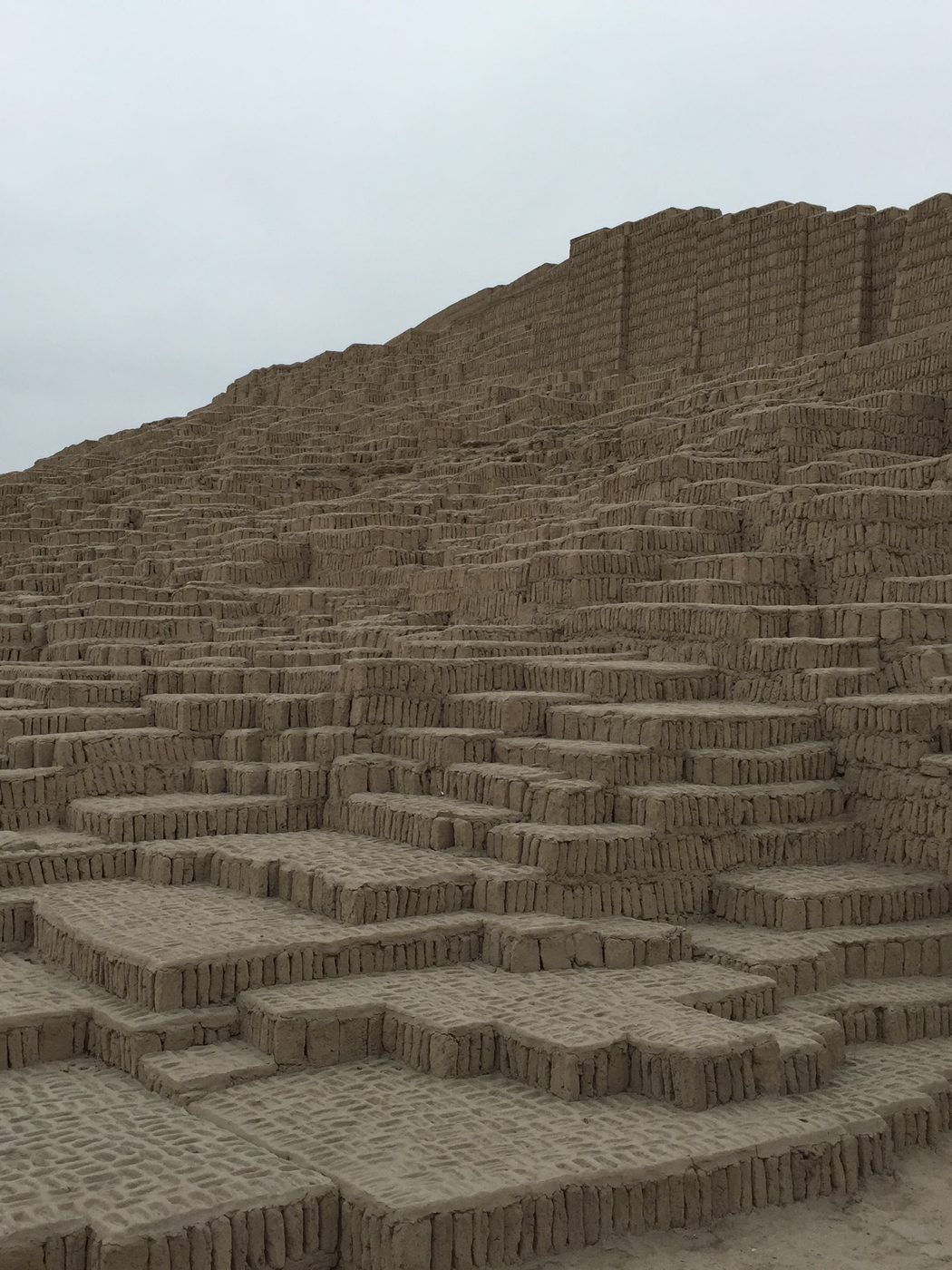
We spent the morning at Huaca Pucllana, a few blocks from the hotel — an adobe pyramid sitting in the middle of Miraflores, built by the Lima culture somewhere between 450 and 650 AD. It is made of millions of handmade mud bricks, and they are not laid flat. They stand on end, spaced slightly apart, like books on a shelf, and the whole face steps back in terraces as it rises. The point of standing them upright is that the mass can flex rather than resist when the ground moves. It has been doing that for fifteen hundred years. The site museum still makes the bricks by hand to patch it.
We also went to look at the statue of Paddington Bear. Lima has one because the bear is supposed to have come from here, put on a boat by his Aunt Lucy with a label round his neck. He has his suitcase with him, packed, caught mid-departure. London has a Paddington too, in the station he was named for and arrives at. So the same bear stands at both ends of one journey, and the Peruvian end is the leaving.
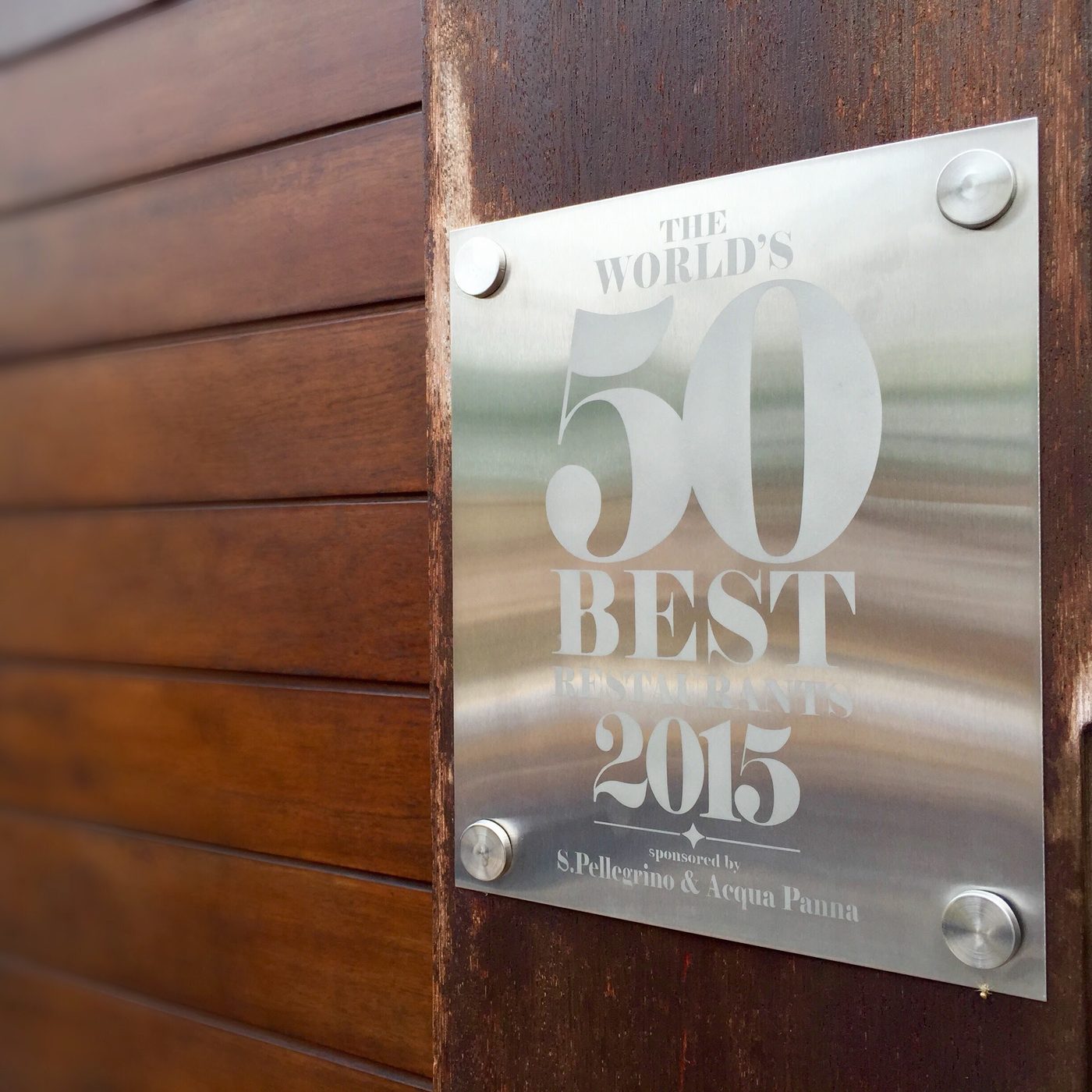
Lunch was Maido, in Miraflores, booked for one o’clock, for two. There is a plaque in these photographs — The World’s 50 Best Restaurants, 2015 — and it is fixed to the frame of the gate, at the threshold, where you pass it going in. It can only have been there a few months, because that year’s list had been announced in June. Maido entered at No. 44, its first appearance anywhere on the list. I did not know I was eating somewhere on its way up. It took the top spot outright in 2025.
The name comes out of the room as two syllables — my-doh. In Japanese it is three, まいど, but Spanish runs an ai together the way it does in baile, and the counter says it the Spanish way. It is not a word for strangers either: maido is what a Japanese counter calls to a regular, not hello but something nearer to good to see you again. Tsumura was born in Lima in 1981; his family had come from Osaka, and Osaka is where he went to learn the cooking — at a sushi counter called Seto, and a restaurant called Imo to Daikon, which means potato and radish. He named the place after the greeting rather than after anything on the menu.
The menu was called the Nigiris Experience. A nigiri is the plainest form sushi takes — an oblong pillow of seasoned rice, pressed by hand, with one thing laid across it, and sometimes a band of nori — or a collar of it, standing proud of the rice, for the gunkan. The confirmation email is blunt about where you have to sit to eat it: Zone: Sushi Bar. It was one of two omakase menus, and you choose between them when you book rather than when you sit down — I had picked the Nigiris Experience because I figured it might be the only chance on the trip to eat Peruvian-style sushi. The menu that is presented before the meal is not a list of items to order but a guide to what you are going to be consuming: twenty items printed over a thick pink brushstroke ring with the restaurant’s name ghosted inside it.
The ring is an open ensō — the Zen circle drawn in one movement and left unclosed, the brush lifting before the stroke comes round. It stands for the incomplete — a life still being made, still developing, something you are in the middle of rather than something you close. I did not think about it for a second at the time, but it seems worth noticing now.
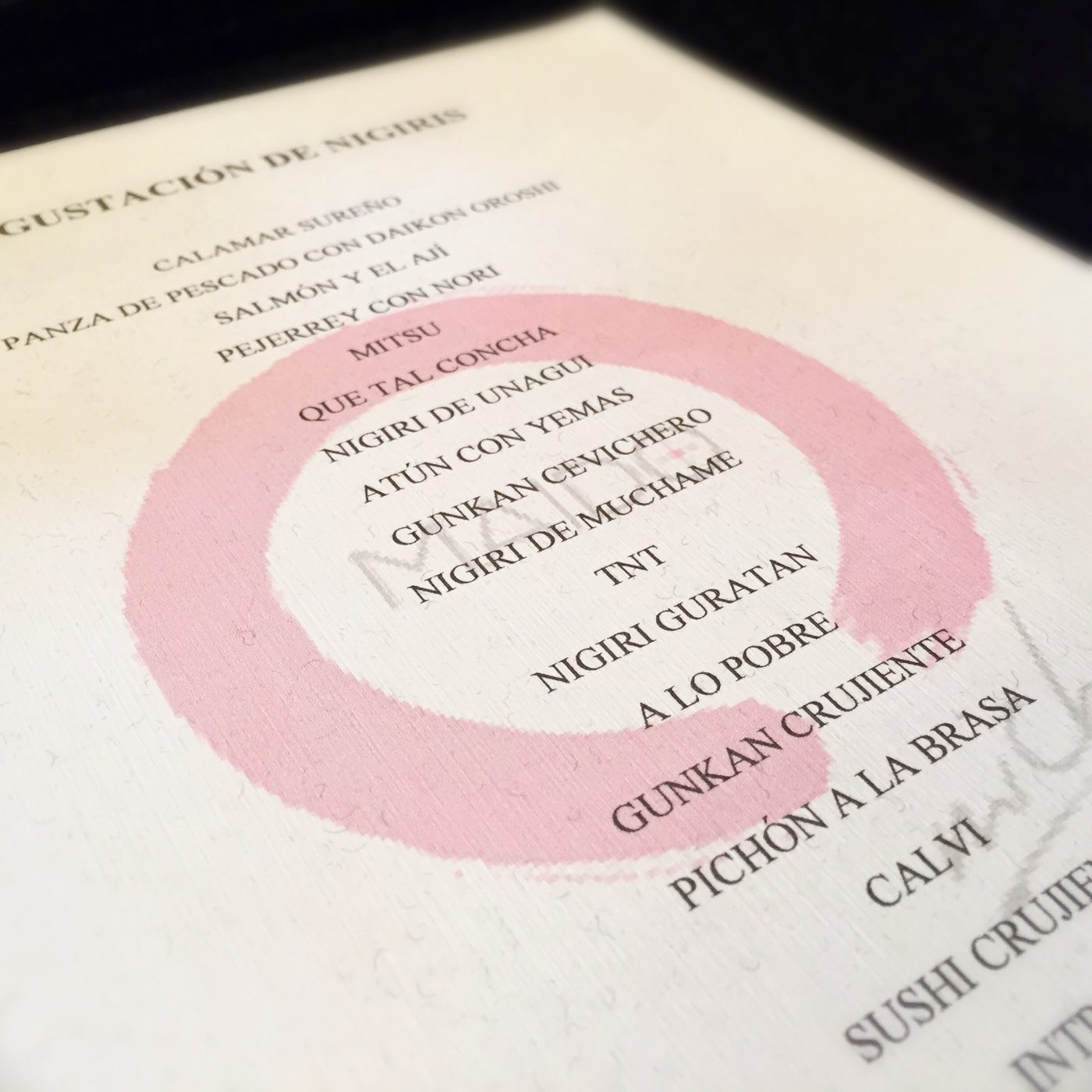
What I can see across the plates is the argument Maido was making. Squid scored and lacquered with tare (tah-reh). Fish belly under momiji oroshi — daikon grated through with ají, so the Japanese condiment arrives coloured by a Peruvian chili. Salmon under ají amarillo with black sesame. A piece walled round with nori called Gunkan Cevichero, which is exactly what the name says — fried squid and dressed raw seafood served in the architecture of a gunkan. Beef under a quail egg injected with ponzu, named for lomo a lo pobre — the limeño plate of steak, fried egg, plantain and rice that the phrase belongs to, shrunk onto a finger of sushi. Muchame, the Peruvian cured-seafood preparation, made into a nigiri. A scallop piece the menu calls Que Tal Concha, which is a pun, and a piece called TNT: rice walled round with nori to hold it, something pale and soft set inside — squid again, by the scoring on it — and red chili dusted over the top. The name is the warning. Nigiri Guratan, which is gratin — a French word, borrowed into Japanese as guratan (goo-rah-tahn), and set to work on a Peruvian counter, where it turns out to mean cream cheese torched brown over a breaded prawn. And, near the end of the list, foie gras over rice under a dark glaze, called Intruso — the Intruder. A French luxury given a Spanish name and a place on a Japanese-Peruvian counter, and the kitchen is the one calling it the interloper. Two pieces on that menu are carrying three passports apiece.
One name on that page resisted me for years, and it turned out not to be a word at all. Mitsu is the chef. Mitsuharu Tsumura, whom Lima calls Micha, and the piece named for him is the counter’s signature, and it runs on the other omakase too, the Nikkei Experience, the menu I did not take. A kitchen that puts one item on both of its tasting menus is telling you which item it would not remove.
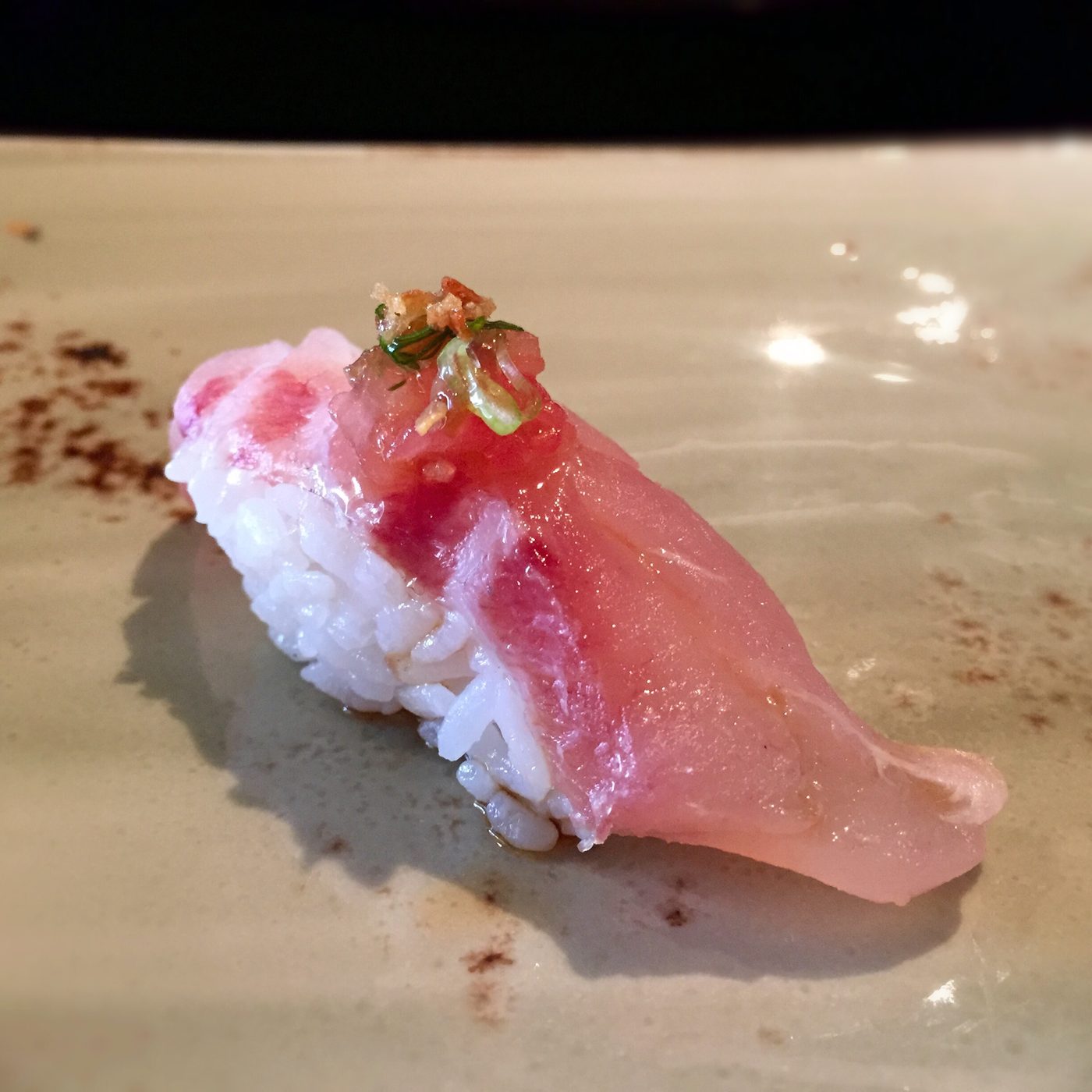
And it is the plainest thing in the photographs. Pink and glassy with a seam of dark red running through it, brushed with something that catches the light, finished with a few green scallion threads and a scatter of crisp fried shreds. That is all. On a menu that ran to foie gras, torched cheese and a piece called TNT, the one the chef put his own name on is fish, rice and two garnishes. I take that to be the point he was making, and I missed it entirely at the time.
Calvi held out longest, and then gave way to a photograph and a spelling.
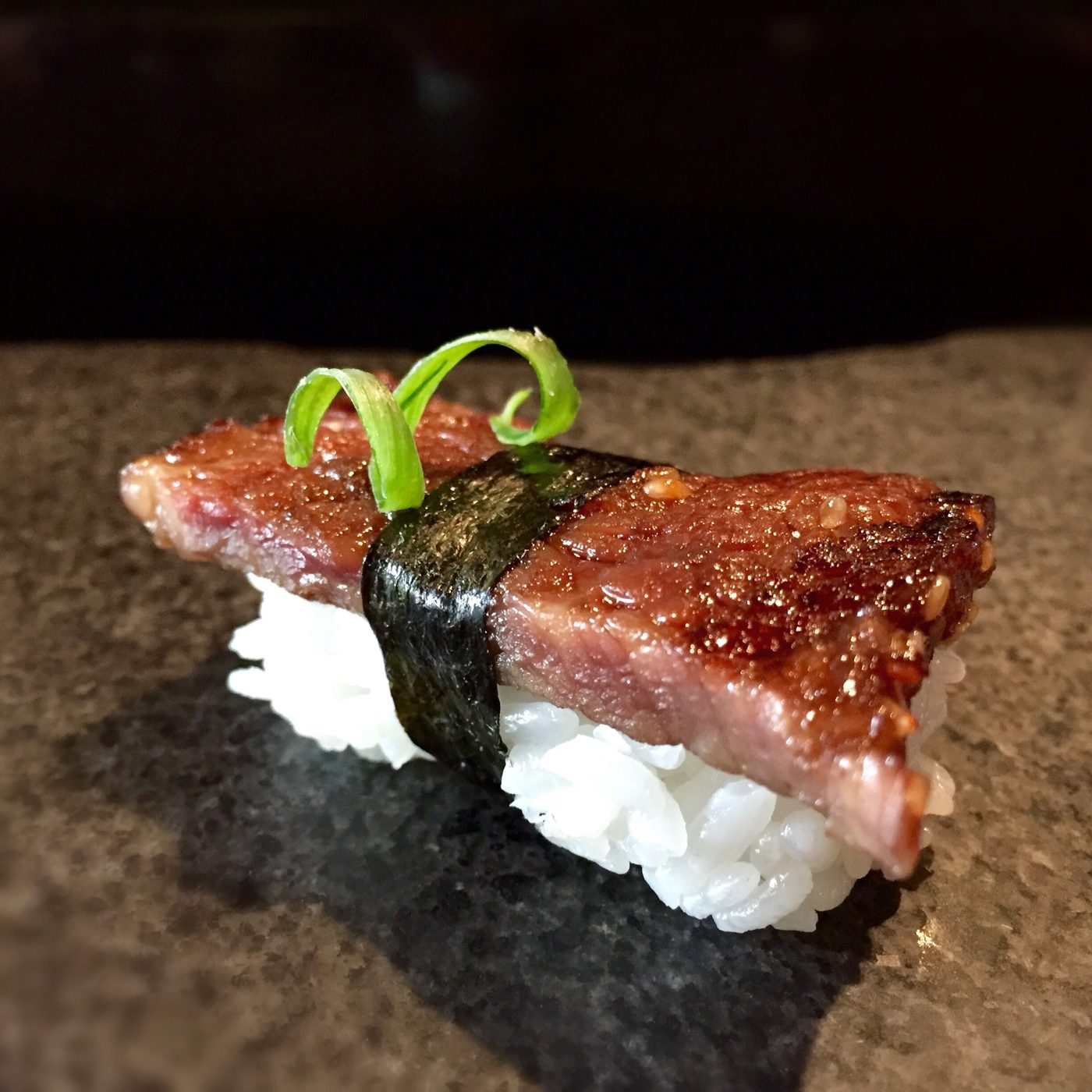
The picture shows a thick slab of beef, lacquered dark and scattered with sesame, banded with nori, finished with two curls of scallion. That is short rib cooked the way Korea cooks it. Galbi — or kalbi, depending on who is romanizing it. And in Spanish, b and v are the same sound, so kalbi set down by a Spanish speaker comes out calvi. They are homophones.
Which makes it, on a Japanese-Peruvian counter in Lima, a Korean dish spelled phonetically in Spanish. Four languages in five letters. I spent eleven years reading it as a word I did not know, and it was a word I knew perfectly well, wearing somebody else’s alphabet.
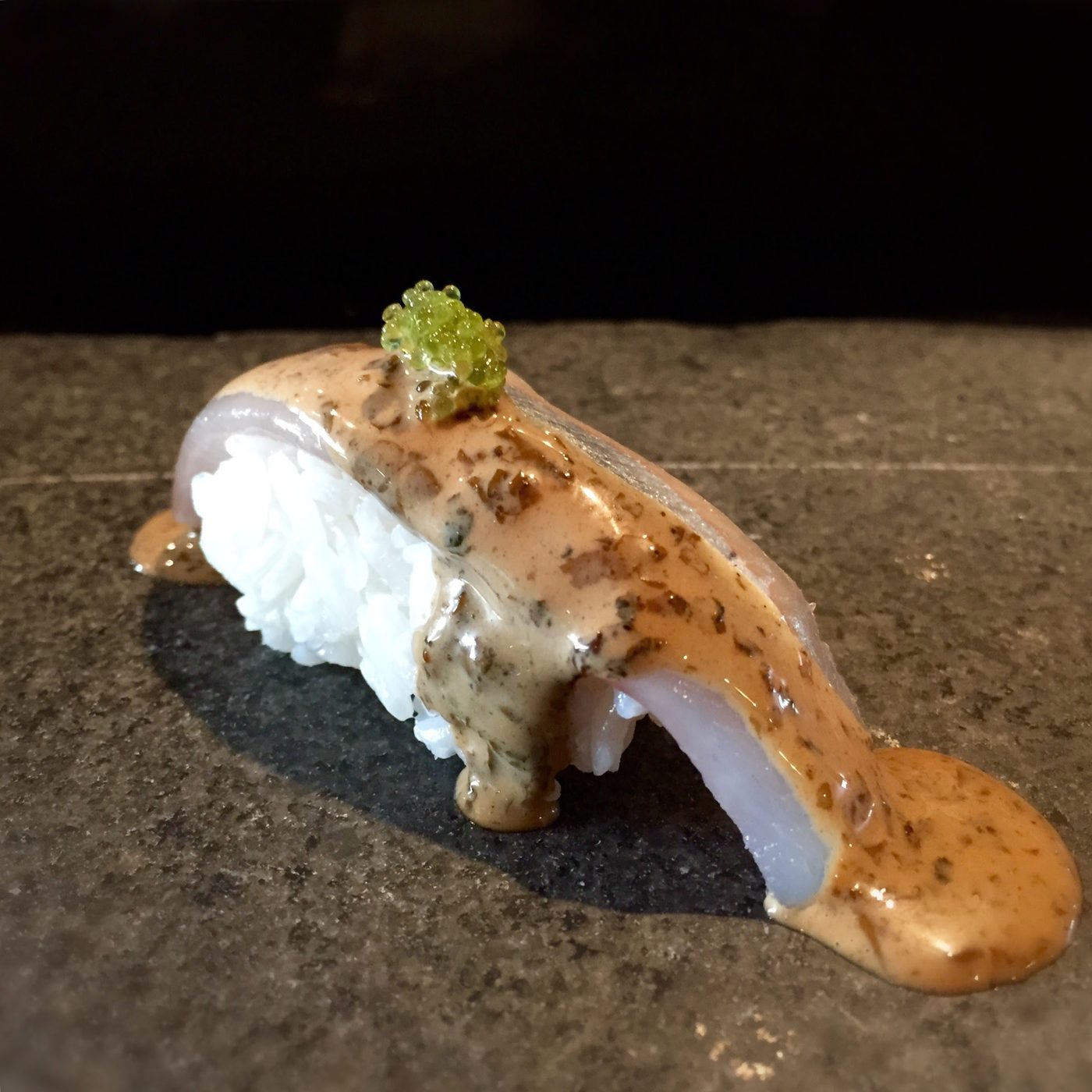
One of the twenty I cannot name. Its line on the menu falls in the fold of my photograph, and I have since gone looking: no record of that carta exists anywhere I can find. Not one of its twenty names returns a result. The sauce is the nori emulsion that dresses the pejerrey earlier in the meal, laid on heavily enough to run off the rice onto the stone, and the roe is the same wasabi tobiko. So I can tell you what is on it and not what it is called. The name is somewhere in that fold.
Look at the rice in any of these and it is loosely shaped, grains still separate, uncompressed, under sauces heavy enough to drown a lesser base. That is the whole of Nikkei in one frame: Japanese technique holding the structure while Peruvian sauce work does the talking. You can see it without having to be told.
Then there was the snail.
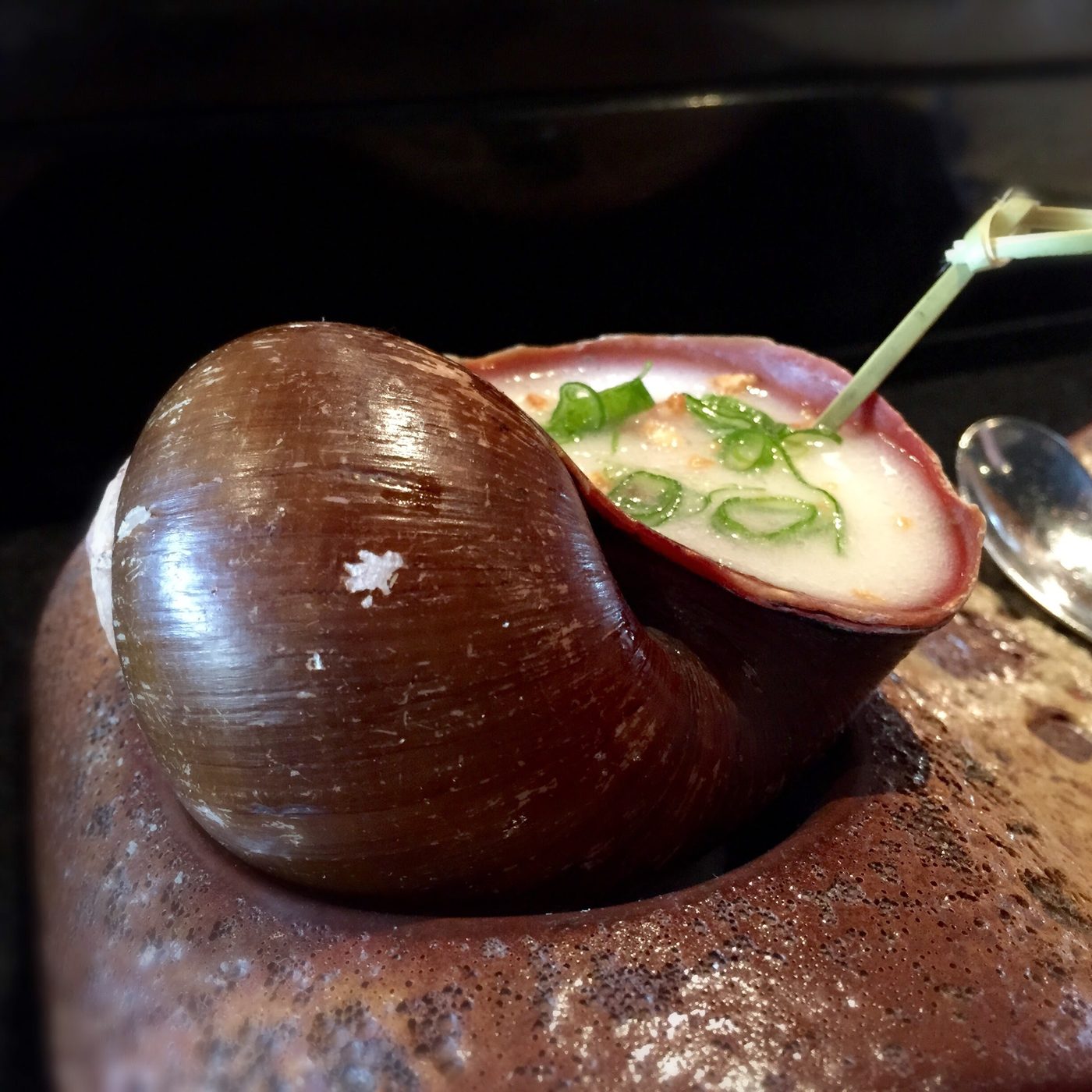
A churo — an Amazonian apple snail, from the rivers around Iquitos — went past us on a tray, and it was about the size of a baseball. We remarked on it to our server, because we wanted to know what it was. He told us it was a pre-order item only, and that was the end of it as far as we were concerned. We were about halfway down the list.
It came at the end of the savoury run, most of the menu later: cooked the way the Amazon cooks them, the meat drawn out and bound back into a creamy broth and returned to its own shell, with a bamboo pick to fish out the body. Nobody made anything of it. It was simply there.
They had not handed us a spare. Someone decided to make us one each, and then presented them at the place in the sequence where they belonged.
I have wondered since whether we were mistaken for somebody — a Japanese visitor of some standing, perhaps. I do get taken for Japanese from time to time. The likelier and duller explanation is that the maître d’ was reading the room, as they do at that level, and a table that notices a churo going past and asks about it with actual curiosity is the table you send the pre-order dish to. Most of a dining room at a newly-listed restaurant is there for the listing. Maybe not many of them are as curious about what they are eating as we were.
That churo is not on the printed menu at all, so it does not appear in any count taken from the page. My guess is that it belongs to the Nikkei Experience, the menu we did not take.
The twentieth and last item on the list is Huevo y Nido, which also appears on the separate dessert list Maido calls Happy Ending: a white chocolate shell over chirimoya standing in for the white, a goldenberry gel for the yolk, a nest of cacao and a cloud of cotton candy. A fried egg built entirely out of Peruvian fruit and cacao, which is the same joke the savoury pieces had been telling all lunch, told once more on the way out.
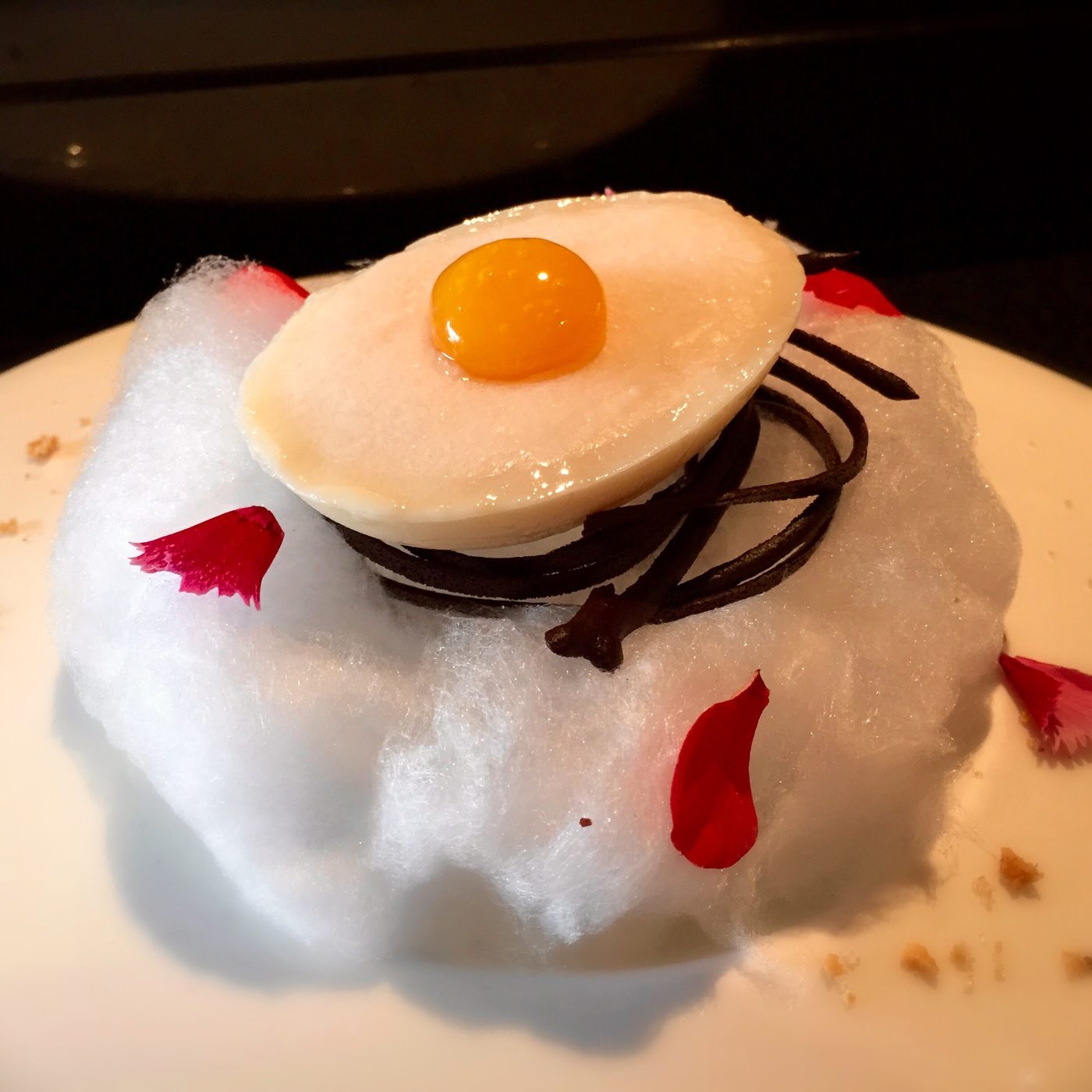
A chocolate dessert arrived after that one, on the house like the snail. I have no photograph of it. It is on the Happy Ending menu in the same frame as the Huevo y Nido, one entry down: Amador Chocolate, with hazelnut cream, wild berries, vainilla ice cream, mango and cushuro. The menu prints vainilla, the Spanish spelling, inside otherwise English copy — which tells you the translation was done in-house.
Cushuro is Nostoc, a cyanobacterium that grows in cold lagoons high in the Andes as small dark spheres, eaten in Peru for centuries and almost nowhere else. So the one course I have neither a photograph of nor any memory of turns out to have carried the least familiar ingredient of the entire day.
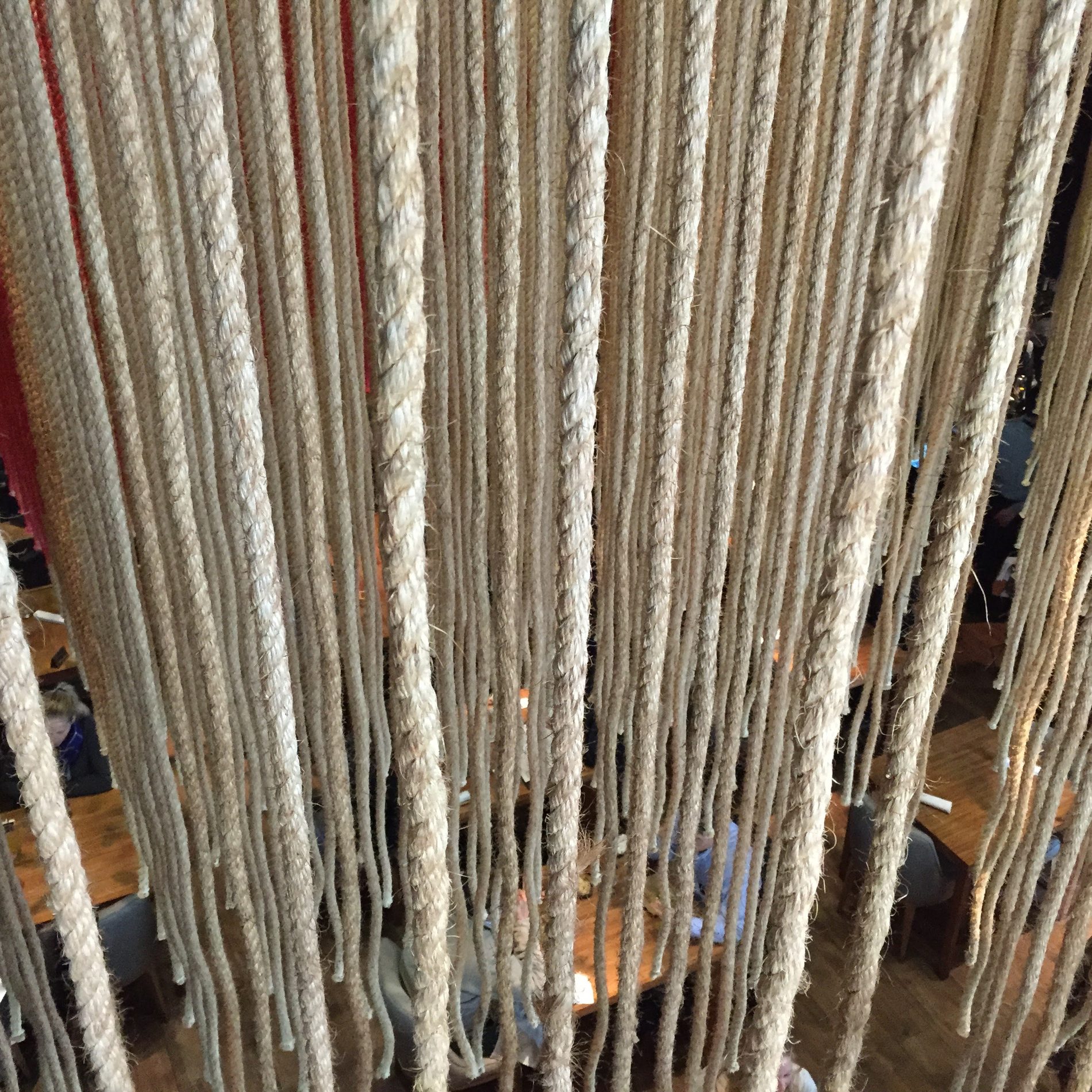
The last Maido frame is at 14:32, shot from our seats at the upstairs counter, downward through a screen of hanging rope into the room below. I have no memory of taking it. It is the best photograph of the day, and it is the only one where I was not documenting anything.
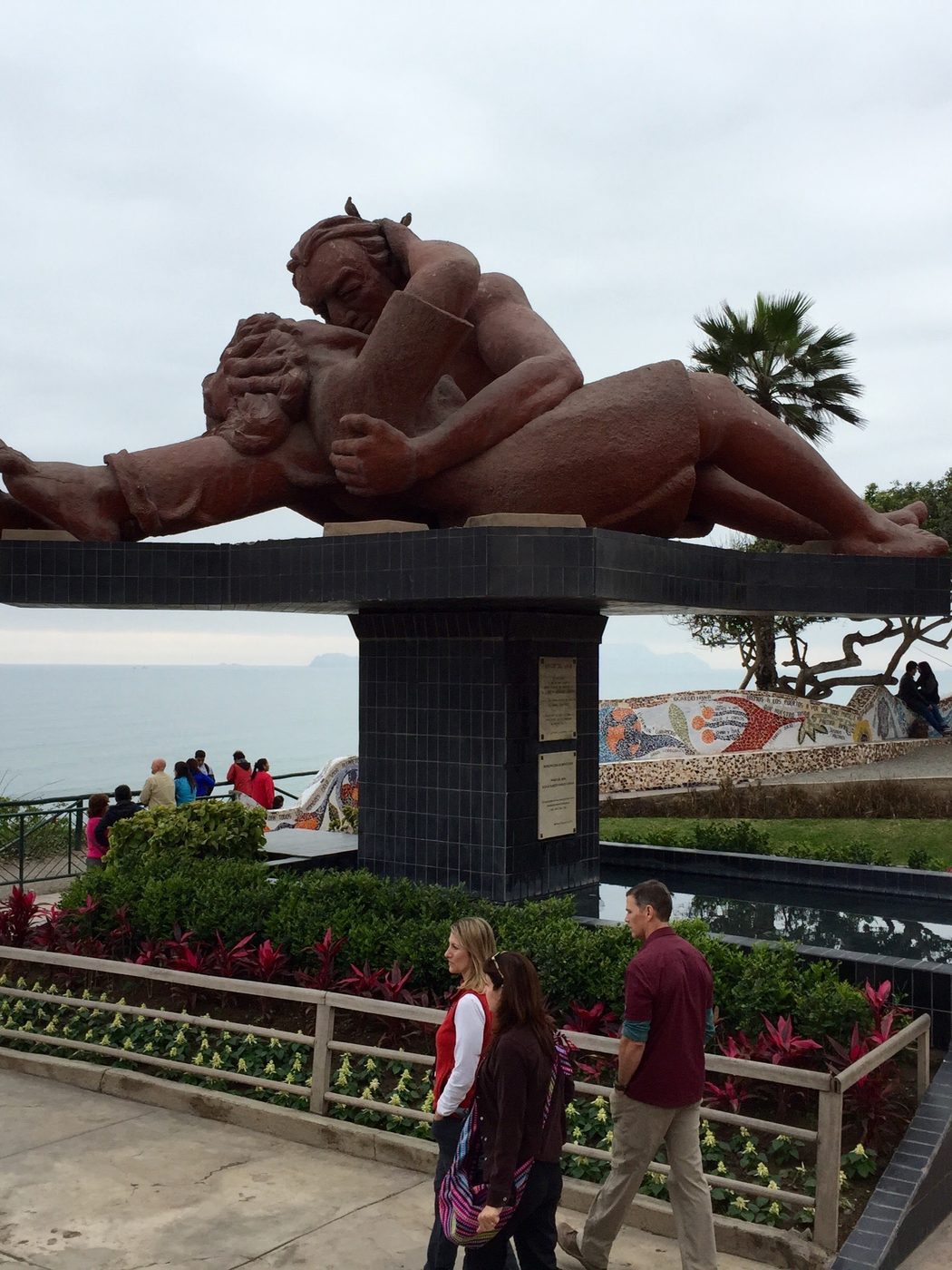
At 16:15 we were on the Miraflores cliffs at Parque del Amor, which is built around Víctor Delfín’s El Beso — an enormous red sculpture of a couple lying down mid-kiss, unveiled on Valentine’s Day in 1993. Mosaic benches curve along the clifftop in the manner of Park Güell, and they carry phrases and poems about love in Spanish and in Quechua, which is the same two-language country the evening’s menu would spend three and a half hours climbing between. We stayed until about half past four.
The remaining three hours I have no record of at all, and the itinerary rules out the obvious guess — the eleventh is printed as a day at leisure, with nothing scheduled against it. The hotel was minutes from Maido and we had not had much sleep on the flights or on our first night at the hotel, so I assume we slept. But that is an assumption. Three hours of a Friday in Lima, simply gone.
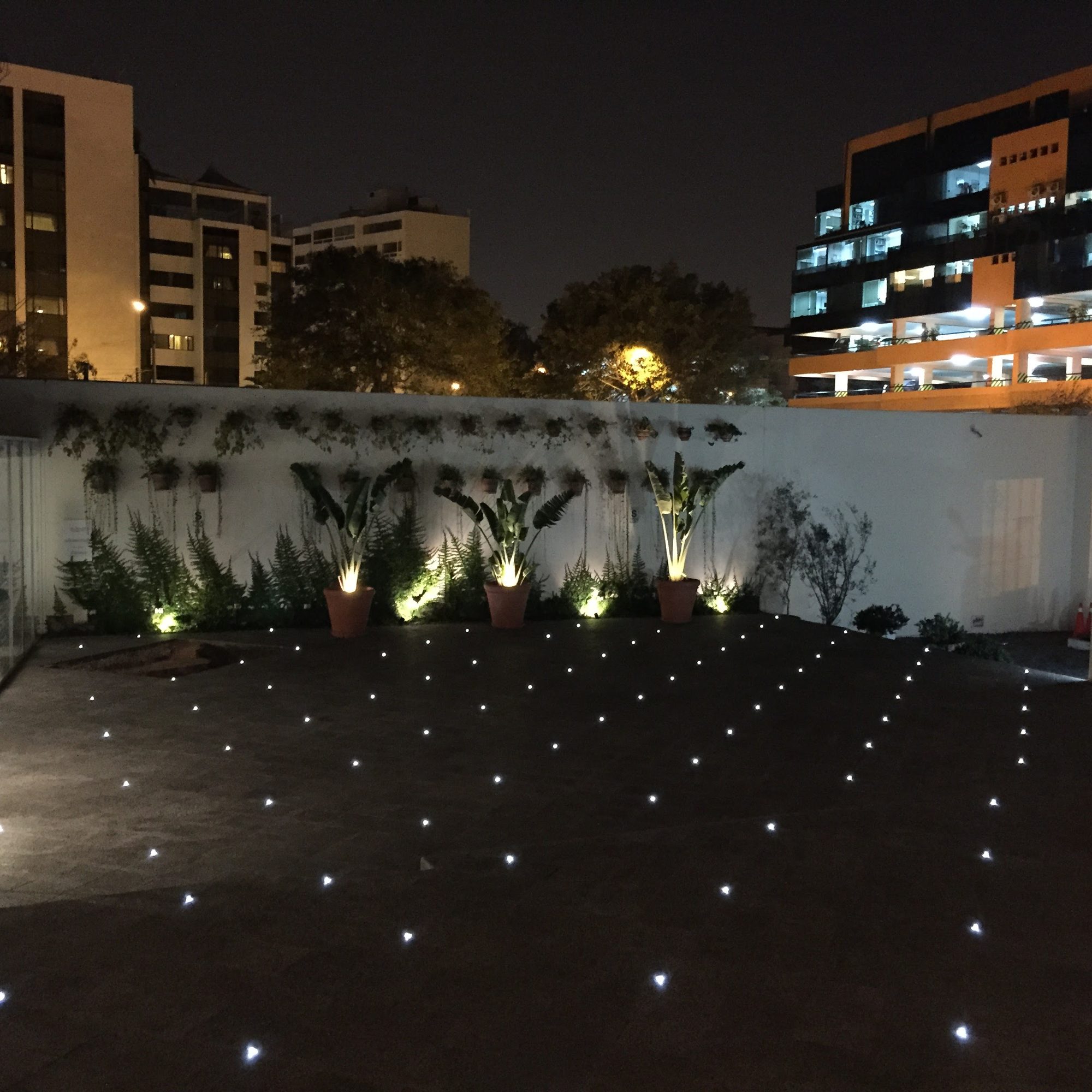
Dinner was booked for eight and the first frame is at 19:42, because neither of us likes being late; we take the view that other people’s time is valuable and not ours to waste. So I had time to wander the courtyard where you park, which is where the first photograph of Casa Moreyra comes from — and the car park is worth a sentence, because its paving is set with points of light, dozens of them, like a star field laid into the ground where you enter the compound. Then the building, which is the point. Astrid y Gastón had moved the year before into Casa Hacienda Moreyra in San Isidro — a house built in the second half of the seventeenth century, rebuilt in the mid-eighteenth after the 1746 earthquake levelled most of Lima, and declared a historical monument in 1972. It was not a grand house that happened to sit in a field. It was the administrative centre of a farming estate, in a valley that ran to thousands of hectares of cultivated land, back when San Isidro was agriculture rather than banking. José de San Martín was received there during the independence period.
Which is worth putting beside the pyramid we had stood in front of that morning. The same city, the same ground, the same threat, and two answers to it eleven hundred years apart: a pyramid built to bend, still standing; and a mansion built to stand firm, which did not, and had to be put up again.
So: a restaurant serving a menu about Peruvian agriculture, installed inside the office of a farm.
The listing meant nothing could be gutted. You cannot consolidate a protected colonial hacienda into one large dining room, so the architects did not try — the estate ended up as a set of scattered interventions around the old house, and the meal moves between them. That is why the tables change under the plates in my photographs. A deep red round slab under the cocktail, a pale blond wood under the desserts. Different rooms, not just different lighting.
The menu was called Región Lima and it is printed across two panels. The first is coast and garden: sea urchin under a crisp with nasturtium, anchovy with cocoa, clams and caviar in yuyo seaweed, squid, then tomatoes, avocado, herbs out of their own beds. The second opens on a single line set apart from everything around it — native potatoes cooked in soil, with a huancaína ground on the batán — and runs on through sweet potato, the catch of the day, rice and seaweed, pigeon with native squash and cacao. Above that second panel is a small elevation diagram: a line of stones stepping from 5,750 metres down to zero, a scale in kilometres underneath. I assumed for years it was decoration. I am no longer sure that it is — but I cannot tell you it is the running order either, because the sea comes back after the mountain.
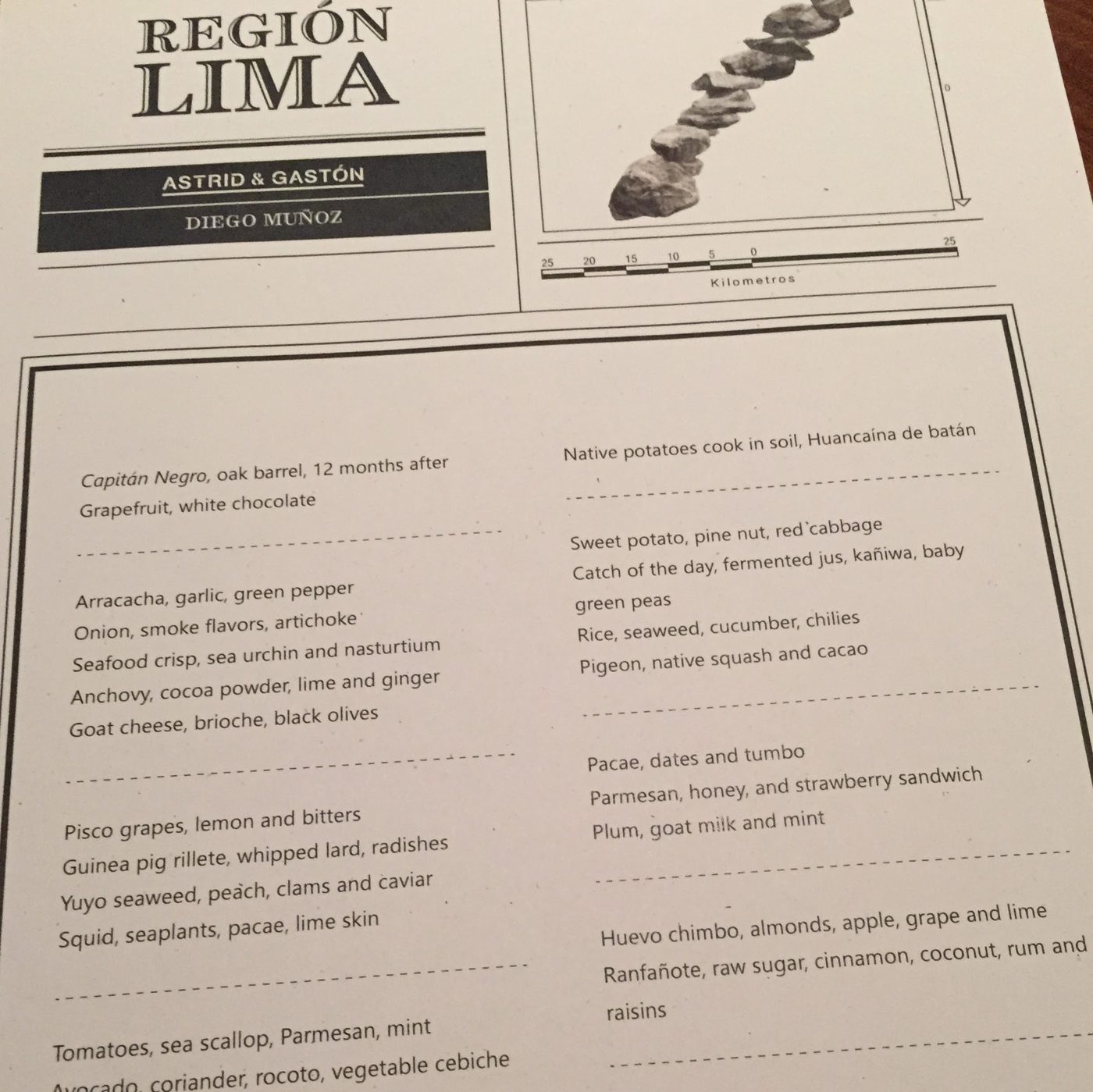
There is one more name on the card, set in its own black bar directly beneath the restaurant’s: Diego Muñoz. Acurio’s name is on the building and half of it is in the title, but the chef running this kitchen in 2015 was Muñoz, and the menu gives him his own line. I had been looking at that photograph for eleven years without once registering him.
Thirty items, of which twenty-eight are plates and two are drinks. Guinea pig rillette under shaved radish, sitting on a deep magenta disc, served on a wire nest strung with red glass beads. Yuyo seaweed with clams and caviar on black stone. A tuile of sea urchin scattered with cut nasturtium leaves. Anchovy rolled and dusted in cocoa. An egg yolk set low and slow, ringed with sprouted grains in a clear amber broth and dusted with kale — a chicken soup taken apart and rebuilt, and the most restrained thing on the table.

At 20:55 they brought out a stone.
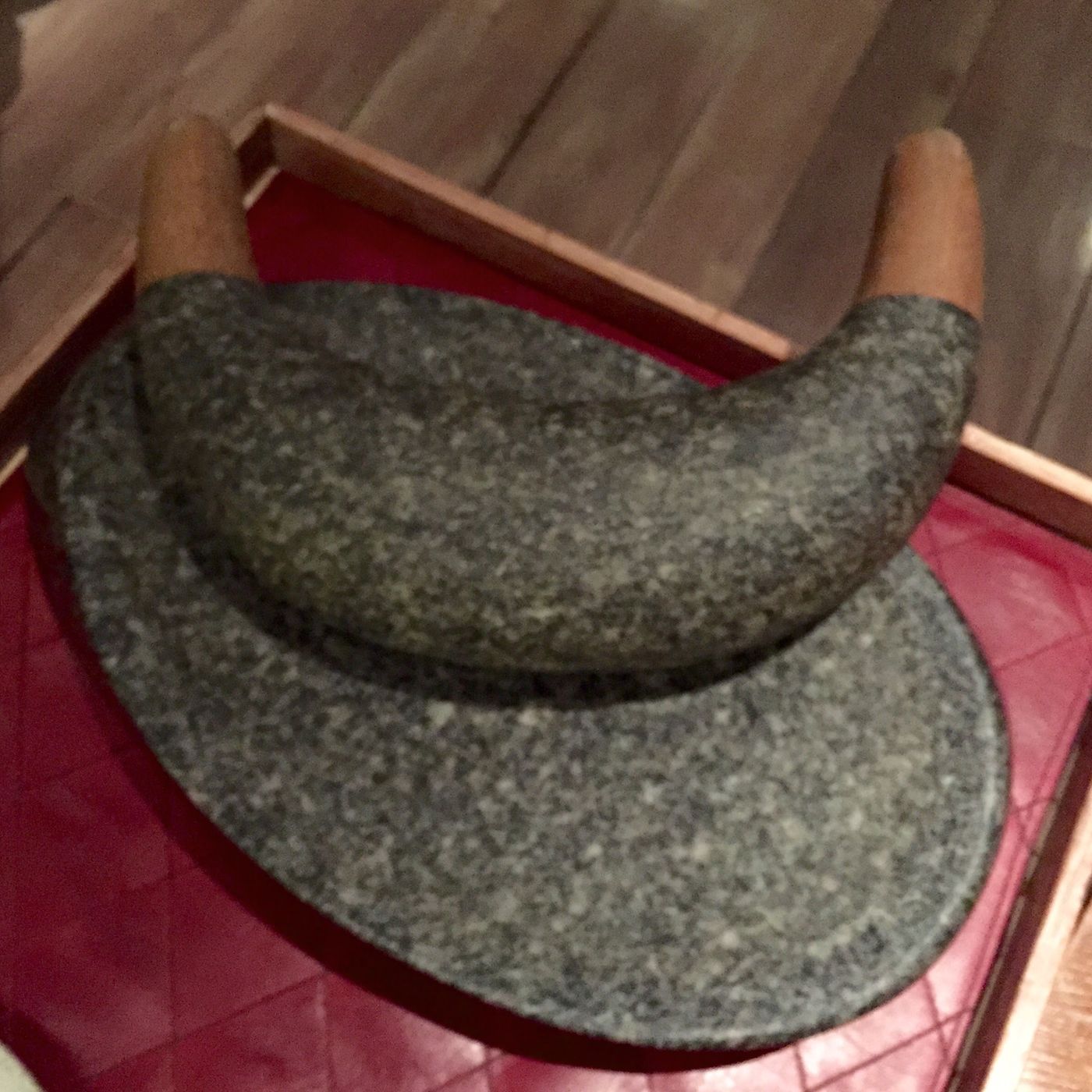
A batán — the Andean grinding stone, a flat base with a rocking crescent called an uña — carried to the table in a fitted wooden case, laid on red cloth like a relic. I photographed it, filed it as theatre, and forgot it. I was wrong. I also shot nine seconds of video that evening, and in it a waiter has both hands on the crescent, grinding a huancaína across the base. By the end of the clip the sauce is spread over the whole surface — bright ají amarillo streaked through with dark green, coarse in a way no blender produces. A batán breaks the ají and the cheese rather than emulsifying them, and the friction warms the sauce as it goes.
Fifteen minutes and twenty-six seconds later, they opened the earth.
It arrived sealed on a shallow ceramic dish: a low round bed of earth and burnt leaves, flat across the top and rolled over at the rim, thatched with straw, nothing visible underneath. A server came in with two spoons and worked it open from one edge, lifting the straw back in sections, then breaking through the leaves, until the potatoes were sitting exposed in the ash. This is huatia — the Andean earth oven, where potatoes are buried under heated clods and the whole structure is collapsed over them. It is a farmer’s field technique, and it was being performed in a dining room in San Isidro on a handmade round trunk table.
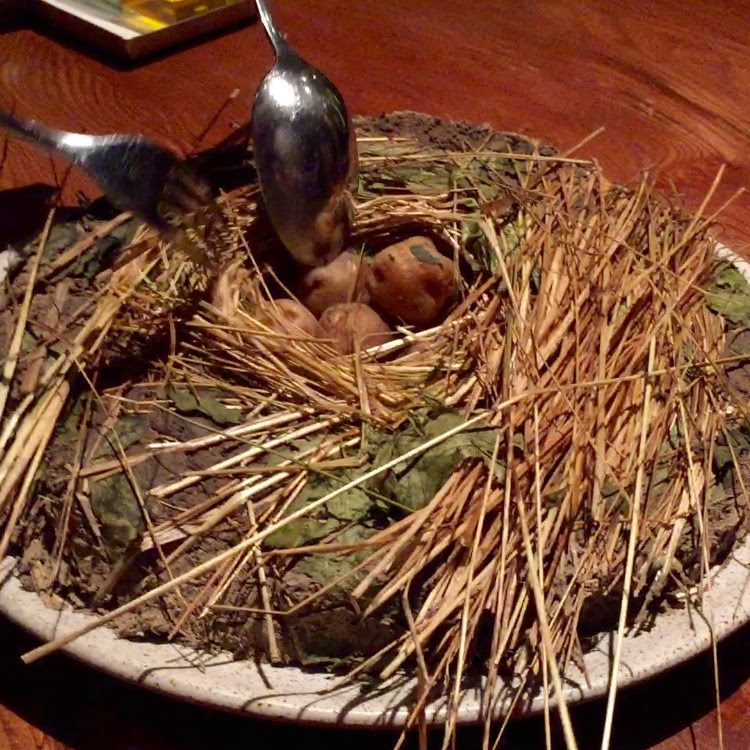
Karen asked the waiter where it had all come from, and he told her the potatoes and everything around them were grown in the garden and baked in clay on site. Restaurants say this constantly and it is usually loose. I went and checked the architects’ drawings. The site plan has a labelled zone for pachamanca, huatia and grills; a garden called the infinite orchard; and greenhouses for highland and jungle produce. The claim was standing next to its own infrastructure. No kitchen at that volume feeds itself from one garden, and he hedged appropriately — but the beds existed, the earth oven existed, and the dish came in off it.
The most protected space on the property, the old courtyard, holds a glass box. It is the research space — a development kitchen with a tasting table at one end, built entirely transparent, lit up at night with a tree growing through it. The service kitchens are elsewhere and hidden. Of everything they could have put in the middle of a three-hundred-year-old courtyard, they chose to put the laboratory under glass and light it.
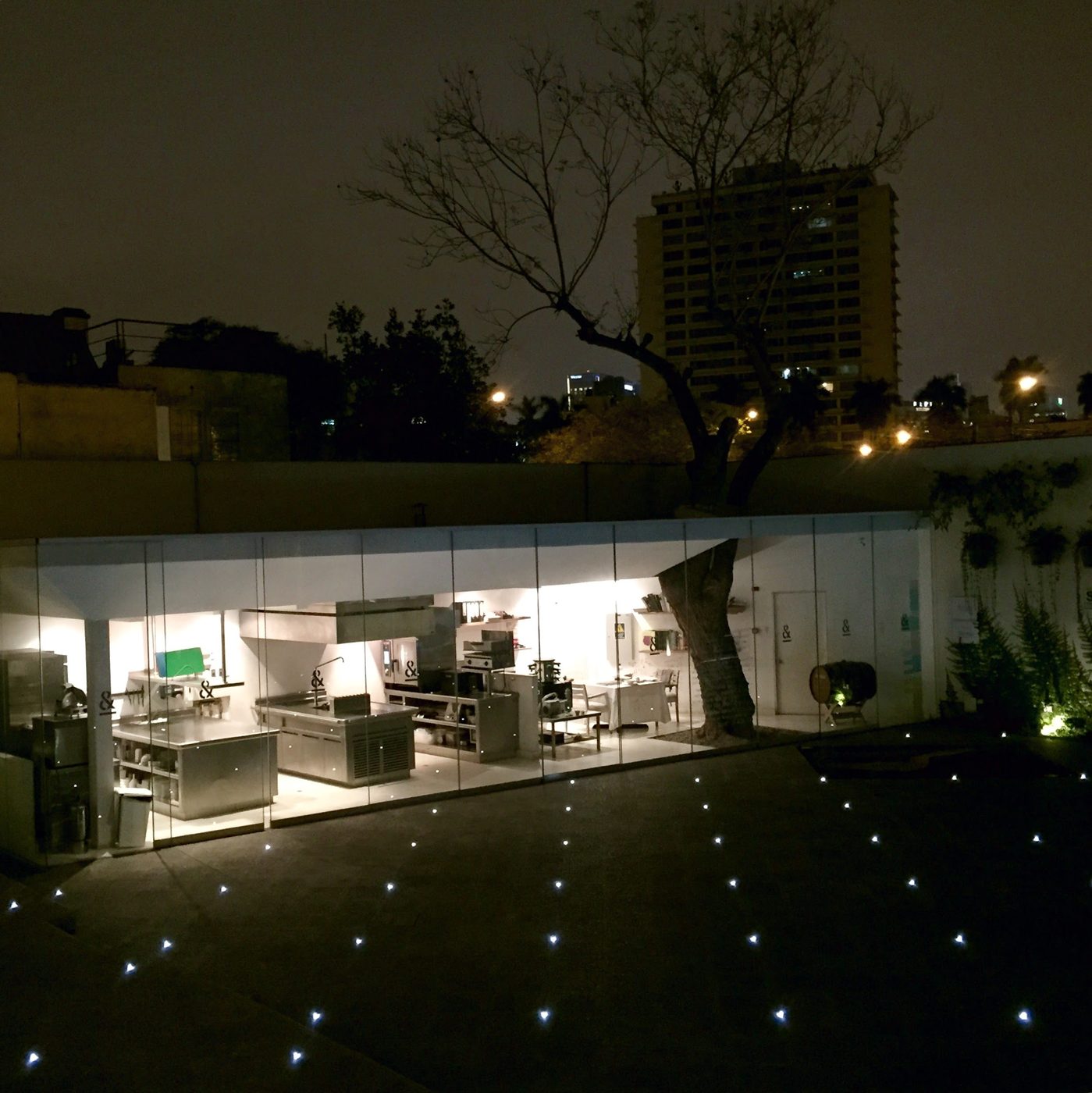
That tells you where Peruvian cooking was in 2015 more precisely than any list does.
The desserts belong to Astrid Gutsche — the pastry chef, and the Astrid on the door. The name is the two founders’ first names: Gastón is Gastón Acurio, and she is his wife and his partner in the restaurant. Pacae, the Amazonian ice-cream bean, white and cottony, with dates and tumbo. Huevo chimbo with almonds, apple, grape and lime. Ranfañote, a criollo Lima sweet of raw sugar, cinnamon, coconut, rum and raisins. Lúcuma with chocolate. Then two chocolate batons on a silver tray with small mint leaves pressed into them.
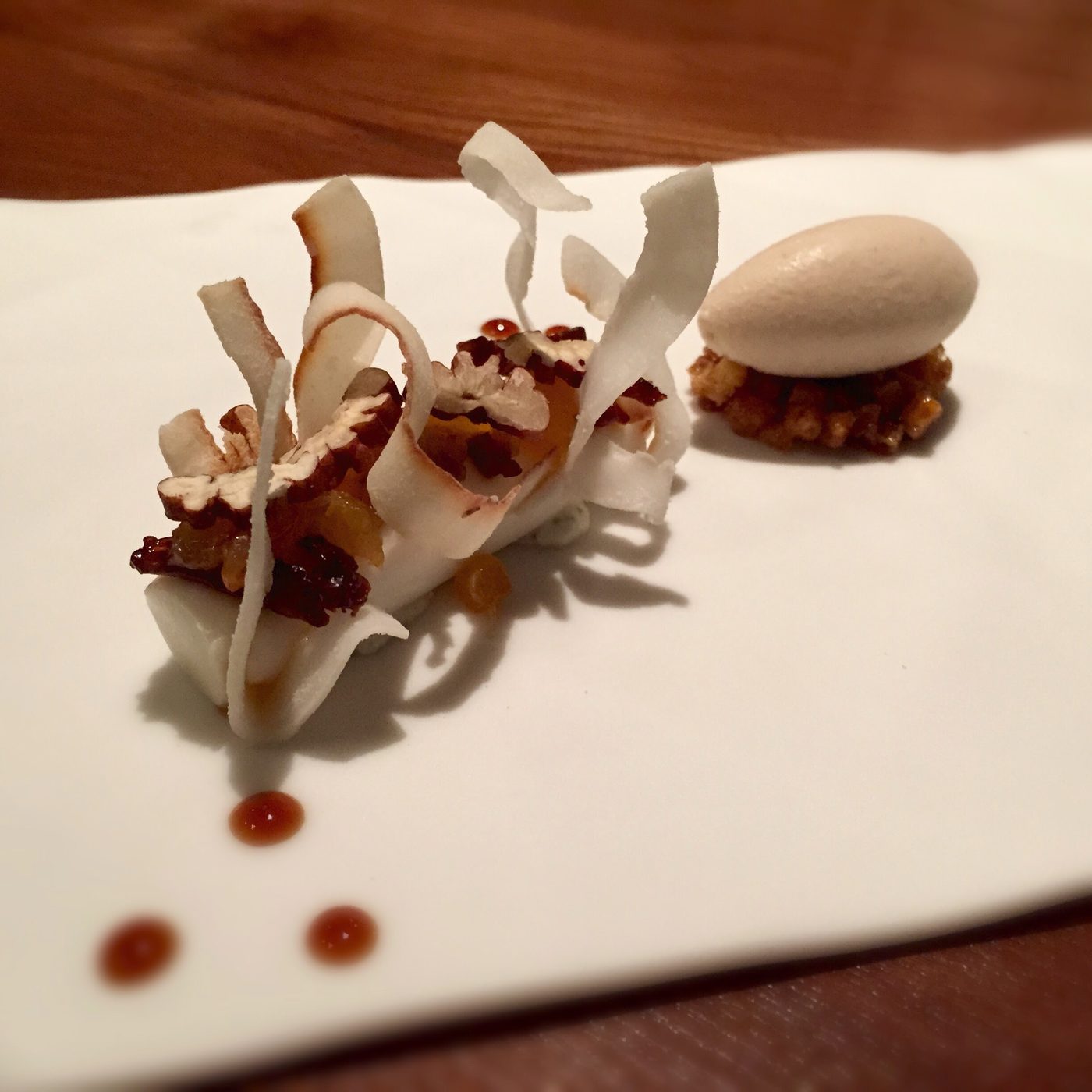
Thirteen days after we ate there, Gutsche was named Latin America’s Best Pastry Chef, cited for combining European technique with indigenous South American ingredients and traditions. Which is a fair description of the paragraph above, and of the photographs I took of it without understanding what I was looking at.
The last frames are a waiter at the table at 22:37 with a cream siphon in both hands, charging the foam onto the coffee in the room rather than behind a door; the menu photographed at 23:02 as a record; and the sign at 23:12, on the way out. Thirty courses between sitting down at eight and leaving at twelve past eleven — three hours and twelve minutes, which works out at a fraction over six minutes a course. For food this elaborate, that is brisk.

The timestamps also settle something I could only half remember. I am outdoors at 19:42 and outdoors again at 22:55, at the two ends of the meal, and the frames between them are not all of one room. In a restaurant whose rooms are scattered across an estate, that is worth something: whatever else I have forgotten, we did not sit in one room all night.
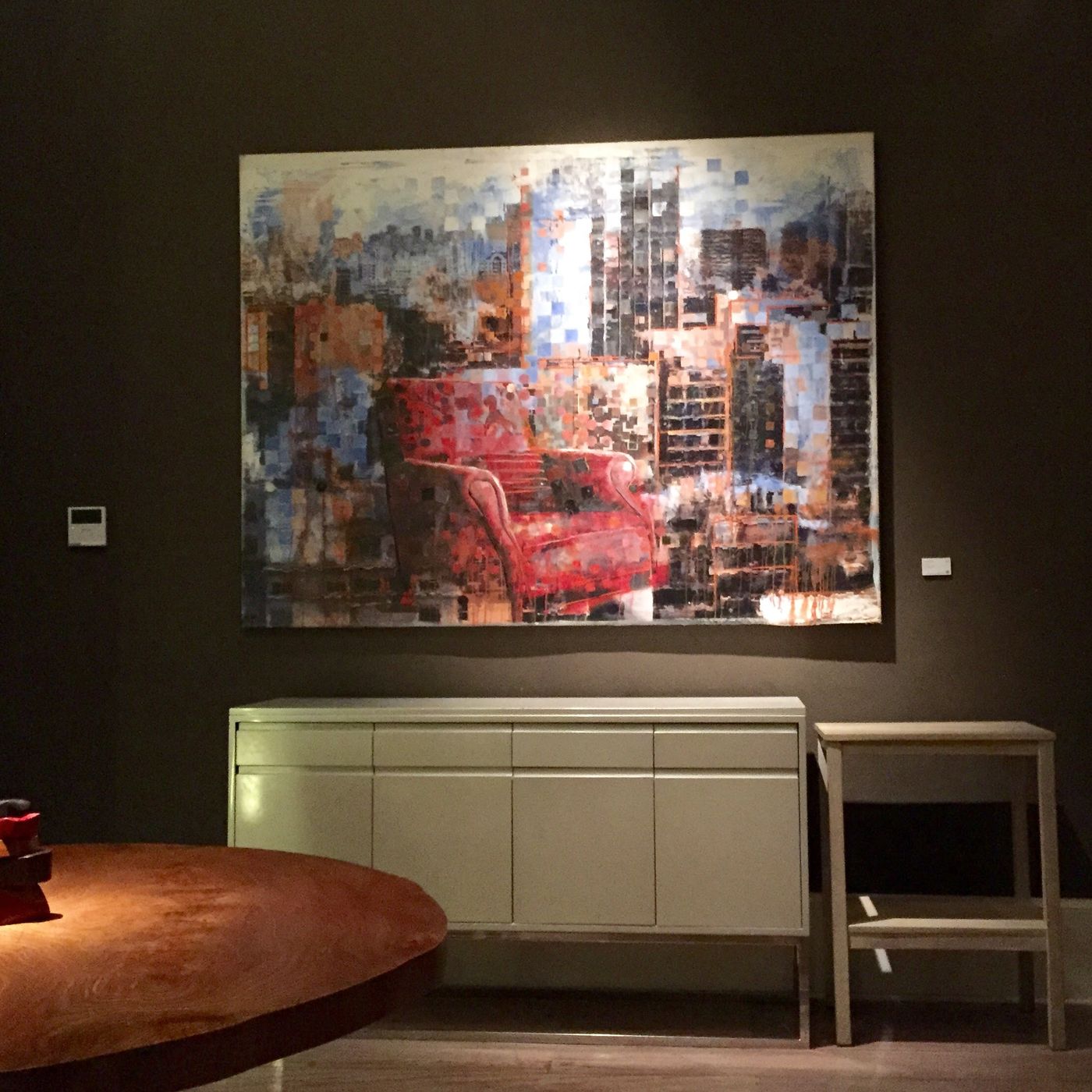
Here is the count. Twenty items on the list, closing on the Huevo y Nido, plus the two that arrived on the house — twenty-two at Maido. Thirty at Astrid y Gastón, of which twenty-eight are plates and two are drinks. Fifty-two courses, across ten hours and twelve minutes, by two people who had landed at half past midnight.
And for the record, I did not set out to eat fifty-two. I set out to eat thirty-seven — twenty at Maido and seventeen at Central. Thirteen of the difference is Astrid y Gastón simply being a longer menu than the one I could not get into. The other two arrived on the house, unasked. Which is either a defence or a confession, depending on how generous you are feeling, and I have never been able to decide either.
The itinerary prints the eleventh as a day at leisure, and that is exactly what I used it for. What it also prints, seven days later, is another day at leisure in Lima — we came back through the city for three days and two nights on the way to Iguazú. So there was a second free day available, and I knew it when I made the bookings. I did not have to do all of this on this day. But I did anyway, and I do not regret it.
Two restaurants, then, arguing opposite sides on the same Friday. Maido collapsing a whole country into single bites at a counter where nothing moved but a pair of hands. Astrid y Gastón spreading one across an estate and walking us through it room by room, because the building would not let them do otherwise. I would not have been able to articulate that in 2015. I could only see it by laying the photographs out side by side a decade later.
A word on the numbers, since I have been circling them. The restaurant that was full was Central, and in 2015 it stood at number four in the world. Astrid y Gastón was fourteen. Maido was forty-four. So I spent my one free day at the fourteenth and the forty-fourth best restaurants in the world, and the only thing standing between me and the fourth was a reservation book.
Which did not spare me anything, though for years I assumed it had. Central’s menu that season was Alturas Mater — Elevations — seventeen courses arranged by altitude, running from twenty-five metres below the sea to four thousand two hundred above it. Región Lima, which I booked in its place, was thirty. The restaurant that turned me away made my day thirteen courses longer than it would otherwise have been.
And it did not even change the idea. Región Lima carries its own elevation profile, the same journey between sea level and the sierra that Central’s menu was built on. In Lima in 2015 the ambitious tasting menu was an altitude menu. I had not escaped the concept. I had only changed which kitchen was making it, and added thirteen courses on the way.
Central was named the best restaurant in the world in 2023. Maido took the same title in 2025. Astrid y Gastón has gone off the world list altogether and sits at eighty-first in Latin America. Three restaurants, one city, one Friday: two of them would go on to be first in the world, and the one ranked highest on the day has fallen from third in its own region to eighty-first. Nothing I ate predicted any of that, and nothing about either meal was diminished afterwards.
That is roughly my whole position on ranking as a format. The best restaurant in the world can have an off night and a modest one can catch every condition right, and a list cannot see either. I would rather recognize work on its own terms than sort it against everyone else’s. And yet the plaque was on the gate in my photograph, three months old, and I would not have booked either restaurant without it. Both things are true. The list got me in the door; it is not what I remember.
What I remember is a snail nobody made a fuss about.
I had also forgotten, until I went through the albums this week, that we went back. The Peru leg ended where it began, in Lima. Argentina was the second half of the trip, starting at Iguazú. We had three days and two nights back in the city before that flight, and on the first of those nights we ate at Maido a second time.
Not the omakase. Five plates from the carta, between 19:57 and 20:21 — mostly things we had not eaten on the Friday, which was the point of going. A Guratan maki, the same gratin rolled up. Foie gras — the Intruso again. A beef short rib cooked for fifty hours, with a box of chaufa beside it.
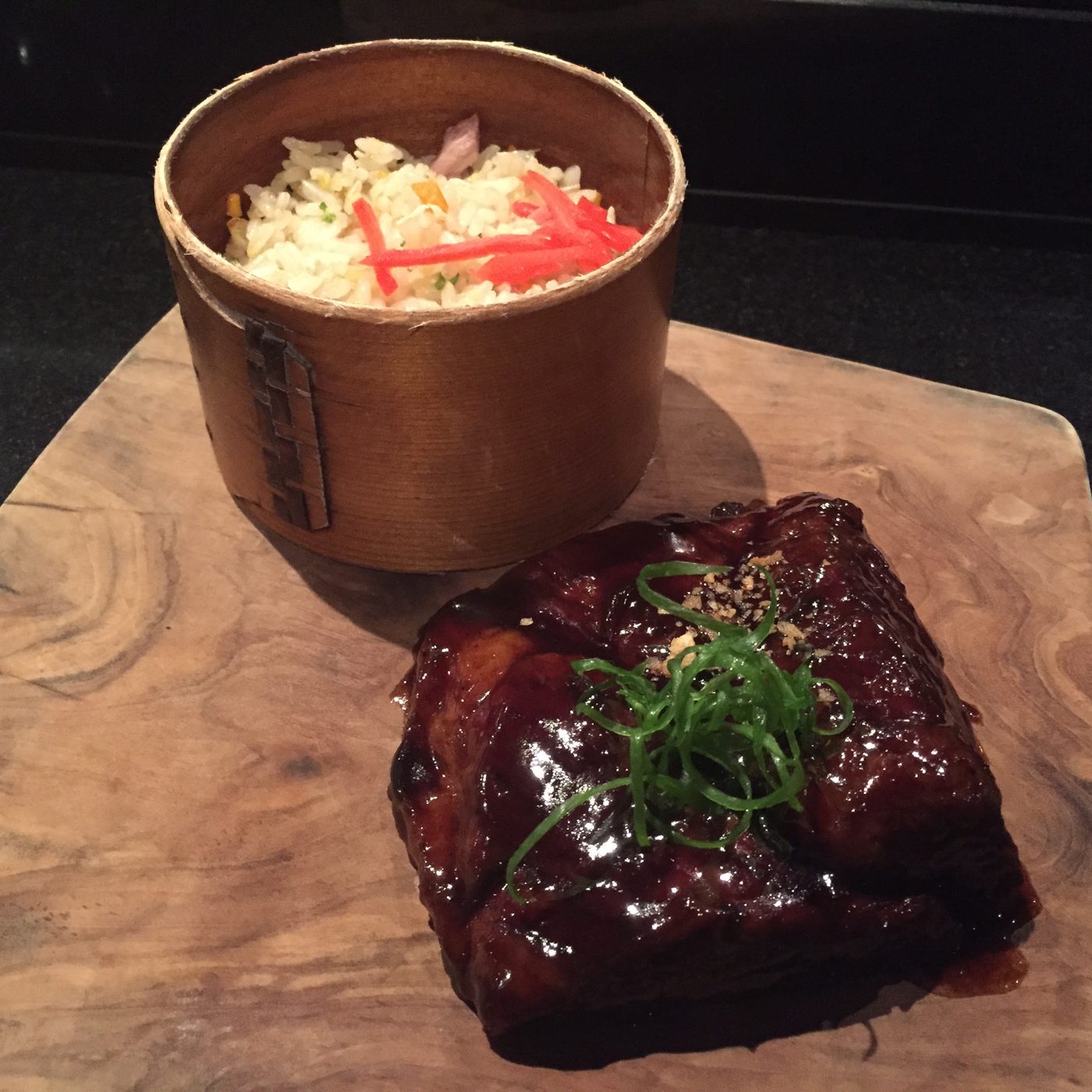
And two pieces we had eaten six days earlier and ordered again anyway.
Fifty-two courses on the Friday, and with the whole of Lima still out there, we went back to the same room. I still have no vocabulary for what any of it tasted like. But I have the itinerary, and the itinerary is not ambiguous.
There is one more thing the photographs gave me that I did not expect. I have been telling this story for years as an endurance event, with my wife as the person who had to be dragged through it. Then I went back to the video I shot of the huatia being opened, and it is her voice on it, eight hours into the day, leaning in to ask a waiter where the potatoes came from. She may not have been enduring it. She was paying better attention than I was.
Every course of both meals, photographed and set down one by one, is in two companion pieces: the Nigiris Experience at Maido and Región Lima at Astrid y Gastón.
Order this: at Maido there is only one omakase listed now, the Maido Experience. That is the way I would do it, because it takes you on a guided journey through the courses. At Astrid y Gastón they now offer two tasting menus, but neither is the thirty-course menu I ate — I believe they run to fifteen or eighteen now. Take the earlier seating so the movement between rooms happens while you can still see the house. Do not attempt both in one day. I did, and I would do it again, and I am aware those are two different statements.



The Newsletter
New pieces, plus what’s on my table next. Every few weeks.

An error has occurred somewhere and it is not possible to submit the form. Please try again later or contact us.


