


Astrid y Gastón, Lima: Región Lima, Course by Course

Jacob Ung
September 15, 2026

8 min read
All thirty items of the Región Lima menu at Astrid y Gastón, Lima, photographed on 11 September 2015 and set down in the order the card printed them.
This is the photographic record of one dinner: the thirty-item Región Lima menu at Astrid y Gastón, in Casa Hacienda Moreyra, San Isidro, Lima, booked for eight o'clock on Friday 11 September 2015. We sat down at eight and left at twelve minutes past eleven.
Twenty-eight of the thirty are plates; two are drinks. They appear here in the order the card printed them, keeping the card's own wording and spellings.
The account of the day this belongs to, and of the twenty courses eaten at Maido earlier the same afternoon, is in Ten Hours, Fifty-Two Courses.
Región Lima
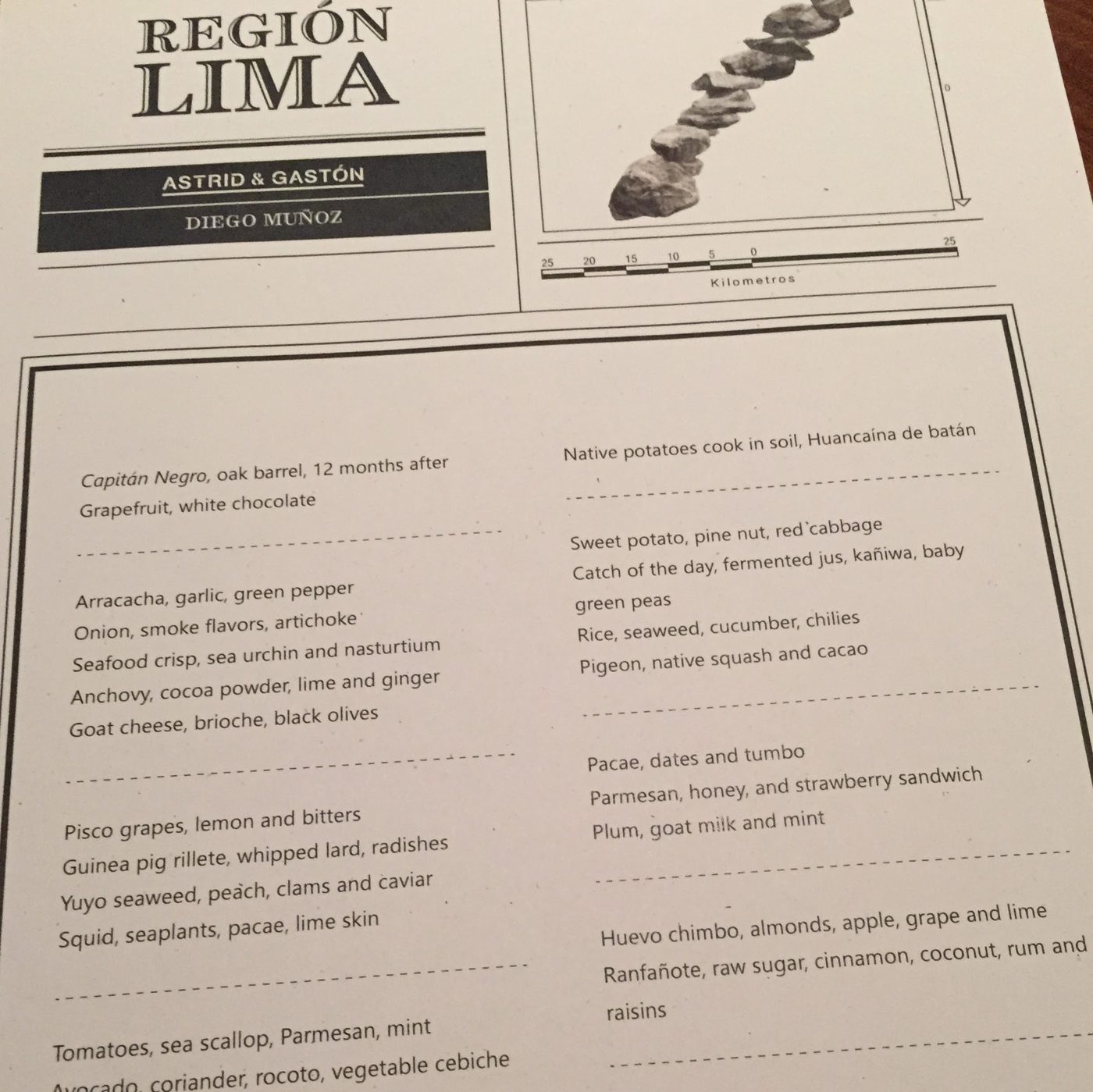
The Menu
Two panels, thirty lines, and a masthead that reads Astrid & Gastón — Diego Muñoz. Acurio's is the name on the building; Muñoz was the chef who actually cooked this, and the card gives him equal billing. The lines are not run as one list. Dashed rules break them into blocks — the kitchen marking where the meal changes gear. There are no numbers anywhere on the card, which is why the order below is the order as printed, read down one panel and then the other. The card's own spellings are kept below, capitalization aside: rillete with one L, American flavors, and an English that slips in places.

Capitán Negro, Oak Barrel, 12 Months After
The first of the thirty, and one of only two that are not plates. A Capitán is Peru's Manhattan: pisco and red vermouth, stirred, no fruit, no fuss. This one had been in oak for a year before it reached the glass — which is what 12 months after means — and arrives under a dense pale foam almost as deep as the drink itself. No ice, no garnish. A round lamp burning behind it.
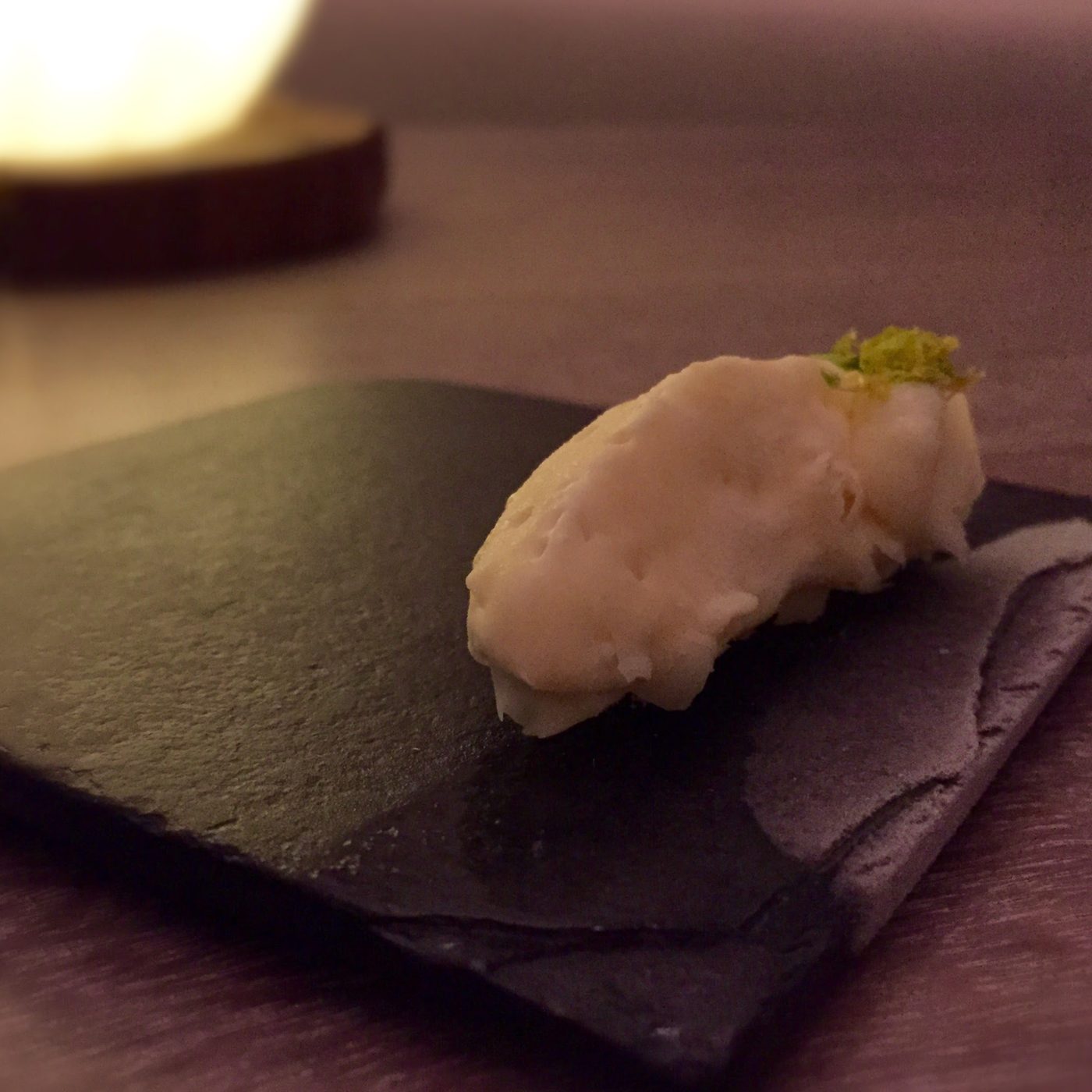
Grapefruit, White Chocolate
One pale quenelle on a black slate tile, its surface pitted and dimpled the way a frozen ganache sets, a small tuft of zest pressed into the high end. Nothing else on the slate. Two ingredients, one bite, second in line. A kitchen that opens a thirty-course menu this quietly is confident about what is coming.

Arracacha, Garlic, Green Pepper
Arracacha is an Andean root that tastes like the place where celery, parsnip and chestnut meet — grown in the highlands long before the Spanish arrived, and still barely known outside the continent. Here it is sheeted, rolled into open cones, fried hard and dusted heavily in ochre, laid end to end along a bar of rough granite. The wider end of each splits open in a fork.

Onion, Smoke Flavors, Artichoke
The card prints flavors, American spelling, in an otherwise British-leaning English — one of several small tells that the translation was done in-house. Four wooden dowels crossed and bound at the centre make a stand, and in the cradle of it sits a loose mound of very fine pale-gold threads, fried crisp. The two mauve stars pressed into the top are chive blossoms: the onion flowering over its own dish.

Seafood Crisp, Sea Urchin and Nasturtium
A thin amber crisp curled up off a dark wooden board, spread with a coral-pink cream and studded with black pearls. The flat round leaves laid over the top are nasturtium — veins radiating from the centre of each one like a tiny lily pad. Nasturtium is peppery, closer to watercress than to anything floral, which is the point: it is there to cut the urchin, not to decorate it.

Anchovy, Cocoa Powder, Lime and Ginger
A small lidded clay pot, its lid propped in front of it. Inside, a pale cream, and lying on it two tight rolls of deep crimson flesh dusted brown across the top. One is rolled loosely enough to show the red core. The anchoveta is the most-caught fish on earth and Peru lands most of it — and almost all of it is ground into fishmeal and fed to farmed salmon somewhere else. Putting it under cocoa, on a thirty-course menu about this coast, is an argument about what the country does with its own catch.

Goat Cheese, Brioche, Black Olives
The bottom two-thirds is the brioche — and it does not read as bread at first, because it has been baked with no crust at all, just a fine close crumb toasted gold around the edge. Above it the goat cheese, and over that the olives as a glossy bubbled glaze, with a thin coil of orange peel set into the top. Black olive and orange is a Mediterranean pairing. Peru grows both.
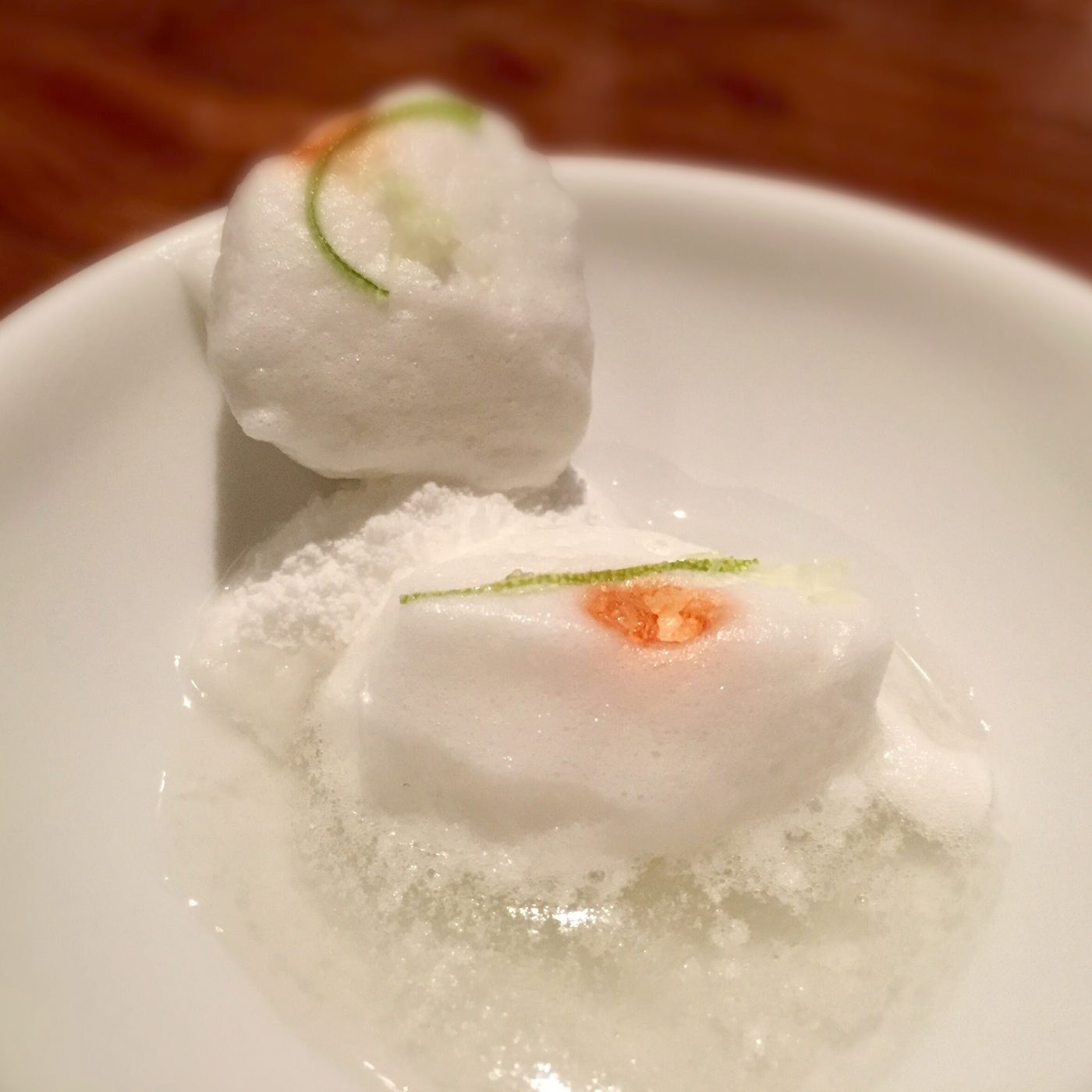
Pisco Grapes, Lemon and Bitters
Not pisco — the grapes it is made from. Eight varieties are permitted, quebranta and italia the best known, and they are grown along this same coast south of Lima. Served as two white aerated pieces, one set above the other, a thread of zest across each and a single orange dot below. A pisco sour taken apart and rebuilt as a solid, which is also the eighth thing you have eaten and the point at which you realize how long this evening is going to be.
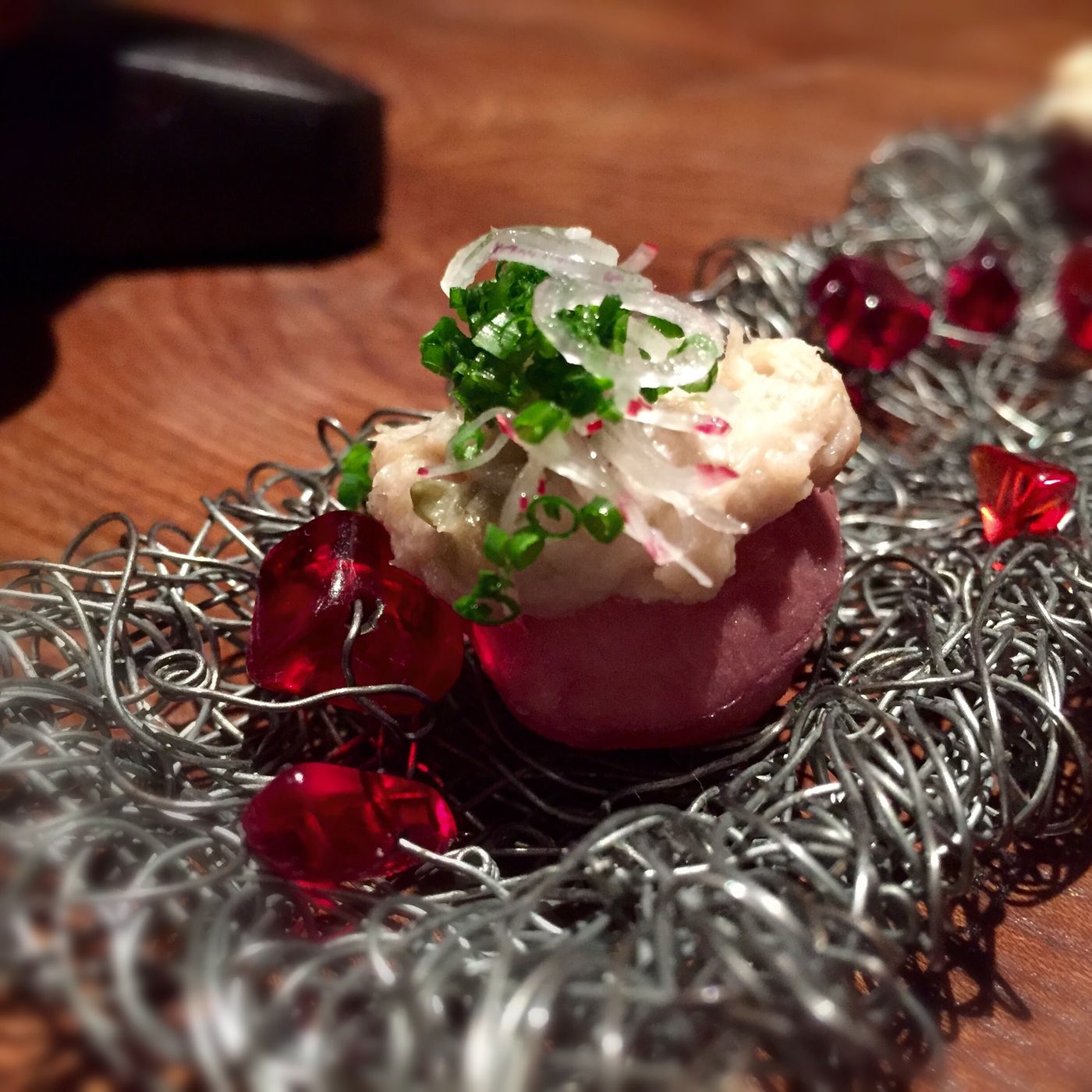
Guinea Pig Rillete, Whipped Lard, Radishes
Rillete with one L, as the card prints it. The meat is cuy — guinea pig, domesticated in the Andes for something like five thousand years and eaten there long before it was ever a pet anywhere else. Treated as a French rillette: cooked down, shredded, bound with its own fat, then set on a deep magenta disc with shaved radish and chive over the top. The whole thing arrives on a tangled wire nest strung with red glass beads.

Yuyo Seaweed, Peach, Clams and Caviar
Yuyo is the seaweed Peruvians actually eat — sold wet by the bag in coastal markets, dressed with lime and onion, cheap and everyday. Here it is dried to a green crumb and spread across a black stone, with translucent clam slices curling out of it, orange roe on one side and black caviar on the other. The luxury ingredient and the market ingredient are on the same rock, and the seaweed is the one doing the work.

Squid, Seaplants, Pacae, Lime Skin
You cannot see this course. The bowl is filled corner to corner with a dense ivory foam, holding its own shape, and everything named on the card is underneath it. What is visible: one borage flower, violet petals around a black anther cone, and a scatter of dark crumb across the far edge. Pacae is the ice-cream bean — a long Amazonian pod whose seeds come wrapped in white cotton-textured pulp, sweet and faintly vanilla. It turns up again at course twenty-two.

Tomatoes, Sea Scallop, Parmesan, Mint
Tomatoes in pink, yellow and green in a ridged glass dish, a scarlet powder thrown over them, small white flowers and mint through the top, white curds running through the middle. The tomato is South American before it is Italian — it went the other way across the Atlantic. A plate that puts Parmesan on one is quietly reversing the usual direction of the compliment.
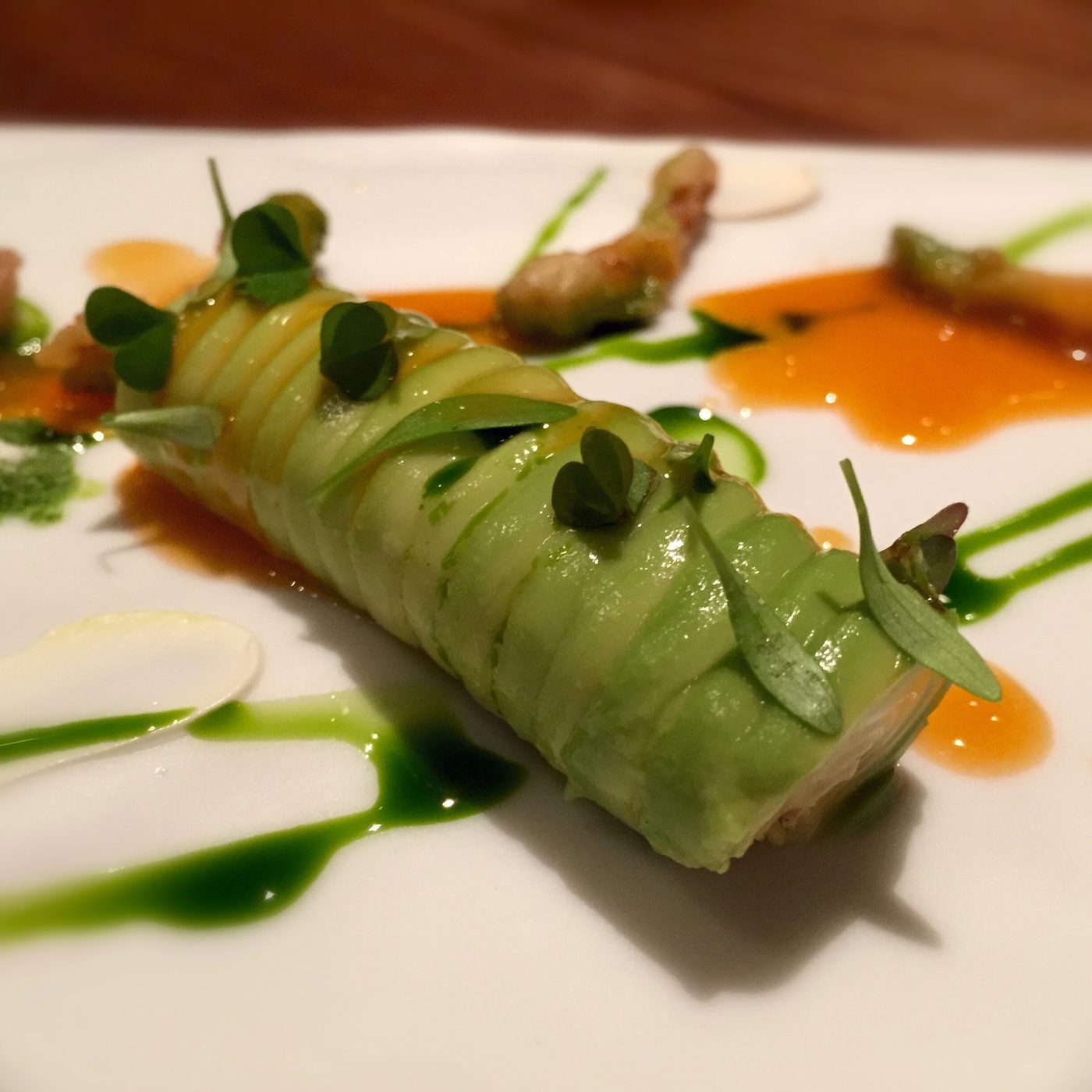
Avocado, Coriander, Rocoto, Vegetable Cebiche
Rocoto is the one Peruvian chili that genuinely bites — thick-walled, apple-shaped, black-seeded, and hot in a way that ají amarillo never is. Here the cebiche has no fish in it at all: vegetables cured the way the fish would be, packed into a cylinder and wrapped in overlapping avocado slices, with micro leaves pressed along its length and an orange sauce and green oil run across the plate.

Herbs from Our Garden, Yellow Flesh Potato, Green Soup
From our garden is the kind of line restaurants say loosely. This one had the infrastructure standing next to it: the architects' site plan for Casa Moreyra labels a garden called the infinite orchard, plus greenhouses for highland and jungle produce. The potato is papa amarilla, the yellow-fleshed variety that collapses to a purée almost on contact — combed flat across the base of the bowl here, with a green quenelle set into a slick of green over it.

Aglio e Olio, Limo Chili, Parsley
An Italian dish name, printed in Italian, in the middle of a menu about the Lima region — and it belongs there. Italian immigration reshaped this coast's cooking in the nineteenth century; Lima has been eating and adapting Italian food for as long as it has been eating Japanese. The coils are translucent and read as more ribbon than noodle. Ají limo scattered red over the top, green herb oil underneath, an orange crumb at the edges.

Chicken, Egg Yolk, Sprouts, Kale
The most restrained thing on the table, and the one I would order again first. An egg yolk set low and slow, bedded in sprouted grains in a thin clear amber broth, dusted with kale. The charred nugget of chicken sits out on the rim of the plate, apart from everything else — which is the whole idea: a chicken soup taken apart and rebuilt with each part put back deliberately.
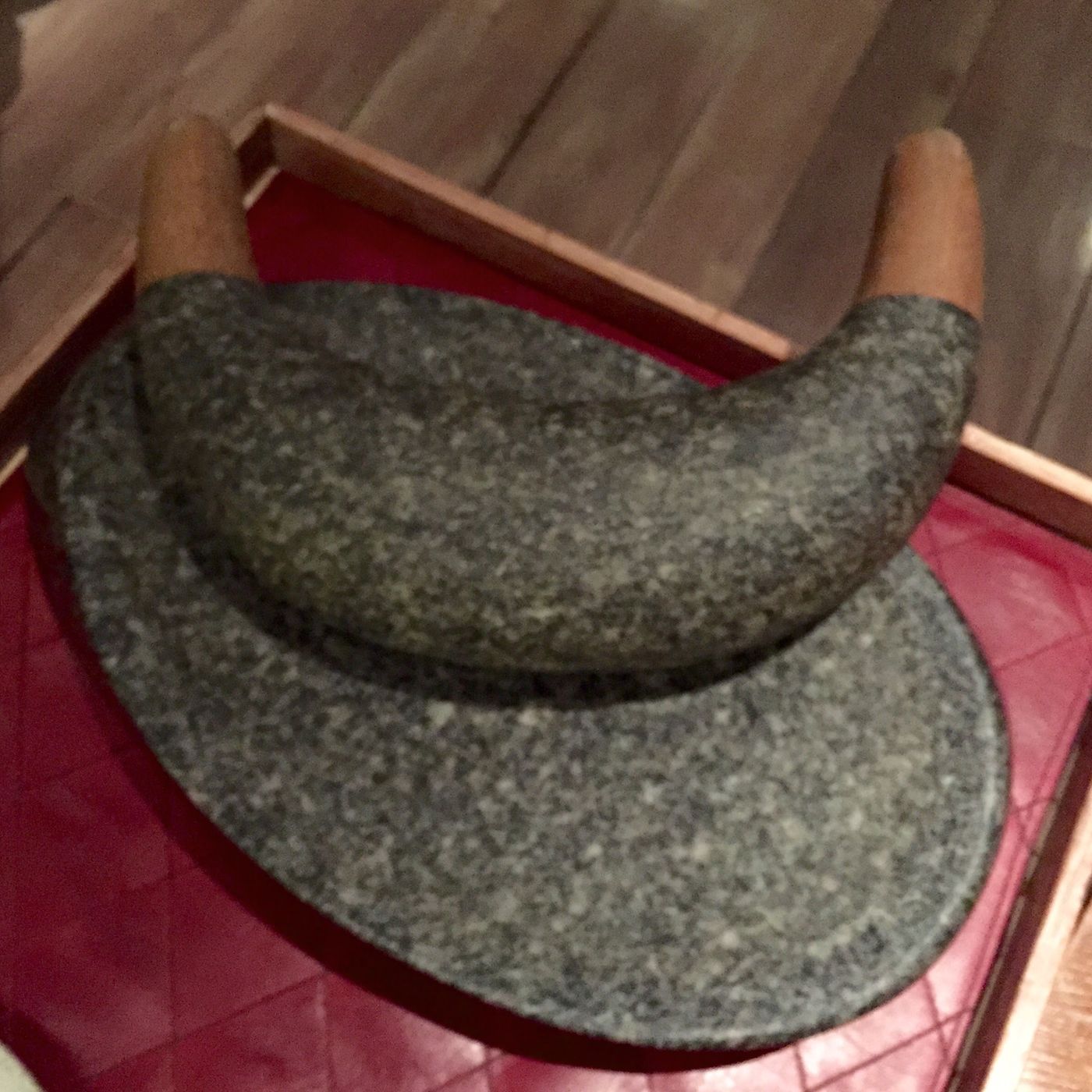
Native Potatoes Cook in Soil, Huancaína de Batán
The batán is the oldest kitchen tool in the Andes still in daily use — a flat stone base and a rocking crescent called an uña, worked with both hands and the weight of the body behind it. It does not emulsify, and that is the point. A blender shears everything to one size and keeps the temperature down; stone crushes and tears, so the ají keeps its edges, the cheese stays in streaks, and the friction warms the sauce while it is being made. A huancaína off a batán tastes of separate things rather than of one thing. It came out at 20:55 and was ground at the table.
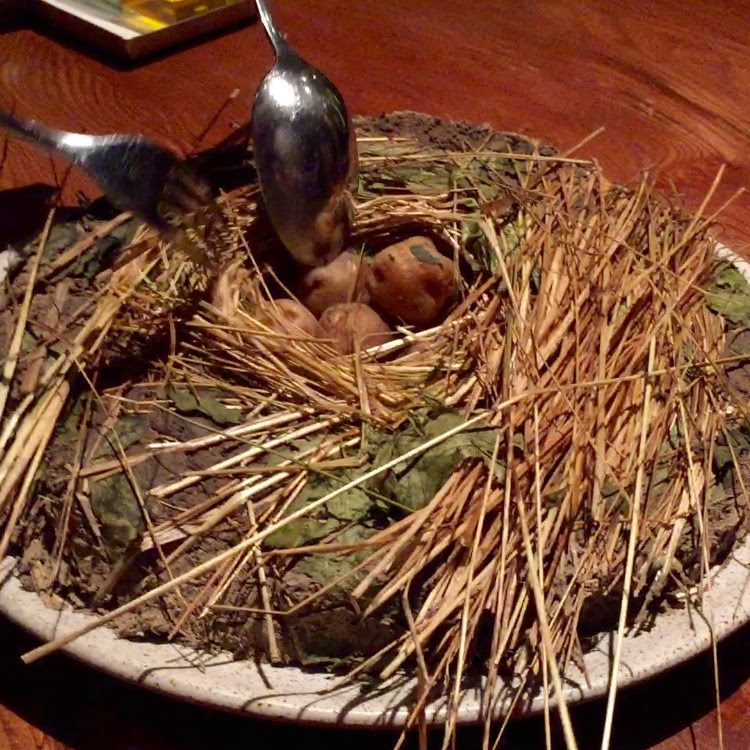
Native Potatoes Cook in Soil, Huancaína de Batán (Opened)
Huatia is not pachamanca, though both bury food. Pachamanca is a pit lined with fire-heated stones. A huatia is a small dome of dried clods built in a harvested field, fired until the earth itself is hot enough, then collapsed inward onto the potatoes. It is a field technique before it is a restaurant one — timed to the potato harvest, built from whatever the ground has just given up, and traditionally eaten standing where it was dug. The site plan for Casa Moreyra marks a zone for exactly this, out by the grills. It reached the table sealed under straw, and was broken open in front of us with two spoons.

Sweet Potato, Pine Nut, Red Cabbage
Camote, the sweet potato, is one of the oldest cultivated plants on this coast — found in Peruvian archaeological sites thousands of years old, and still sold roasted from carts. A short cylinder of it stands in a dark red-brown glaze that runs off down the plate, pale at the cut face, with translucent violet cabbage tucked at either side, cream swirled through the glaze, and a single pine nut sitting in it.

Catch of the Day, Fermented Jus, Kañiwa, Baby Green Peas
Kañiwa is quinoa's smaller, tougher cousin — a tiny dark red grain that grows higher and colder than quinoa will, and never got the export boom. Here it is toasted and laid as a crust over the top of the fish and down one side. The fish underneath is a thick square, barely set. Green peas and herb salsa piled on the crust, a pool of glossy tan-brown fermented jus beside it. The card does not say which fish, and neither will I.
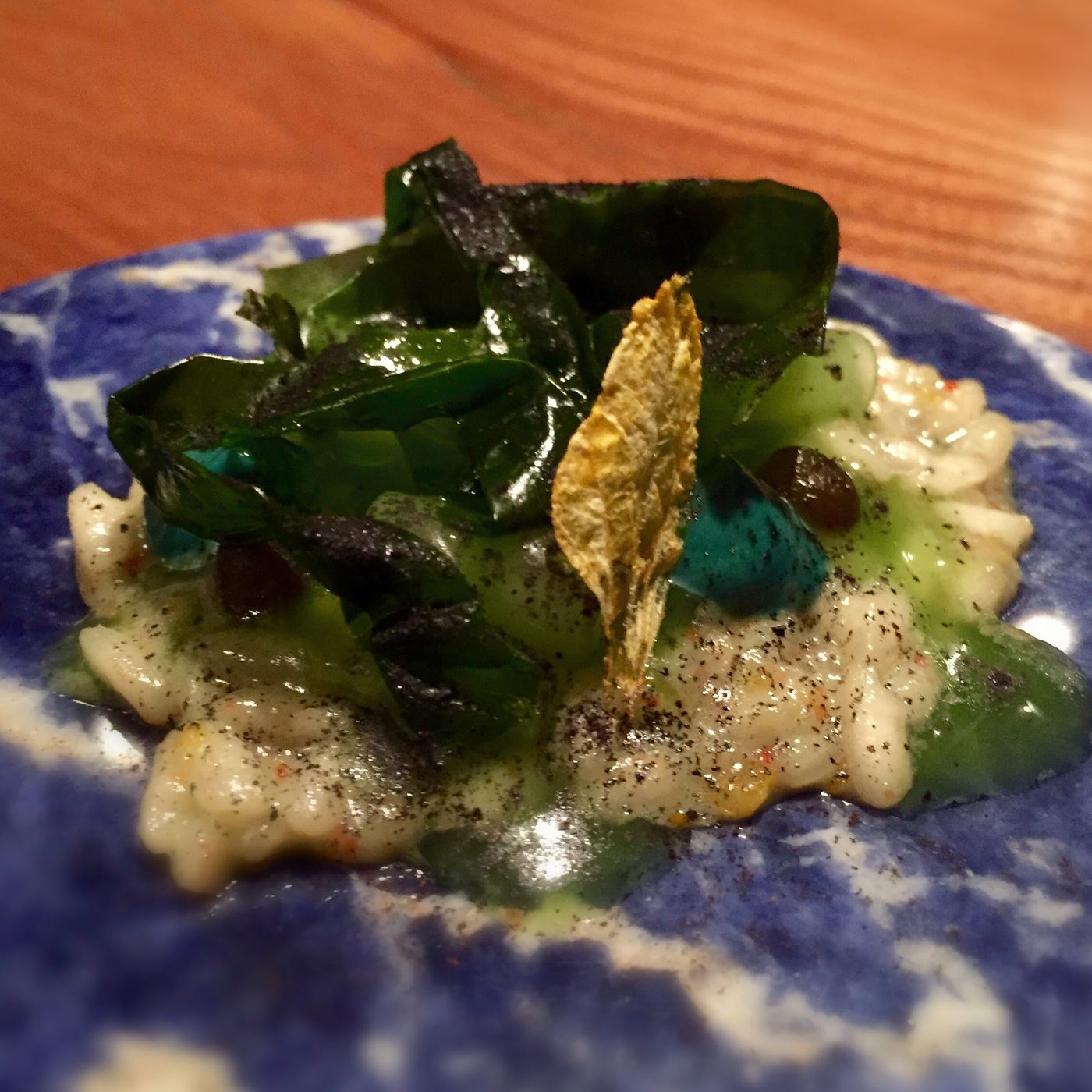
Rice, Seaweed, Cucumber, Chilies
The plate is the loudest thing on this menu — mottled indigo and white, and after nineteen courses of slate, granite and bare wood it arrives like someone raising their voice. Loose creamy rice underneath, dusted all over with a fine black-green powder, glossy dark seaweed heaped on top with translucent cucumber showing through. Rice cooked wet and rich, in the arroz meloso manner, rather than dry.

Pigeon, Native Squash and Cacao
The last savoury course, and the only red meat on the menu. Two pieces cooked rare with the skin still on, one of them under a fine bubbled foam. Orange squash cut to batons beside them, a yellow-orange purée combed across the plate in two sweeps, a cluster of dark caramelized pieces to one side. Cacao here is savoury, not dessert — Peru grows some of the most genetically diverse cacao on earth, and this is what a kitchen does with it when it is not making chocolate.
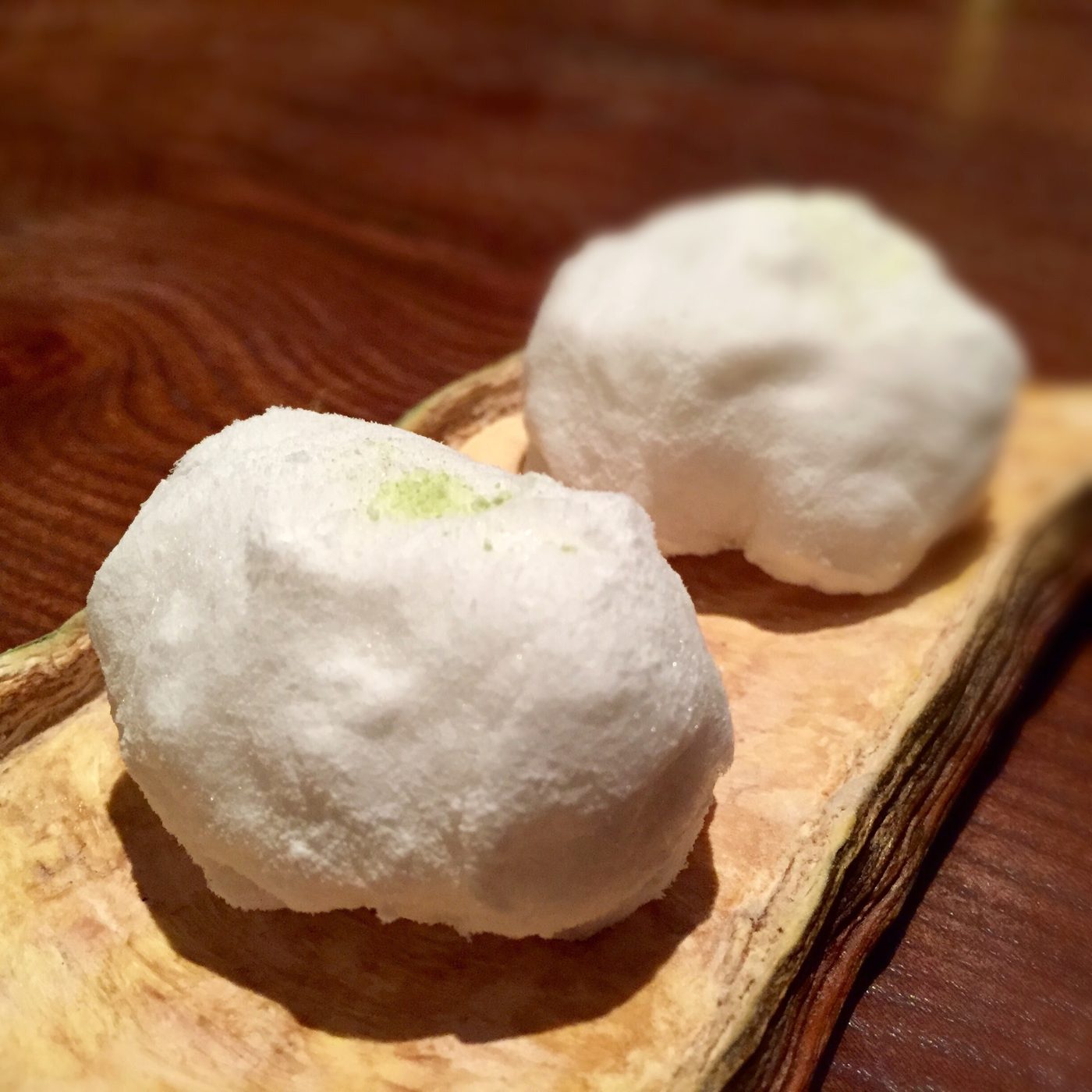
Pacae, Dates and Tumbo
First of the desserts, and the point at which the menu hands over to Astrid Gutsche. Pacae is the ice-cream bean, back from course eleven and this time in its own right — a pod that can run to a foot long, its seeds wrapped in a white pulp with the texture of cotton wool and a flavour close to vanilla. Tumbo is banana passionfruit: same family as the round kind, sharper, more floral, and grown up the Andean slopes rather than on the coast. Two white spheres, powdery and a little collapsed, set in a long shallow trough laid down the length of the table.

Parmesan, Honey, and Strawberry Sandwich
Served in a small metal tin lined with crumpled gold foil, set on a painted ceramic tray — the packaging of something cheap, holding something that is not. Two round sandwiches, each capped with a translucent white disc over a red-orange filling. Parmesan and strawberry sounds like a provocation and is not: aged Parmesan is already doing the sweet-savoury work, and the honey is the hinge between the two.

Plum, Goat Milk and Mint
A pool of scarlet compote in a speckled cream bowl, with four angular white slabs laid across it — set firm enough to hold an edge, fine green flecks suspended inside them — and a dusting of dark powder over the top. Goat milk in a dessert is a Gutsche move: the faint sourness stops the plum from becoming jam.

Huevo Chimbo, Almonds, Apple, Grape and Lime
Huevo chimbo is a colonial sweet built almost entirely out of egg yolk and sugar — one of the convent desserts that came over with the Spanish and stayed. So the kitchen made it look like what it is made of: a yellow sphere with the wet sheen of a yolk, sitting on a white plate moulded into rows of rounded domes. The plate is an egg carton. The whole thing is in on the joke.
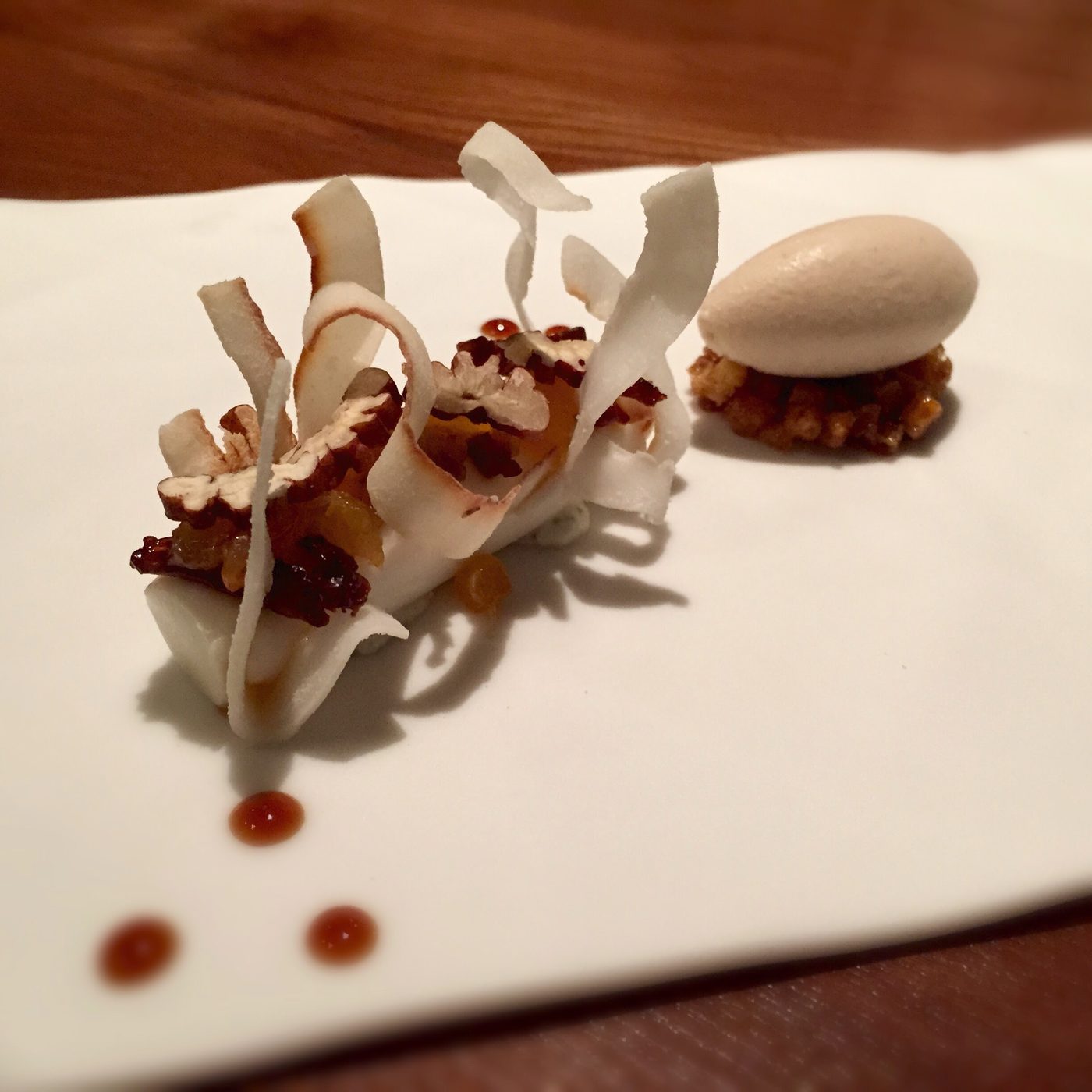
Ranfañote, Raw Sugar, Cinnamon, Coconut, Rum and Raisins
Ranfañote is a criollo Lima sweet — old bread, chancaca (unrefined cane sugar), cinnamon, nuts and raisins, cooked down into something between a pudding and a confection. Street-fair food, not restaurant food. Here the bread becomes the crumble under the quenelle, the chancaca becomes the three caramel dots, and the coconut is shaved wide enough to stand up off the plate.

Custard Apple, Mandarin, Pumpkin Seed Oil
Custard apple is chirimoya, which grows in the Peruvian highlands and is the same fruit standing in for egg white in Maido's dessert earlier the same day — the one course the two restaurants share, used in opposite directions. Two white cylinders on a dark metal disc, matte and powdery, one already beginning to weep at the base. Not a matched pair: one is taller and wider than the other. One each.

Coffee, Milk, Tonka Bean
The second of the two drinks, and the twenty-eighth thing to arrive. Served in a tall stemmed wine glass rather than a cup: near-black under a thick band of pale foam. The foam was charged at the table — a waiter stood there at 22:37 with a cream siphon in both hands, doing it in the room rather than behind a door. Tonka bean is banned outright in the United States for its coumarin content. It is legal almost everywhere else, tastes like vanilla crossed with almond and hay, and is the sort of ingredient a kitchen uses when it knows exactly which border it is on.
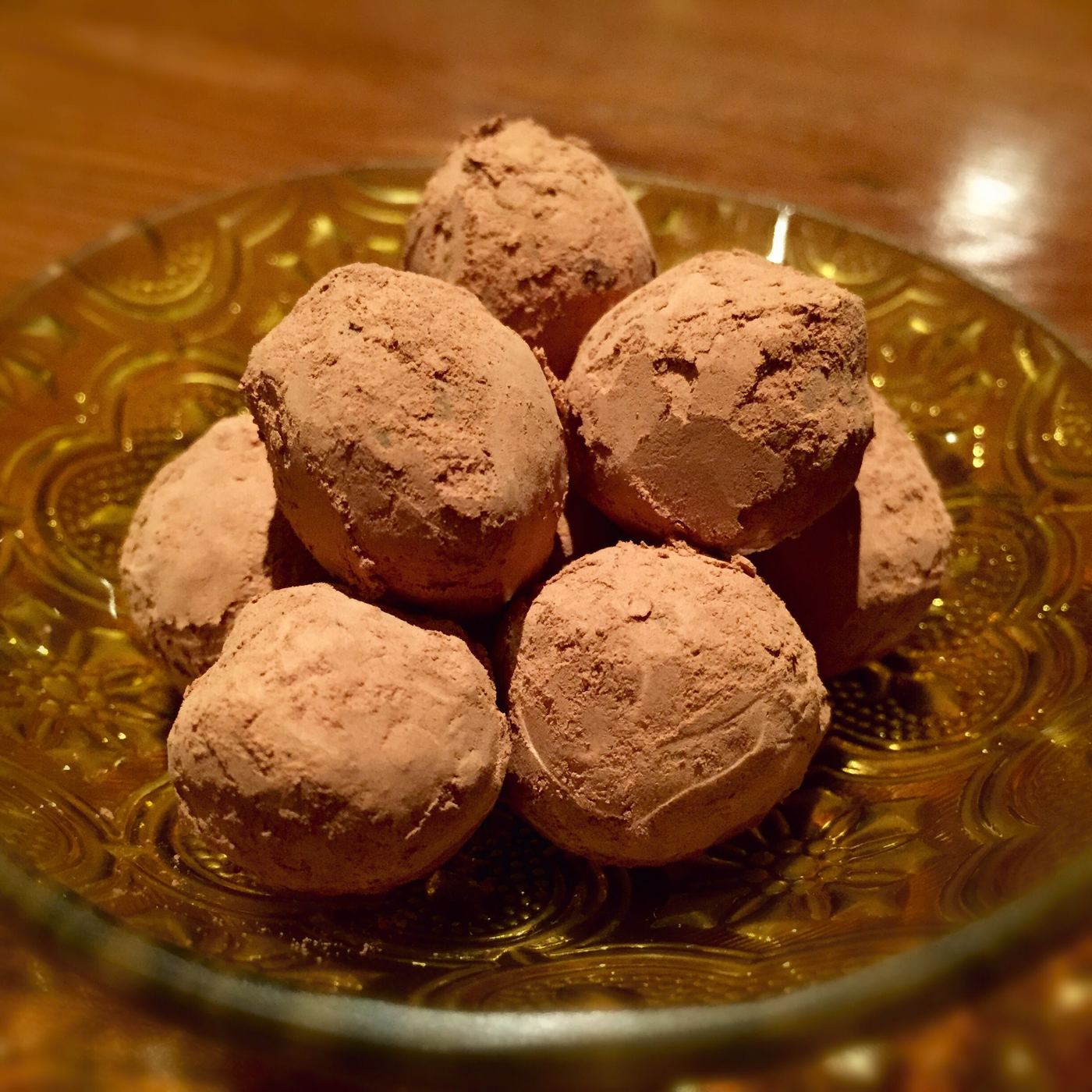
Lúcuma, Chocolate
Lúcuma is the flavour Peruvian children grow up on the way others grow up on strawberry — a dry, dense, maple-and-sweet-potato sort of fruit that almost never gets eaten fresh and almost always gets turned into ice cream. Seven rough spheres piled on a pressed amber glass dish, each thickly dusted in cocoa, the dark shell showing through where the dusting has rubbed off.

Chocolate, Flowers, Mint
Thirtieth and last. Two chocolate tubes on a silver tray, each set along its length with small mint leaves pressed into the surface. We left at twelve minutes past eleven. Thirty courses in three hours and twelve minutes — a fraction over six minutes a course, which for food this elaborate is brisk.



The Newsletter
New pieces, plus what’s on my table next. Every few weeks.

An error has occurred somewhere and it is not possible to submit the form. Please try again later or contact us.


