




It takes me a little over two hours to pull dried scallops apart by hand. First I soak them overnight, and then I sit down and separate them into strands, one scallop at a time, until I have a heap of golden floss and no real feeling left in my pungent, salty smelling fingertips. There’s no faster way that I’ve found, and I have genuinely looked. My advice, if you’re doing it for a crowd, is to recruit somebody to sit with you or put on a long film and accept the afternoon for what it is.
My mother turned eighty this week. That’s what the scallops were for.
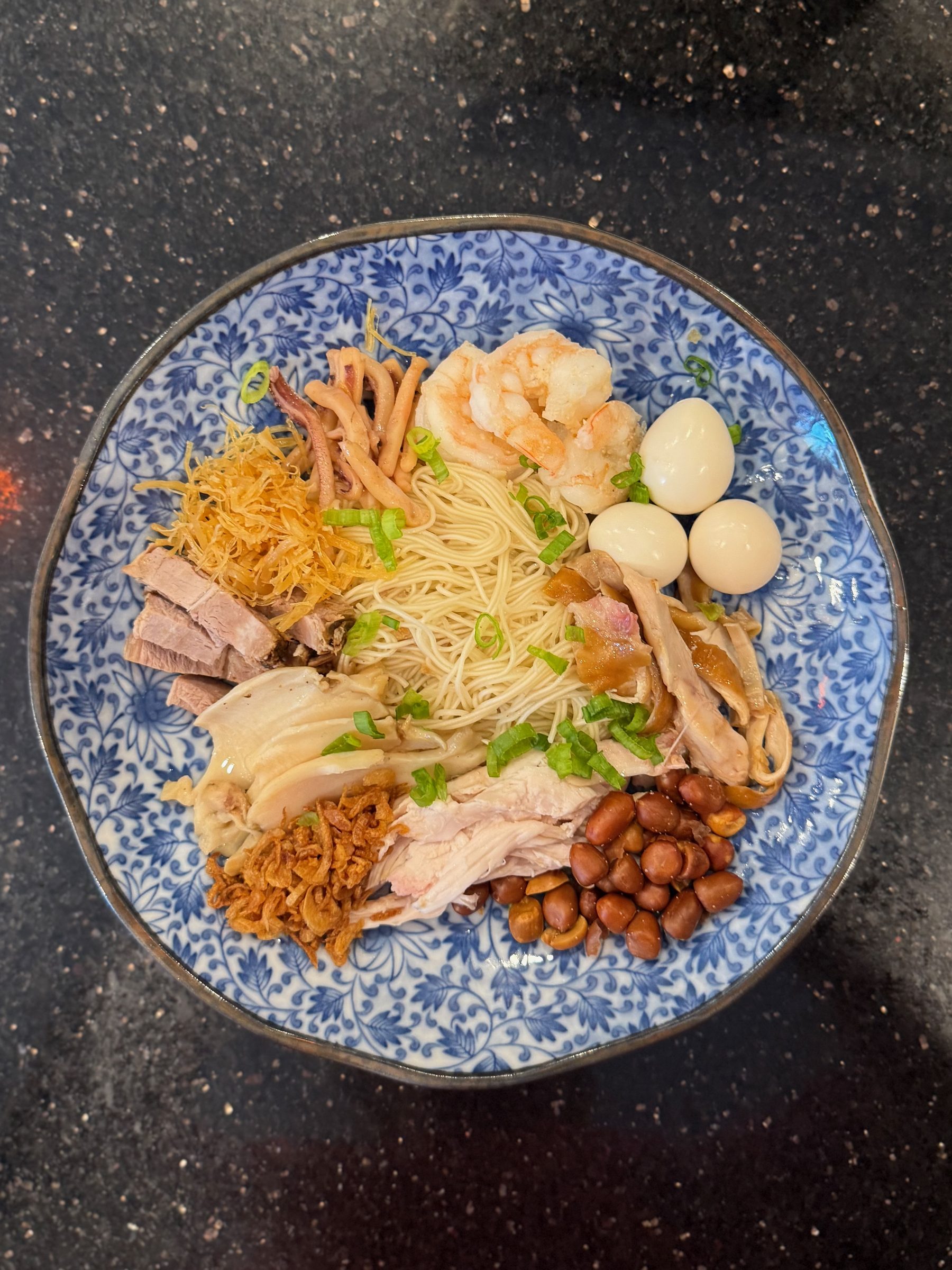
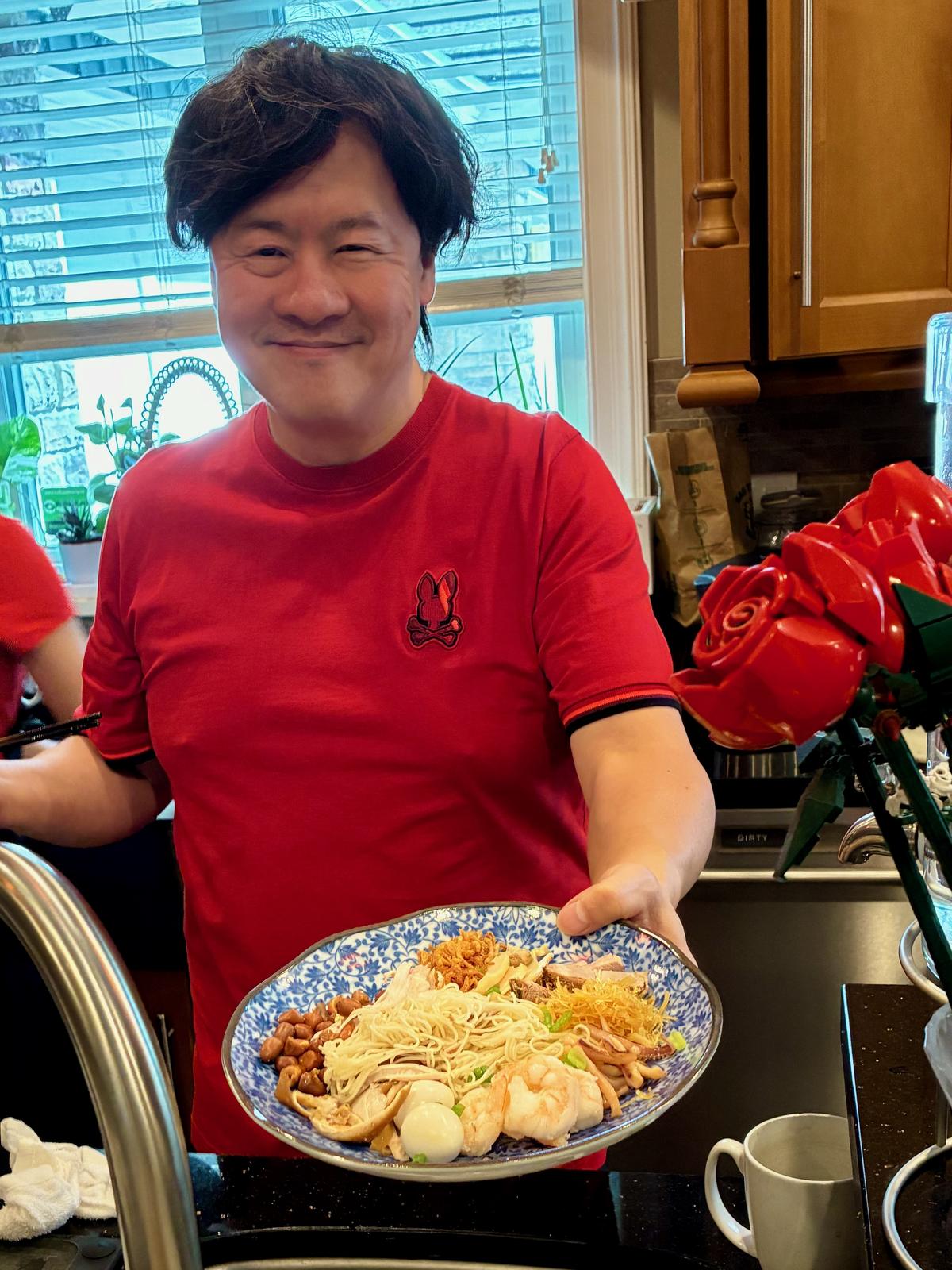
The dish is Tsa Misua, and one of the things I’ve come to like about it is that almost every part of it is negotiable except the noodle itself.
Misua is Hokkien — 麵線, mī-sòaⁿ, and the characters say plainly what it is: 麵, noodle, and 線, thread or line. Noodle threads. Tsa is 炒, chhá, to stir-fry — the same character sitting behind every “chow” and “char” you’ve ever read on a Chinese menu anywhere in the world. So the whole thing is 炒麵線, fried noodle threads, which is one of those names that turns out to be a straight description once you take it apart. In the Philippines you’ll also hear it called dry misua, which is there to distinguish it from the soup, and I should be careful about how I describe that soup, because I’ve heard it dismissed as the lesser version and it isn’t. The soup version is simpler, certainly — but it’s also a full birthday dish in its own right, a bowl of misua in broth with hard-boiled eggs, eaten on the day in place of a cake, and in Hokkien families it’s arguably the more classical form of the two. The difference between them isn’t that one is everyday and the other is special. It’s that one is a soup noodle served in a bowl and the other is a day and a half of work.
The noodle itself is about as plain as an ingredient gets: wheat flour, salt, water, and — on the packet we buy — a little tapioca starch. Traditionally it’s just the first three. The starch is there for elasticity and structure rather than for anything you’d taste, which I like: the one modern addition is in service of the noodle holding together. The way it’s traditionally made, in Fujian, is that you rest the dough to let the gluten come up, roll it into a rope, and then beat that rope against the floor to lengthen it — over and over, the way you’d work a set of battle ropes — before winding it onto poles, drawing it thinner and thinner, and hanging it outside to dry in the sun. A single strand runs to something past a hundred feet, which is why it sometimes gets called the longest noodle in China. It’s also a craft that’s quietly thinning out; the people still making it by hand say they’ve offered to teach anyone who wants to learn and haven’t found many takers, so it tends to pass down inside a family or not at all.
The packet we buy says 手工廈門麵線 across the front — hand-made Amoy vermicelli. I should be careful about what that does and doesn’t tell you: 手工 is the maker’s claim that it’s done by hand, which I take on trust, and 廈門 describes the style rather than the address. Where our particular bag was made, I don’t actually know. Amoy is the old name for Xiamen, the port city in southeastern Fujian, and it’s worth noticing which of the two names ended up on an export bag. Amoy comes from Hokkien rather than Mandarin — from Ē͘-mûi, the Zhangzhou way of saying 廈門 — and it lodged in English because Amoy was one of the five ports forced open to foreign trade by treaty in 1842. The city has been Xiamen in English for decades now. The noodles never got the memo, which I’m glad about, because it means the label is still speaking my family’s dialect without making anything of it.
And then you take a thing made that way and cook it in only a few minutes, because it will break if you look at it wrong.
I’ve thought about that more this year than I used to. The noodle means long life, which is the whole reason it’s on the table — you don’t cut it, you don’t bite through it, you don’t stir it hard enough to snap it. And it’s the single most fragile thing in the kitchen. Nobody in my family has ever said that out loud, as far as I know. You just learn to handle it carefully, the way you learn most things in a family, which is to say by watching somebody else do it and never asking why.
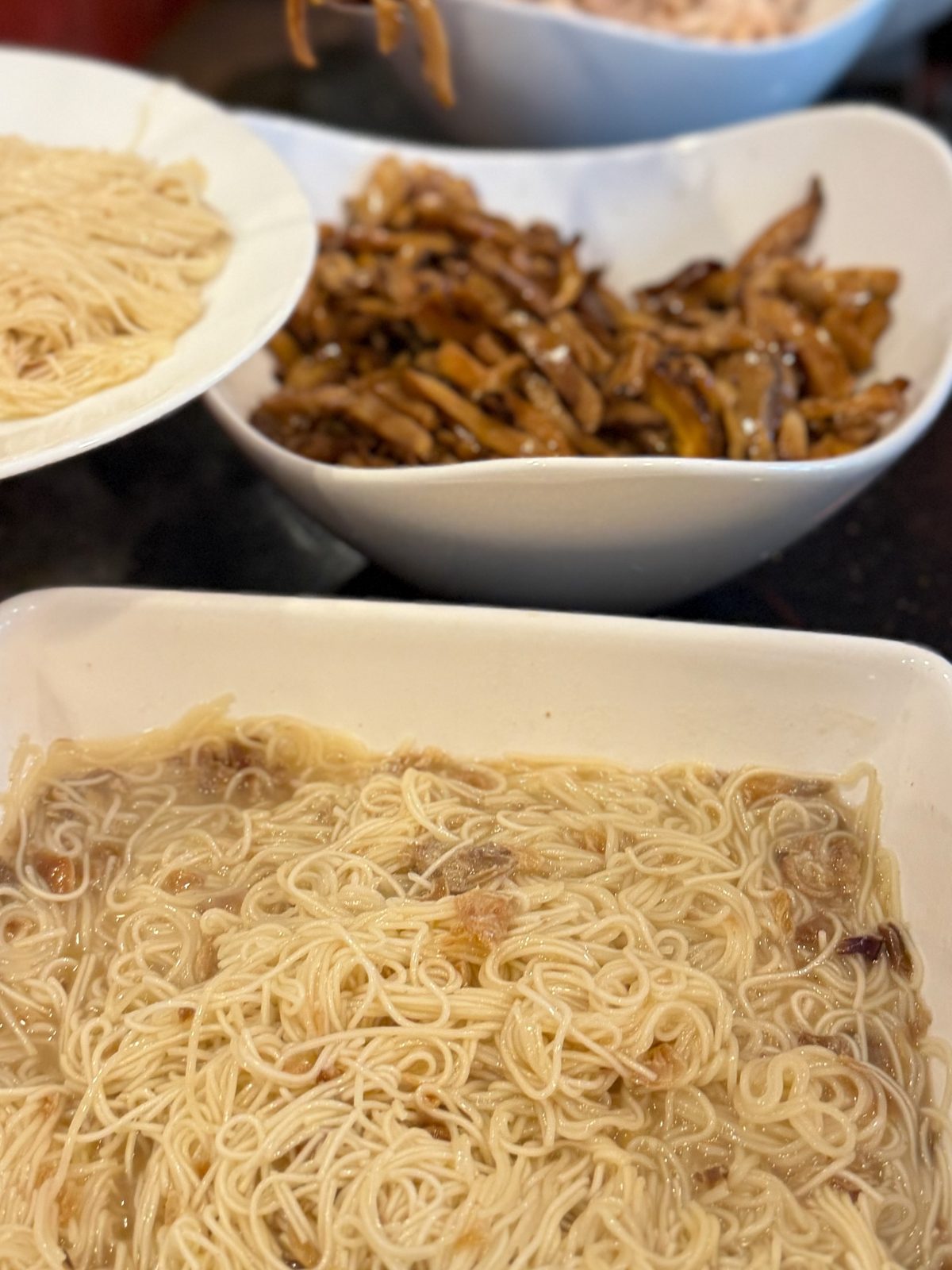
We blanch it quickly first, then stir-fry it with fried shallots so the shallot ends up in the noodle rather than only sitting on top of it, and then a little of the broth goes in — pork neck bones and chicken bones, started one or two days ahead. What comes out isn’t a dry noodle and isn’t a soup. A little wet, not soupy. That sounds like a small target and it really isn’t; it’s the part I’d be most nervous about handing to somebody else.
Almost everybody came in red, which is not a dress code anyone sends around in advance.
In a Chinese Filipino family, the people younger than whoever’s having the birthday wear red, and the celebrant wears whatever they like. It isn’t reserved for the big ones either — you wear red for any birthday of somebody older than you, as a way of paying them respect. Black is the one genuine prohibition — it reads as an ill wish toward the person you’re there for, and as an insult to the host, and I don’t know anyone who’d risk it.
The order people eat in works the same way. My mother first as the birthday celebrant, then down by age and generation. Nobody announces any of it and nobody has ever needed to.
Karen and I make this together, and I should say plainly that it isn’t my dish — I inherited it. As far as I can trace it, it came from my father’s mother, and she passed it to my mother, and at some point my wife and I took it over.
My grandfather and my father were both enthusiastic eaters and neither of them cooked, which I suspect is most of the explanation for how it travelled: it went to whoever was going to make it, and that is how most of these things actually get decided, whatever the customs say. It didn’t begin with my grandmother either. Somebody passed it to her and I don’t know who — hers are simply the earliest hands I can name. There’s a circularity in it I like as well: this week I cooked my father’s mother’s dish for my mother’s eightieth birthday, three generations on from the furthest back I can see.
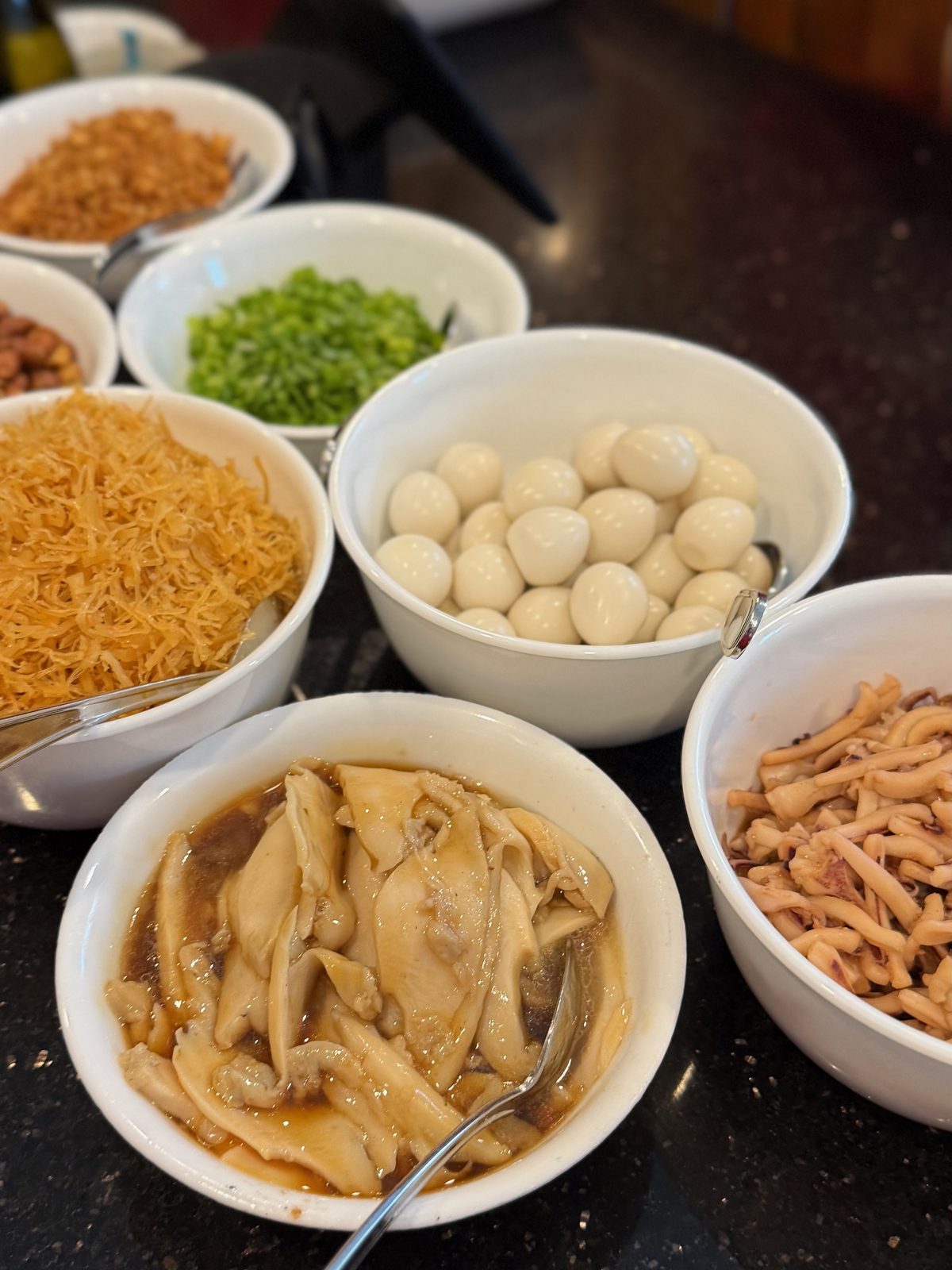
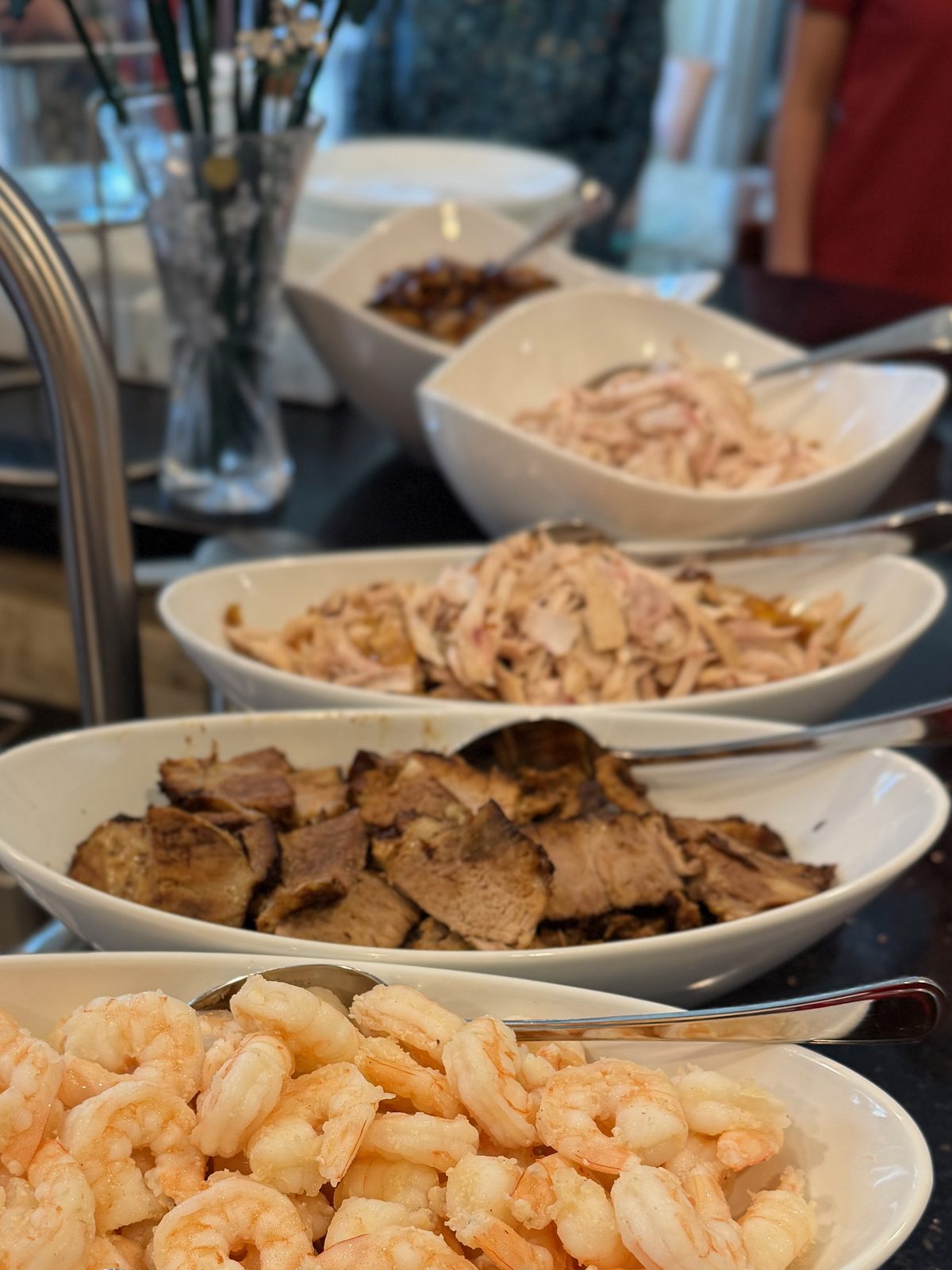
I mention the order because the way we actually serve this looks, at first glance, like the most casual thing in the world. We put out the noodles, and then we put out every topping in its own separate bowl, and you build your own plate — noodles first, everything else after.
Somewhere along the line it became a deconstructed version of itself. I don’t recall how my grandmother served it, or whether my mother changed anything. But thinking about it properly, I suspect it happened on our watch, and I suspect I know why.
My mother is allergic to shellfish. My father loves seafood — really loves it, the more of it the better. Several of my nephews and nieces have their own things they can’t eat. Cook this as one composed platter and you are choosing, every year, which of those people the dish is for. Take it apart and set every component in its own bowl, and you aren’t choosing at all: my father gets his seafood, my mother builds a plate that has none of it, the kids take what they can have, and nobody has to say a word about any of it at the table.
Which means the most distinctive thing about the way we make this dish isn’t a flourish. It’s an accommodation, and one nobody ever announced.
And there’s a further thing I’ve only said out loud recently. The dish is made for my mother’s birthday — that’s whose day it is, that’s who the noodles are wishing long life on. But it’s my father who really looks for it. He’s the foodie of the two of them, particularly when it comes to traditional Chinese food, and he’s the one who waits for this dish to appear. The occasion is hers and the appetite is his, and nobody in the family has ever found that odd enough to remark on.
There’s one more thing in it that I only noticed while writing this down. The dried scallops, the abalone and the cuttlefish are the three components I spend the longest on, and they are exactly the three my mother can’t eat. So those two hours the day before her eightieth birthday went into something that was never going to be hers. What’s hers is the format — that she can build a plate with none of it and still be eating the same dish as everybody else at the table. The labour is for the table. The care is in the arrangement.
We do it that way for a practical reason before a sentimental one. When every component sits in its own bowl, anybody who doesn’t eat something simply doesn’t take it, and nobody has to announce a restriction at the table or be cooked for separately, which I think is about the most graceful way there is to feed a room full of people with different needs. But it does something else too, and this is the part I only worked out by writing it down. A composed platter has a ceiling. Serving everything separately takes the ceiling away entirely, and that’s the only reason our version can carry what it carries. The accommodation came first and the abundance came free with it, which is not the order I’d have guessed.
There are two ways to eat it once you’ve built it, and they land either side of where this family comes from. You can have it in a bowl with chopsticks, which is the Chinese way, and some people at the table do. Or you can have it on a plate with a fork and spoon, which is how Filipinos eat more or less everything.
I take the plate and the spoon, every time. Partly that’s just habit. But mostly it’s that a spoon lets you lift a bit of four or five things at once — some noodle, a little scallop, a piece of chicken, a peanut — and the combinations are the entire point of building your own plate in the first place. Chopsticks make you eat one thing at a time. The spoon is what actually collects the dish.
There were twenty of us that morning, and a great deal left at the end, which is how it is meant to go. Putting out more than enough is rooted deeply in Chinese hospitality, and the abundance is itself the message: it says the host has been generous, that the guests have been cared for, and that nobody is limited to a single plate. You go back for a second and a third if you want one, building it differently each time, and whoever went up last still finds everything there. Not exactly enough. More. I have never heard anybody in my family state that as a rule, but you would know immediately if it had been broken.
Most versions of this are built on chicken, pork, shrimp, mushrooms and green onion, and ours starts in the same place and then keeps going.
The chicken is Soya Chicken, and we buy it rather than make it, which I’ll come back to. What we do with it is the part that matters: we separate it into breast and dark meat and shred both, keeping them apart so people can take whichever they prefer, and the skin gets sliced thin and folded back through the dark meat. There’s Braised Pork Shoulder. There’s Shrimp, cooked with a lot of ginger and a little garlic, and it’s there for the colour and the change of texture as much as for the taste of it. There are White Flower Shiitake Mushrooms, which is a grade rather than a description — thick caps with a pale, cracked bloom across the top, which is where the name comes from. They sit better on a plate than ordinary dried shiitake, and we’d rather they did.
Then there’s the part that makes it a birthday rather than a good dinner. Abalone, out of a large tin, sliced and barely touched by the wok — it’s expensive enough that the whole skill is in not doing anything clever to it. Dried Cuttlefish, soaked back to life and cut into strips, cooked in oil that’s had ginger in it first to take off any edge of fishiness. And the Dried Scallops — soaked overnight, pulled apart into strands, then lightly stir-fried — which is where the two hours went.
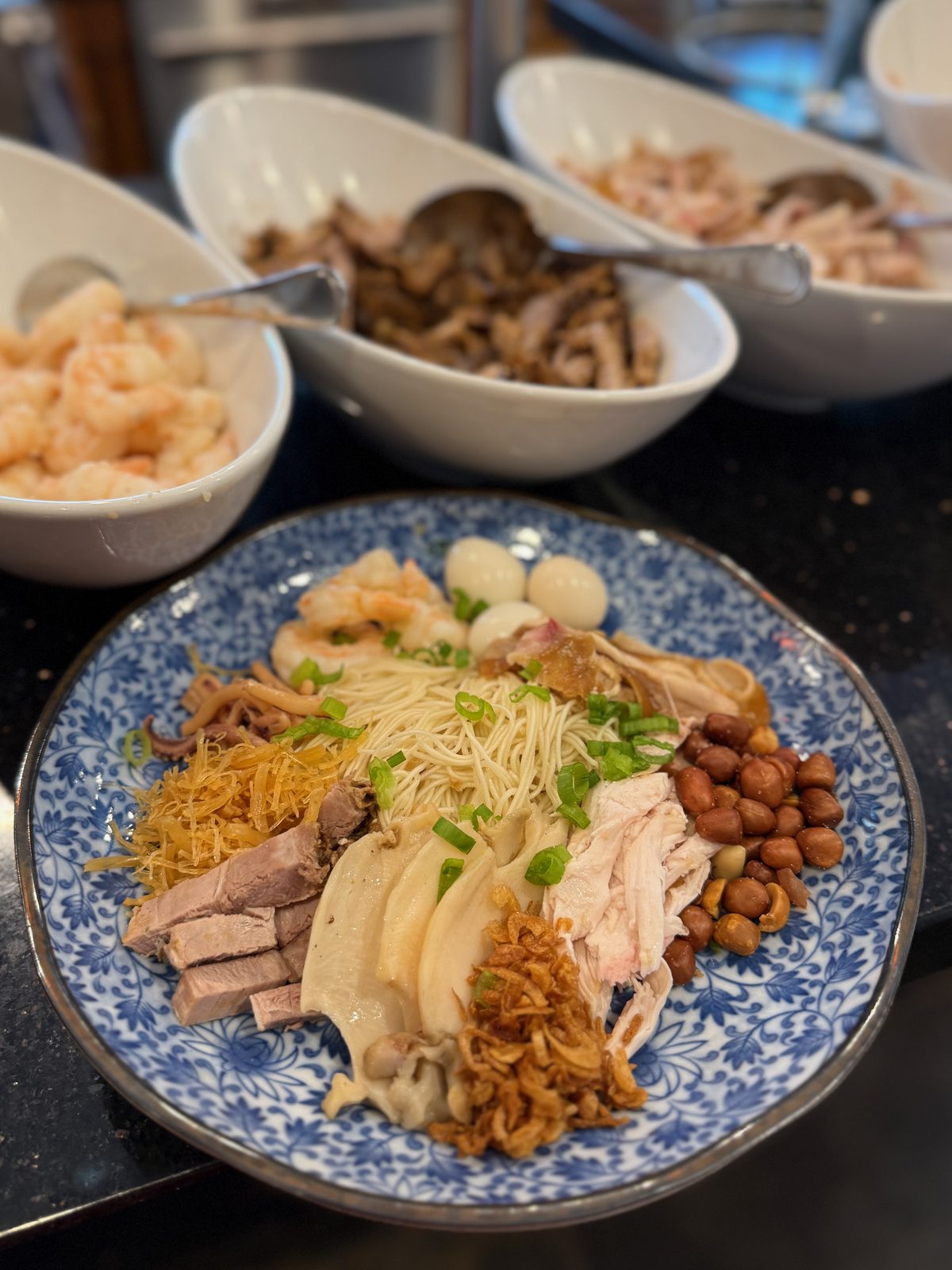
I went looking at how other families make this while I was writing, which I’d never actually done before, and the comparison was more interesting than I expected. Some use fish balls or squid balls. Some use liver, kidney, gizzard. Most load in carrot, cabbage, pechay, snow peas. We use none of that — no organ meats, no fish balls, and almost no vegetables beyond the mushrooms and the onions. What went in instead was dried seafood, which is the shelf a Chinese household tends to open for a banquet. I couldn’t tell you when that happened or who decided it. What I can tell you is that people who grew up with their own version of this dish, and who then eat ours, almost always remark on how many parts there are.
We also use fried shallots where a lot of people use fried garlic, and that one I’ll defend properly. I find fried garlic is too loud for a dish with this many nuanced flavours sitting next to each other. With a dozen separately cooked things on one plate, the aromatics have to get out of their way, and garlic won’t.
Fried salted peanuts with the skin on, which we neither made nor bought — they were a gift from Fortune Terrace, a restaurant near us that we eat at often. Chopped green onions, the green part only.
The older custom uses sliced chicken eggs. We moved to quail eggs because they carry a bit more flavour and because you can serve them whole instead of slicing them, which I like more than I can fully justify.
That old arithmetic doesn’t really survive the way we serve it, though. Traditionally, one egg each and two for the celebrant assumes somebody is doing the counting, and in a build-your-own dish nobody is. Everyone takes as many as they want and no one is keeping score.
What I do, on my own plate, is take three — 三, saⁿ — because it sits close to 生, seng: to live, to be born, to grow. The same wish the noodle is already making, in a smaller package. I don’t know if anyone else at the table does this and nobody has ever remarked on it. Perhaps I like keeping traditions, or perhaps I just like quail eggs that much.
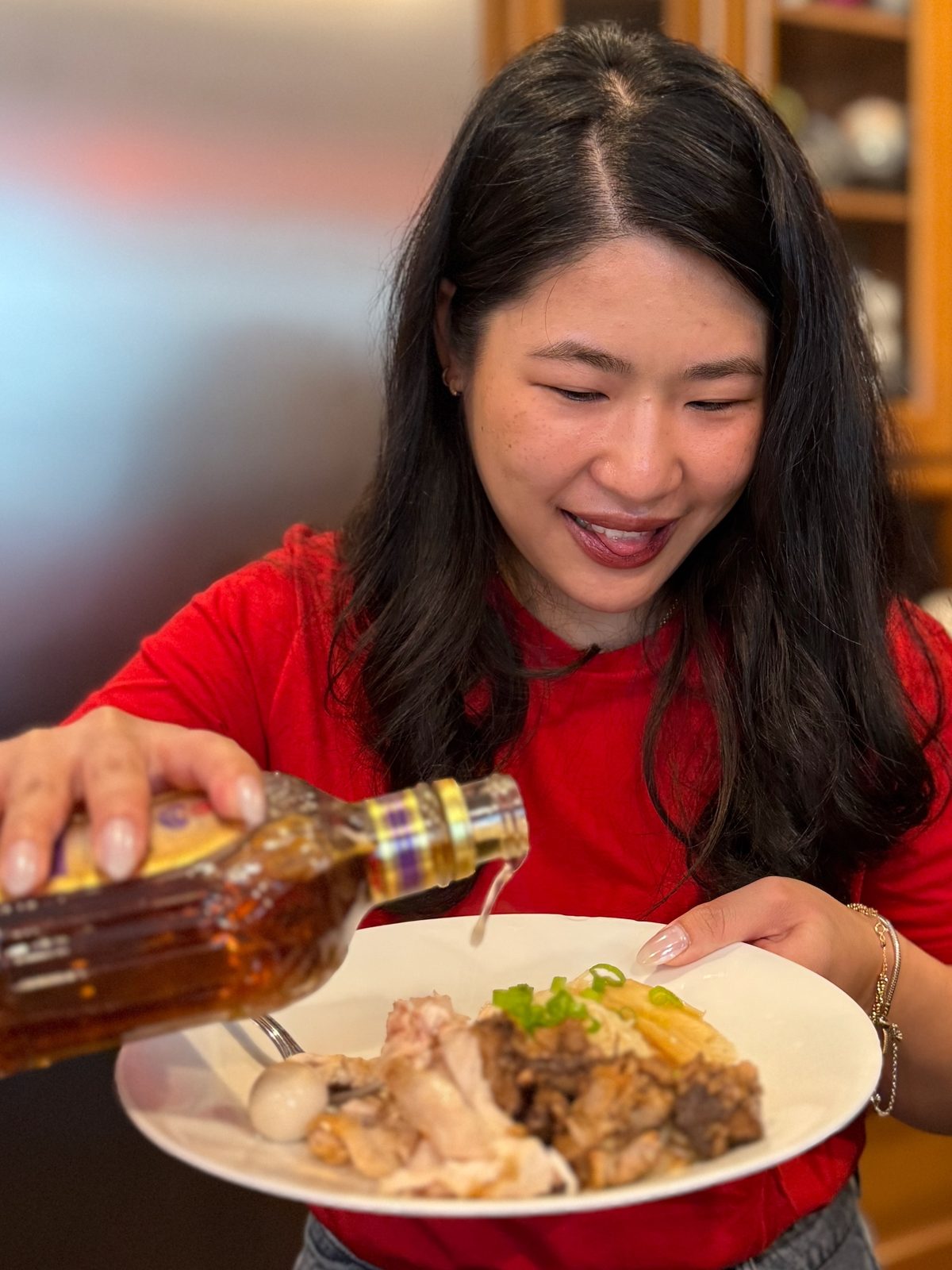
And then there’s the whiskey.
About a tablespoon of it, poured straight over the noodles on your own plate, at the table, by the person about to eat them. Not cooked into anything, not a marinade, not a step in the recipe. Poured at the end.
I’ve never found another family that does this, and I gave up being embarrassed about it some time ago. It surprises people every single time, which I’ll admit is part of the pleasure — my niece Kristen went at her plate with the bottle like she’d been waiting all morning for the chance. It doesn’t need to be anything expensive; whatever happens to be open is fine. It’s just very good, and I don’t have a better defence of it than that.
Where it came from, I can’t tell you with any confidence. My guess is my father’s mother’s side — I know my grand-uncles liked their whiskey — but that’s a guess rather than a story anybody in the family has ever told me. Nobody thought to explain it, the same way nobody thought to explain the noodles.
One last thing, about where the food comes from, because I think it quietly undoes a story people expect to be told.
We buy the Soya Chicken — which is what HK BBQ Master calls it — a few minutes from our house, in the Golden Village — the run of Asian malls through Richmond’s city centre that people here call Metro Vancouver’s new Chinatown, which isn’t an official designation but has been true enough for long enough that nobody argues with it. About half of Richmond identifies as ethnically Chinese.
So the change didn’t cost this dish a component. It supplied one.
There’s a further layer in that which I enjoy more the longer I reflect on it. My family is Hokkien. Soya Chicken and the hanging-meat counter it comes off are Cantonese, a different tradition entirely. So a Hokkien birthday dish, carried out of Fujian and through Manila and across the Pacific, now contains something bought from a Cantonese shop in a Canadian suburb, and nobody at the table has ever experienced that as a seam. It didn’t only survive the journey. It picked things up on the way.
I’ve gone looking for the opposite too — for what the move might have cost us — and I can’t find much. No component we had to give up, no step we stopped doing because the ingredients weren’t here. Which I didn’t expect, and which says more about Richmond than it does about us.
What struck me most, once I’d finished comparing our version against everybody else’s, was how little any two of them agreed on. Different toppings, different vegetables, different aromatics, different eggs entirely. There’s no right or wrong way to make this dish, and I’d been quietly assuming for years that there was one and that ours was simply a version of it.
Apart from the noodles, they’re the one part nobody improvises on and the one part that mustn’t be broken. Which means the tradition was never really the recipe. The tradition is the noodle, and everything around it is a family’s handwriting.
My mother is eighty. We wore red and we ate long noodles that nobody cut. Afterwards Karen and I brought out a birthday cake we’d made, a carrot cake we knew she’d love, and nobody at that table thought the two cakes were in competition.
Happy 80th Birthday, Mom!



The Newsletter
New pieces, plus what’s on my table next. Every few weeks.

An error has occurred somewhere and it is not possible to submit the form. Please try again later or contact us.


