


Tai Tung, Seattle: Ninety-One Years in Chinatown

Jacob Ung
August 31, 2026

11 min read
Ninety-one years in, the Pacific Northwest's oldest Chinese restaurant still sets the table for diners who've never picked up chopsticks.
Ninety-one years is a long time for a restaurant to stay in one family’s hands, in one neighbourhood, largely unbothered by whatever’s trending in Chinese food that decade. Tai Tung has managed it since 1935, tucked into the ground floor of the Rex Hotel building in Seattle’s Chinatown-International District, and it wears the age well — not as a museum piece, but as somewhere that’s simply never had a reason to stop being itself.
I chose to dine here on purpose. We were visiting Seattle for the Mamamoo concert in Kent, but the restaurant itself wasn’t an afterthought fitted around the trip — I specifically wanted to spend a meal properly inside Chinese-American cuisine at a restaurant old enough to have actually lived through the decades that shaped it, rather than one performing that history secondhand. I’d understood Tai Tung to be one of the oldest Chinese restaurants still operating in the country, which made it feel like exactly the right stop.
Worth being precise about that, since it’s the kind of claim a piece like this should get right rather than repeat uncritically. A handful of restaurants elsewhere in the country are technically older and still open — Cozy Inn in Janesville, Wisconsin, dating to 1922, is currently considered the nation’s longest-running; a couple of others in New York and San Francisco trace back to 1920, with looser claims to unbroken continuity. What belongs to Tai Tung cleanly, without any asterisk, is the Pacific Northwest: it’s the region’s oldest continuously operating Chinese restaurant, in the same room, run by the same family, for ninety-one years. And there’s a strange bit of timing worth noting here — the restaurant that held the actual national record for over a century, the Pekin Noodle Parlor in Butte, Montana, founded in 1911, closed for good this past April, a few months before I sat down at Tai Tung. An era changing quietly in Montana while I was, a few states over, eating a meal built entirely out of that same era’s cooking.

The building tells you most of what you need to know before you’ve ordered anything. The neon sign out front still reads “Tai Tung Chop Suey” over its Chinese characters, the kind of signage nobody manufactures anymore because nobody needs to — it was built once and it’s simply never worn out. Inside, the front counter is the first real surprise: not a bar in the drinking sense, just an old-style counter with red stools lined up along it, the kind of seat I always ask for when a restaurant still has one and almost never gets the chance to. The kitchen itself is tucked away on the other side of the room, out of view from here, so the appeal of a stool here isn’t watching the cooking — it’s the wall right behind it. That wall is layered with decades of accumulated memorabilia in the specific way only a family business gets to accumulate it — a signed Seattle Met magazine cover, Seattle SuperSonics and Seahawks memorabilia, handwritten daily specials taped up in Chinese, and a wall of currency pinned edge to edge, bills from what looked like a dozen different countries, plus at least one bill that was never real currency at all, more novelty than money. None of it reads as decor somebody bought. It reads as a family’s actual life, pinned to a wall, over a very long time. My favourite detail, small as it is: old oscillating electric fans, mounted up on the walls, still doing their job. Nobody keeps a fan like that running for decades because it’s efficient — you keep it because it’s always been there, and it genuinely puts you back a few decades the moment you notice it.

We talked with Linda Chan — Harry’s wife, and every bit as much a part of keeping this place running as he is — who came out of the kitchen just as we were leaving. She was, genuinely, one of the sweetest people we talked to on the whole trip, the kind of warmth that doesn’t read as performed hospitality so much as just who she is. Harry and Linda run it together, the third generation at the helm — his maternal grandfather founded the restaurant, his father ran it next, and Harry’s run it since 1979. And it doesn’t stop with them: two more generations are already active in the business. Their children work more on the logistics and back-end side of things, and one of their grandsons was right there working the floor with us that afternoon — one of the servers covering the room, the way servers do at a restaurant this size, rather than assigned to any single table. That’s a different, and better, kind of fact than just “it’s old.” A lot of restaurants this age are one reluctant heir, or one bad year, away from becoming a memory instead of a business. Tai Tung, with a fourth and fifth generation both already active — one of them literally on the floor the afternoon we ate there — looks like it has a genuinely good shot at being around for a long while yet, not just a survivor of the last ninety-one years, but a real bet on the next ninety-one. Call it what it is: a five-generation restaurant, still adding names to that count. I hope I’ll be around to see it celebrate its hundredth.
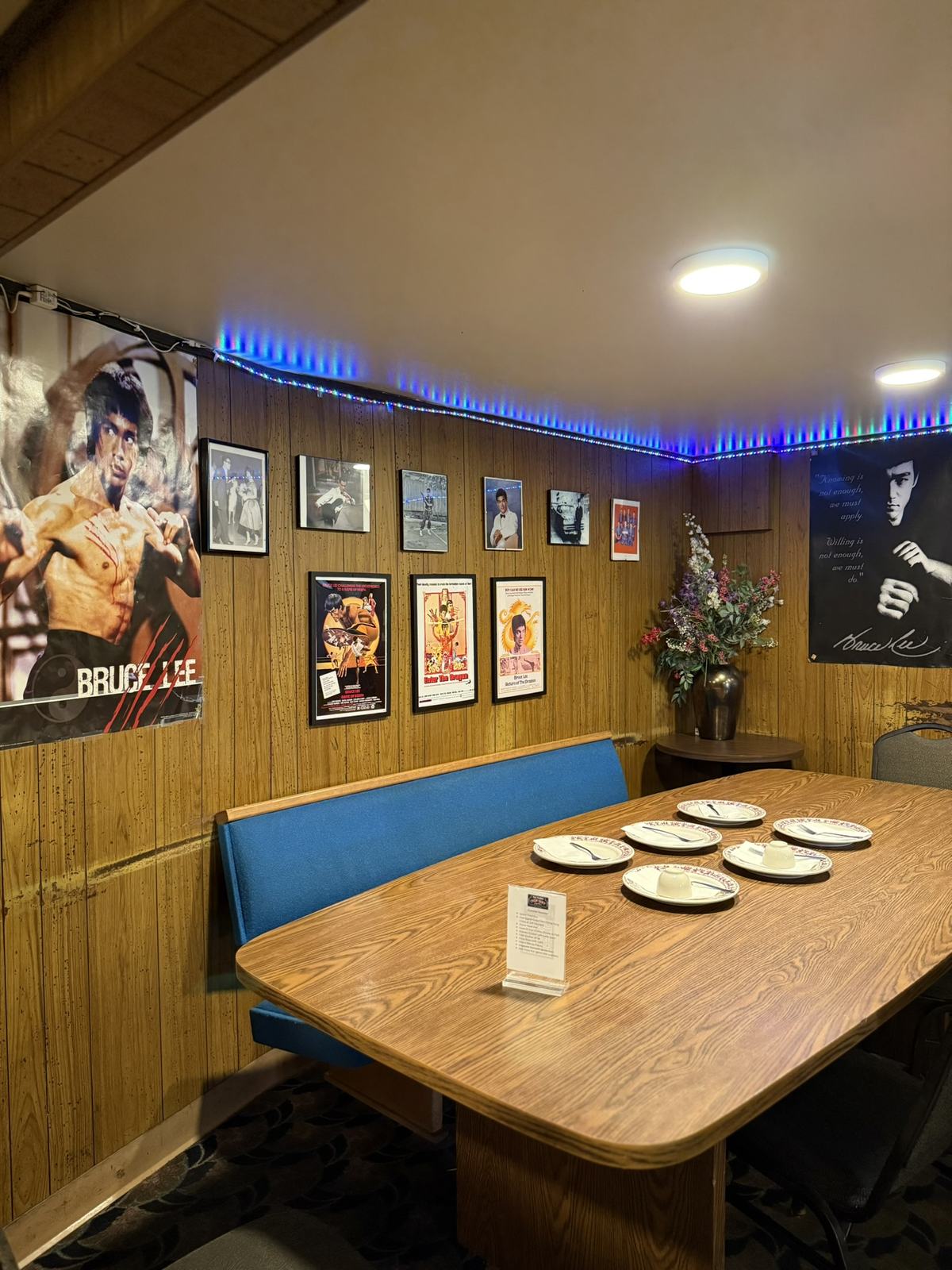
The room carries other history too, and it’s not exactly hidden — a wood-panelled corner near the back is given over to a small memorial to Bruce Lee, posters and photos filling the wall, impossible to miss even on a first visit. He lived in Seattle from 1959 while at the University of Washington and was, by Harry Chan’s own account, a regular here — he liked a corner booth with his back to the wall, and staff knew to bring him cabbage soup and then oyster sauce beef with rice without being asked. Anthony Bourdain — one of my own heroes, and someone I’ve actually had the chance to meet in person — ate here too, in 2017, though not on camera: no crew, no segment, just Bourdain quietly having a meal, low-key enough that Harry Chan didn’t even clock who he was until another customer asked for a photo. The restaurant’s list of notable diners over the decades reportedly runs to Bill Gates and Olympic speed skater Apollo Ohno as well. It’s a nice detail to know going in, but it’s genuinely not the reason to go — the reason to go is what I noticed at our own table, and every table around us.
There’s real history behind who ends up in this room, and it helps to take it in order. When Grandpa Quan — Harry’s maternal grandfather — opened Tai Tung in 1935, the audience he was cooking for was Chinatown itself: the Chinese immigrant community who lived and worked around King Street, wanting food that tasted like home rather than food that explained itself to outsiders. Harry Chan once described that first menu to a local reporter this way: pig feet, pig tails, ox tails, salmon head, peashoot vegetables steamed with pork, preserved pimento — real, unfiltered comfort food, made for people who already knew exactly what it was supposed to taste like. It was the second generation, Harry’s father, who widened the menu as the neighbourhood itself started to widen — as more non-Chinese diners found their way into Chinatown, first as visitors, then as regulars. Dishes built to travel well beyond that original audience, like chop suey and egg foo young, already had a foothold on the menu from close to the beginning, but it was this second-generation era where they became the main way most people outside the neighbourhood came to know Tai Tung at all — and, more broadly, more or less where Chinese-American cuisine as a category comes from. None of the earlier menu has fully disappeared, either; it’s just moved. Those handwritten specials taped up in Chinese behind the counter, the ones I couldn’t read myself, are almost certainly where those older dishes still live, for the customers who know to ask. Harry doesn’t sound entirely certain that older half will last, either — in that same interview, he said of it: “It’s all going to, at some point, disappear.” One menu in English, for the version of the restaurant most walk-in diners expect; one menu in Chinese, still quietly serving the people it was actually built for first.
The food came fast — our first dish was on the table in under three minutes, which is rare for any restaurant to pull off with something actually cooked fresh to order. I said as much to our server. Later, I mentioned to Linda directly that the heat of their wok must be something else — apart from how fast it came out, everything had real wok hei, that specific charred, smoky depth that only comes from cooking hot and fast. The tables around us weren’t quite what I expected walking into a ninety-one-year-old Chinese restaurant in the middle of Chinatown. Most of the other diners weren’t Chinese at all, spanning a genuine range of ages, seated in groups both large and small, and every table I could make out sounded happy — specifically about the food, not just the room or the occasion. Nobody there seemed to be chasing nostalgia for a neighbourhood they’d grown up in. They were there because the food is really good, full stop, which is exactly what the second generation set out to prove, and a different and in some ways harder thing for a restaurant to sustain for nine decades than simply being old.
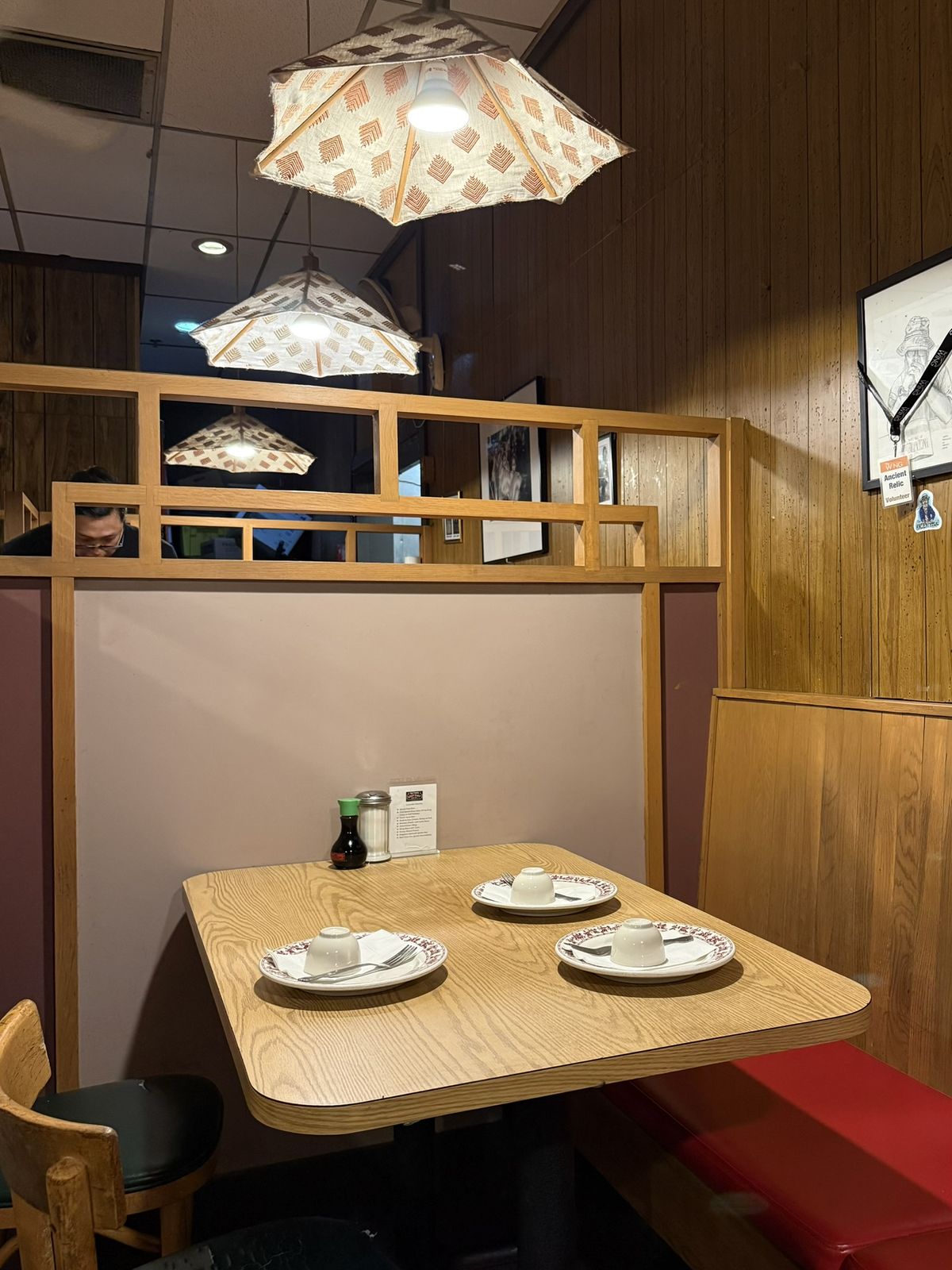
The table setting made the same point without saying a word. Sit down at most Chinese restaurants today, in a Chinatown or otherwise, and you’ll typically get a small plate, a rice bowl, and chopsticks — a setting built around how the food is actually meant to be eaten. At Tai Tung, we were given a Western-sized dinner plate and a fork, napkin included — but the plate itself was clearly aged, worn from real use, with a fading maroon Chinese-style border pattern running around its edge. It wasn’t only the plates in front of us, either — the serving plates our dishes arrived on carried that same aged character, the kind of wear that only comes from decades of actual work, not a display piece. That’s not an oversight, and I don’t think it’s really about serving the food “wrong” either — it reads as the same deliberate, decades-old choice that widened this menu for outside diners in the first place, still sitting on the table exactly as it was set for them then. Decades later, judging by the room around us that afternoon, it still works.
The food itself backed that up. We also, admittedly, ordered more than two people reasonably should have — but I wanted to actually taste my way through classic Chinese-American cooking, not just sample a plate of it, and there was too much on the menu I wanted a real bite of to order conservatively.
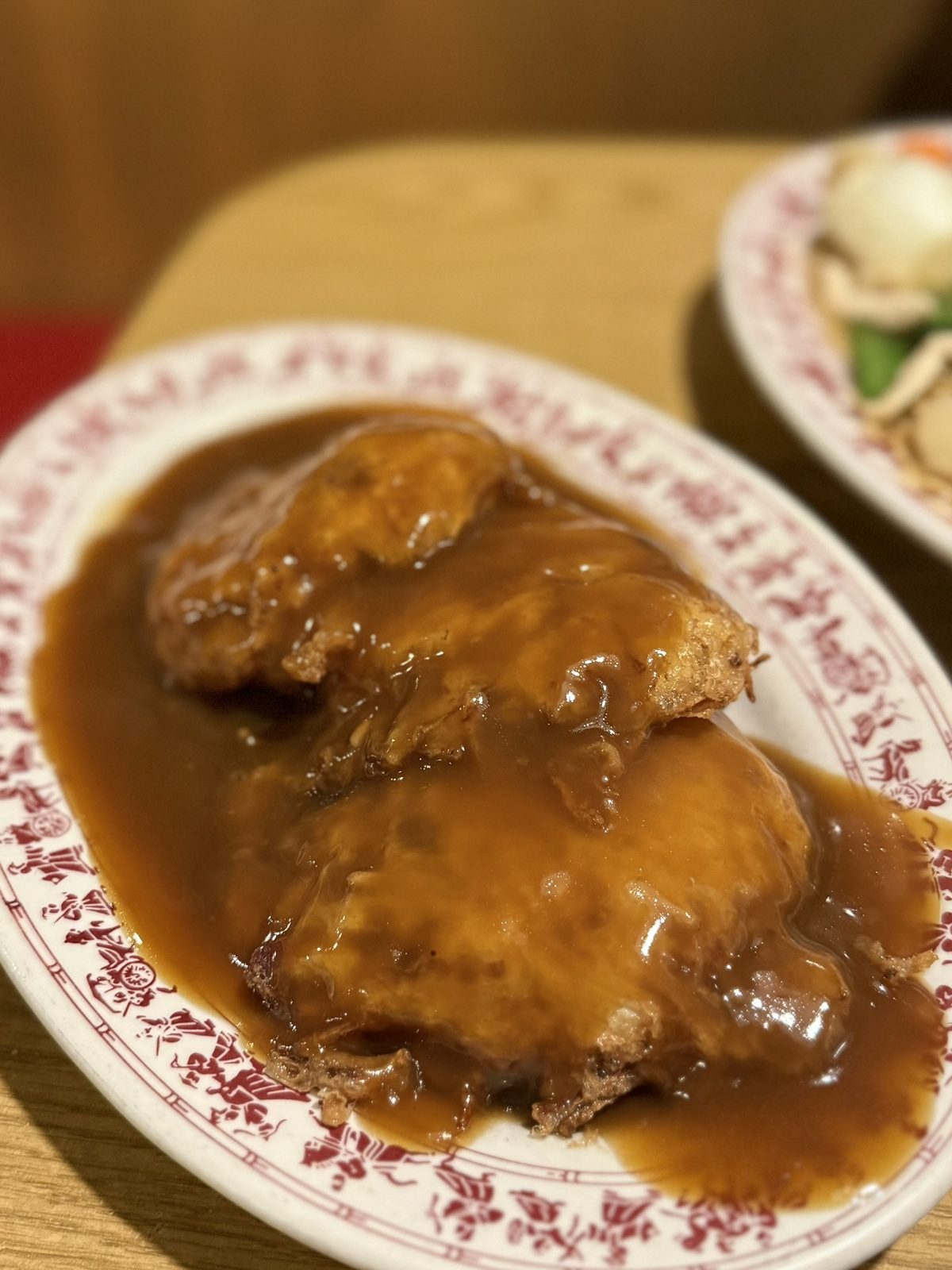
Pork Egg Foo Young arrived first, blanketed in a dark, glossy gravy — the kind of dish that’s less about subtlety than comfort, which felt exactly right for a restaurant built to be comfortable rather than impressive.

Chicken Chop Suey came next — chicken stir-fried with cauliflower, snow peas, bok choy, bean sprouts, and celery in a light, thin sauce, ordered as the exterior sign instructed me to. The vegetables were the real tell of a kitchen that’s been doing this for decades: cooked through but still genuinely crisp, nothing soggy, nothing overcooked past the point of tasting like itself. Fresh ingredients, handled with a light touch — it sounds like a low bar until you remember how often it isn’t cleared.

The House Special Chow Mein leaned Hong Kong-style too, and read as the newest thing on the table in menu terms — a shrimp-and-chicken medley with snow peas, bok choy, and mushroom in a light sauce, also featuring slices of barbecue pork, carrots, and water chestnuts, over a bed of crispy pan-fried noodles. It’s a genuinely nice structural trick: the noodles underneath stay crisp exactly where the sauce hasn’t reached them yet, so the dish gives you two different textures depending on which forkful you’re on.

And then Almond Chicken, apparently one of the restaurant’s actual signature dishes rather than just a menu regular — battered, fried chicken strips topped with crushed almonds, with a small dish of dark sauce on the side for dipping, similar to the gravy the Pork Egg Foo Young had come in. It didn’t really need it. The chicken itself was the whole point: a very light batter, genuinely crisp, and the taste underneath it good enough that dipping felt more like a courtesy to the sauce than something the dish actually required. It’s a simple dish done with real confidence, the kind of thing a kitchen only gets this comfortable with after making it a few thousand times.
We finished with fortune cookies, the way you’re supposed to — and it turns out that’s its own small footnote in this same story. Fortune cookies aren’t Chinese in origin at all; they trace back to Japanese confectioners, and the version most familiar today was popularized by Japanese-American bakeries in early-1900s San Francisco, before Japanese incarceration during the Second World War left Chinese American manufacturers to take over production and, with it, the association most people now assume is original. In a room that was, built in 1935, doing exactly what it was apparently built to do — put a fork in a stranger’s hand, however unfamiliar the food might be to them, and make them feel entirely at ease ordering it — it felt like a fitting way to end: one more thing at the table that isn’t quite what it appears to be at first glance.

I keep coming back to a version of the same thought whenever I write about restaurants like this one — the ones that never rebranded, never chased a trend, never needed a design refresh to stay relevant. Tai Tung isn’t interesting because it’s old. It’s interesting because staying exactly what it always was — the fork, the dinner plate, a room genuinely full of people who don’t share the cuisine’s own heritage but keep coming back anyway — turned out, ninety-one years later, to still be the thing that works.
One last thing, and I only came to it after the fact: the name itself. 大同 — tai tung in Cantonese — is usually rendered as “great harmony,” though the two characters read more plainly as “big together”: a gathering place, everyone at the same table. Ninety-one years on, in a dining room where hardly anyone shared a background with anyone else, it turns out the restaurant has been quietly answering to its own name the whole time.
Order this: the Pork Egg Foo Young and Chicken Chop Suey if you want the restaurant’s Chinese-American foundational dishes; the Almond Chicken if you want its actual signature. If you’re dining alone, take a seat at the counter — that decades-deep wall behind it is worth the company. Next time, I’m ordering the two ghosts at the table with me: Bruce Lee’s usual — cabbage soup, then oyster sauce beef with rice — and what Anthony Bourdain got the one time he quietly ate here, no cameras — roasted duck, mapo tofu, beef with garlic, sweet and sour pineapple chicken, and kung pao chicken.



The Newsletter
New pieces, plus what’s on my table next. Every few weeks.

An error has occurred somewhere and it is not possible to submit the form. Please try again later or contact us.


