


Penny Crown, Calgary: An English Room and a French Kitchen

Jacob Ung
September 8, 2026

7 min read
The room reads as an English pub and the menu is French, which turns out not to be a contradiction but the definition of a New York tavern.
Editor's note, 21 September 2026: this piece describes a dinner on 8 September. On 17 September, Penny Crown was named one of thirty finalists for Air Canada's Best New Restaurants 2026. The winners are announced on 16 November.
Penny Crown calls itself a New York–style tavern. I spent an evening there in September quietly deciding it was nothing of the sort: the room felt like an old British pub, and the menu read French. Both readings were correct. Neither was the objection I took it for.
The form has a template, and it is Minetta Tavern in Greenwich Village: a room that opened in 1937, relaunched in 2009 to serve French bistro food out of a tavern that had been sitting there for seventy-odd years. Look at what it puts on the table — Roasted Bone Marrow, Steak Frites, Steak Tartare, and a burger built from a selection of dry-aged cuts it has never disclosed. Now look at Penny Crown's menu: Roasted Bone Marrow, Steak Frites, Beef Tartare, and a burger whose blend the chef has spent years arriving at and does not publish. The warmth is English, the cooking is French, and the burger is the American part.
I had never been to Marda Loop. That is a small admission with a larger one inside it: I was last in Calgary more than a decade ago, and if you had asked me then where to eat, food would not have made my list of what I remembered about the city. The neighbourhood itself is long settled. The strip along 34 Avenue is not — house after house converted into something commercial, several of them restaurants. Parking took some finding, which is its own kind of endorsement: a street with that many rooms on it has no curb to spare. If you know the area you will know where to leave the car. I didn't.
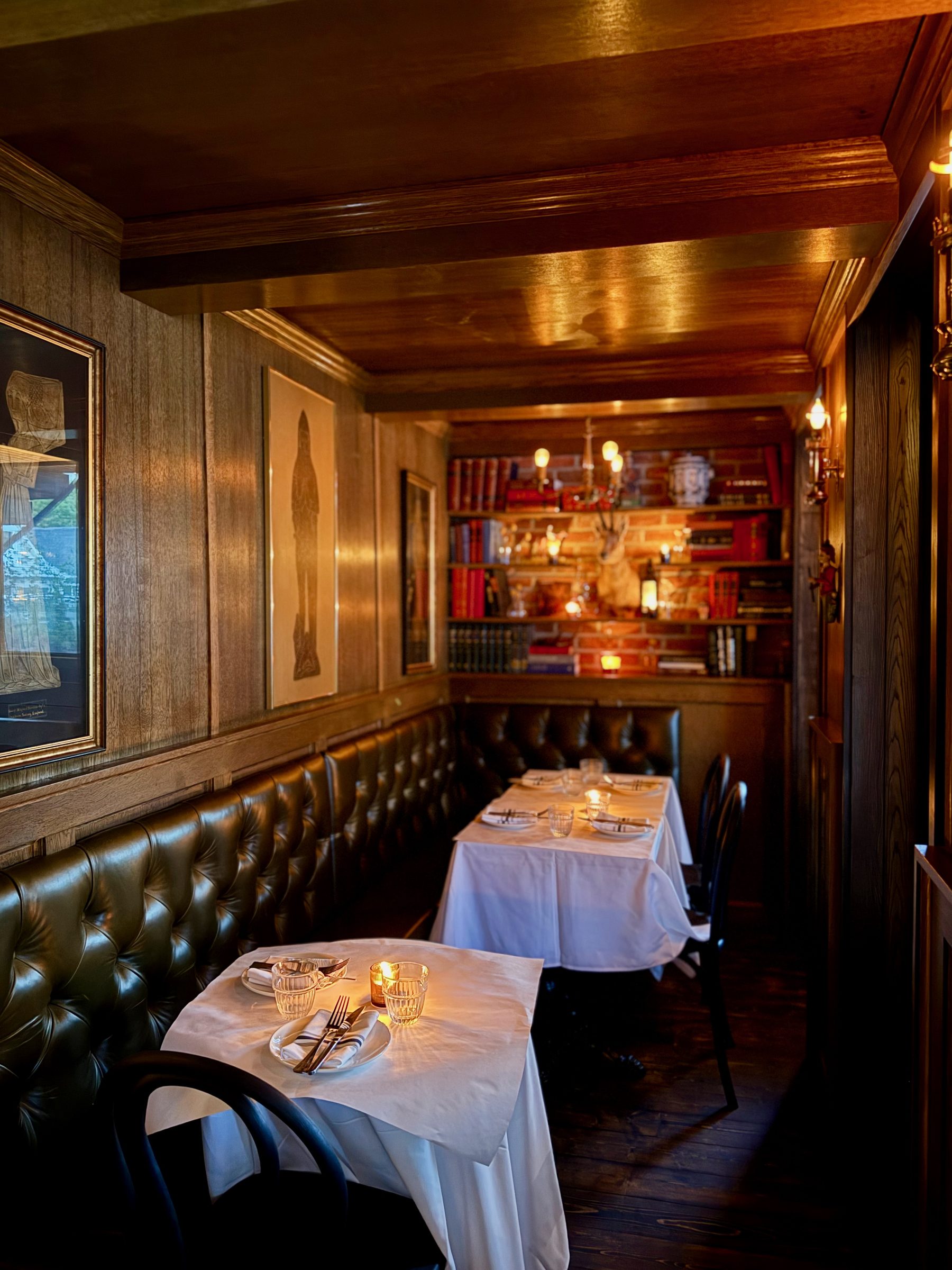
Inside, the first thing I felt was nostalgia, which is a strange thing to feel in a room that opened last November. Dark panelling, buttoned green leather along the banquette, old photographs crowding the walls, a brick alcove at the far end stacked with red-spined books under a small chandelier. Pressed tin overhead, a curved bar, and real tea lights flickering on white cloth — not the electric imitations so many rooms have gone over to. The owner has since described the New York taverns the team went to look at as buildings that seemed to have stood for hundreds of years, with the lights low and the music right. He was not describing a building. He was describing a feeling, and the feeling has an English accent because that is where the American tavern came from.
We had a seven o'clock table and sat down just before. Three dishes arrived together about twenty minutes later, and they had been chosen three different ways — one by me, one by my wife, and one on our server's recommendation, which turned out to be the one that mattered.
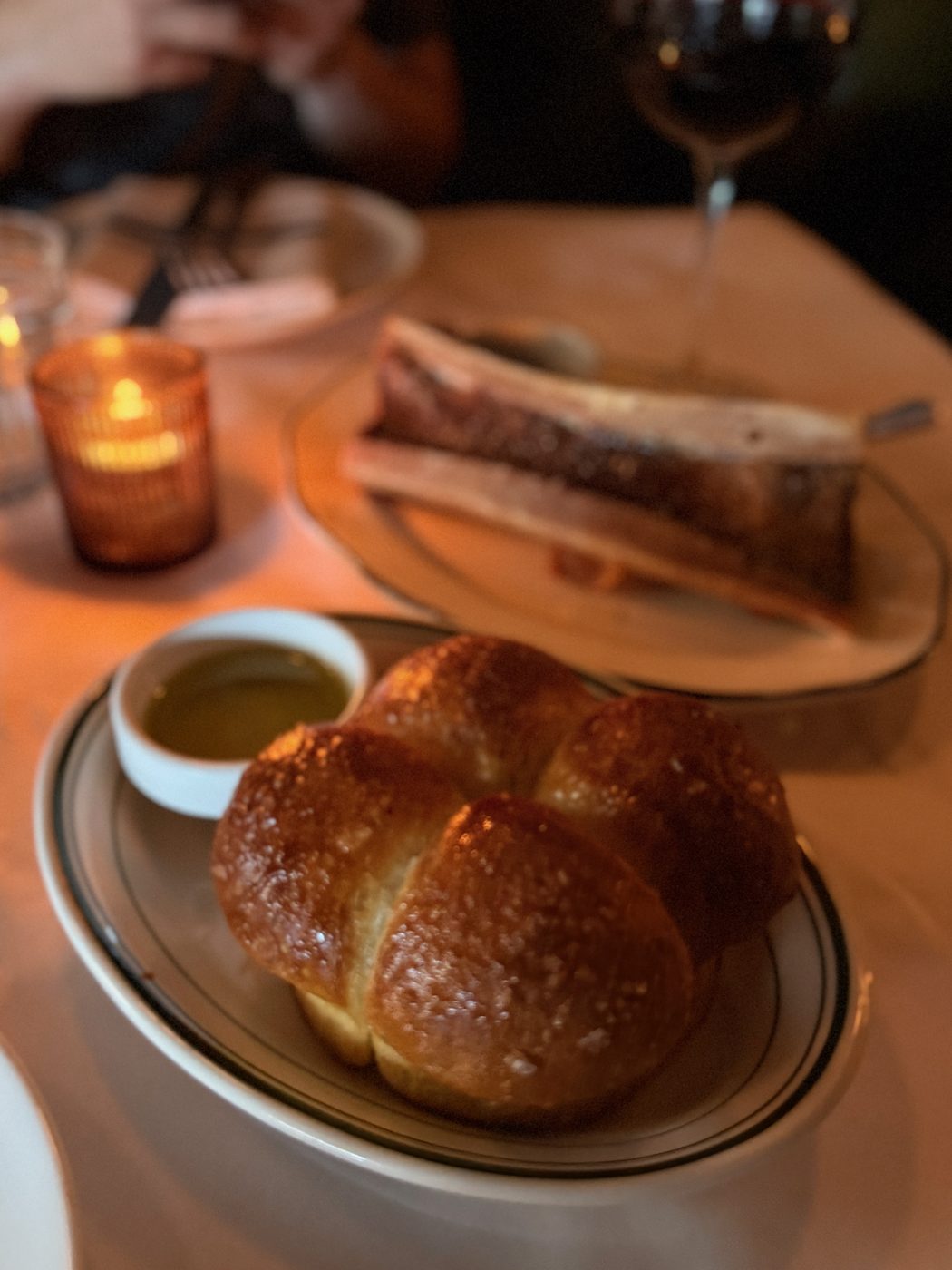
The Potato Focaccia Roll arrives salted on top, with a ramekin of olive oil beside it. The flavour is focaccia. The texture is not — it is a potato roll, light and fluffy in a way focaccia never is, and the two ideas sit together better than they have any right to. We hadn't ordered bread. Our server pushed for it while she was taking the order, and I will come back to why she was right.
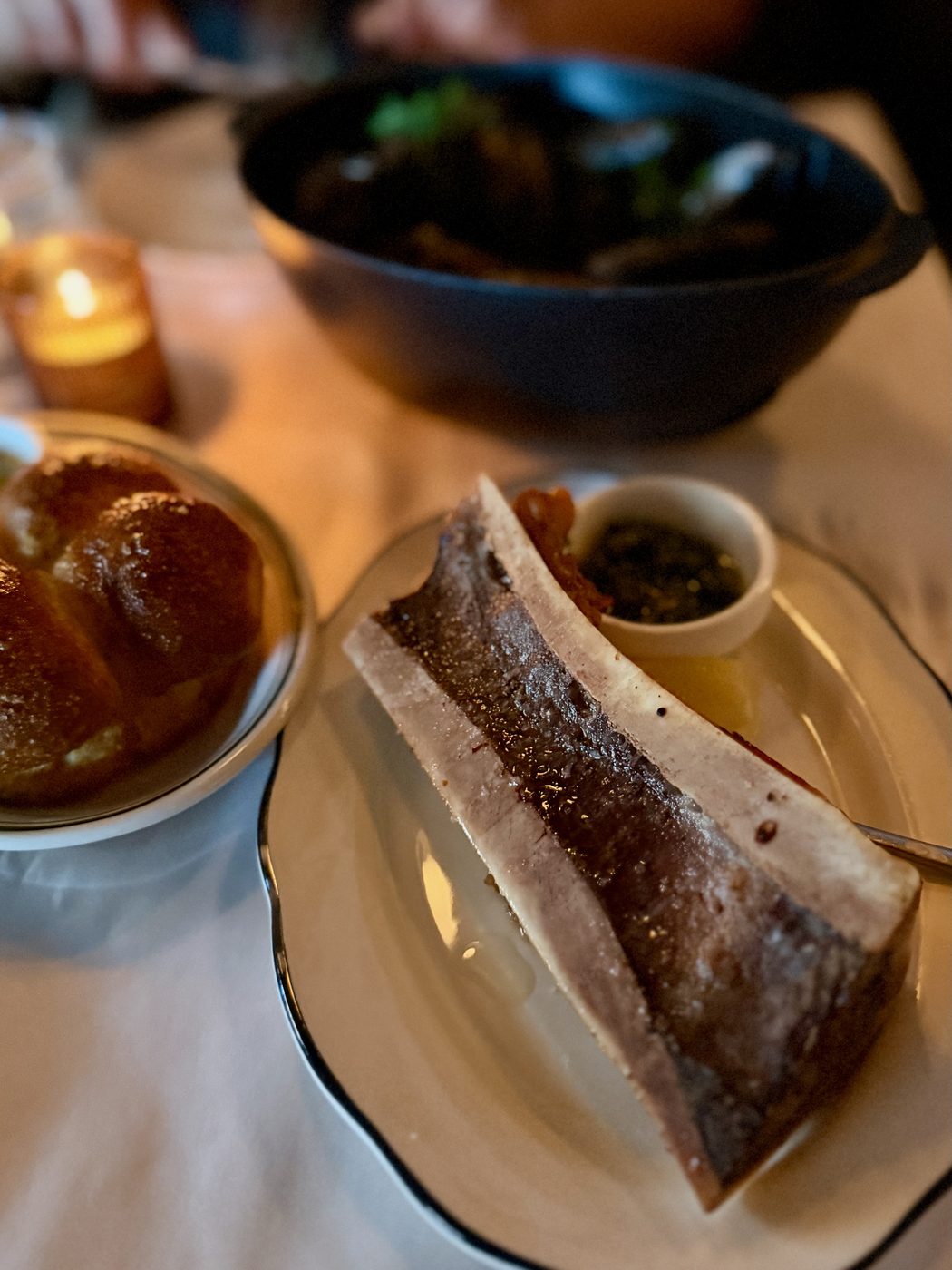
Bone marrow is always rich and always a little decadent. Plated, it tends to be the plainest-looking thing on a table. Some kitchens can't leave that alone — they bury the bone under a haystack of dressed greens so it arrives looking like a salad that lost an argument. This one came as a single split bone, roasted, salted, glossy, with a spoon and a ramekin of salsa verde on the side. This is the way I like it. I also do not think you should order it without the bread, which is what our server had understood about my order before I did.
The menu lists anchovy, and I never saw one. My assumption at the table was that it had been used as a substitute for salt — melted into the bone before roasting, doing its work invisibly, which is a clever way to use it. Writing this up, I have realized my assumption may have been wrong in a way I caused myself. Classic Italian salsa verde is built on anchovy, and I am a purist about bone marrow and left the ramekin almost untouched all evening.

The Mussels Cocotte came in a small black cast-iron pot with dill on top, in sherry, capers, brown butter and lemon. Karen chose this one — she loves mussels, and has a better record than I do at ordering them. These were unusually plump and genuinely large; our server said they were from Prince Edward Island, which would fit, since the rope-grown mussels from there are known for thin shells and a lot of meat inside them. The broth is one reason the bread kept disappearing. The other was the marrow.
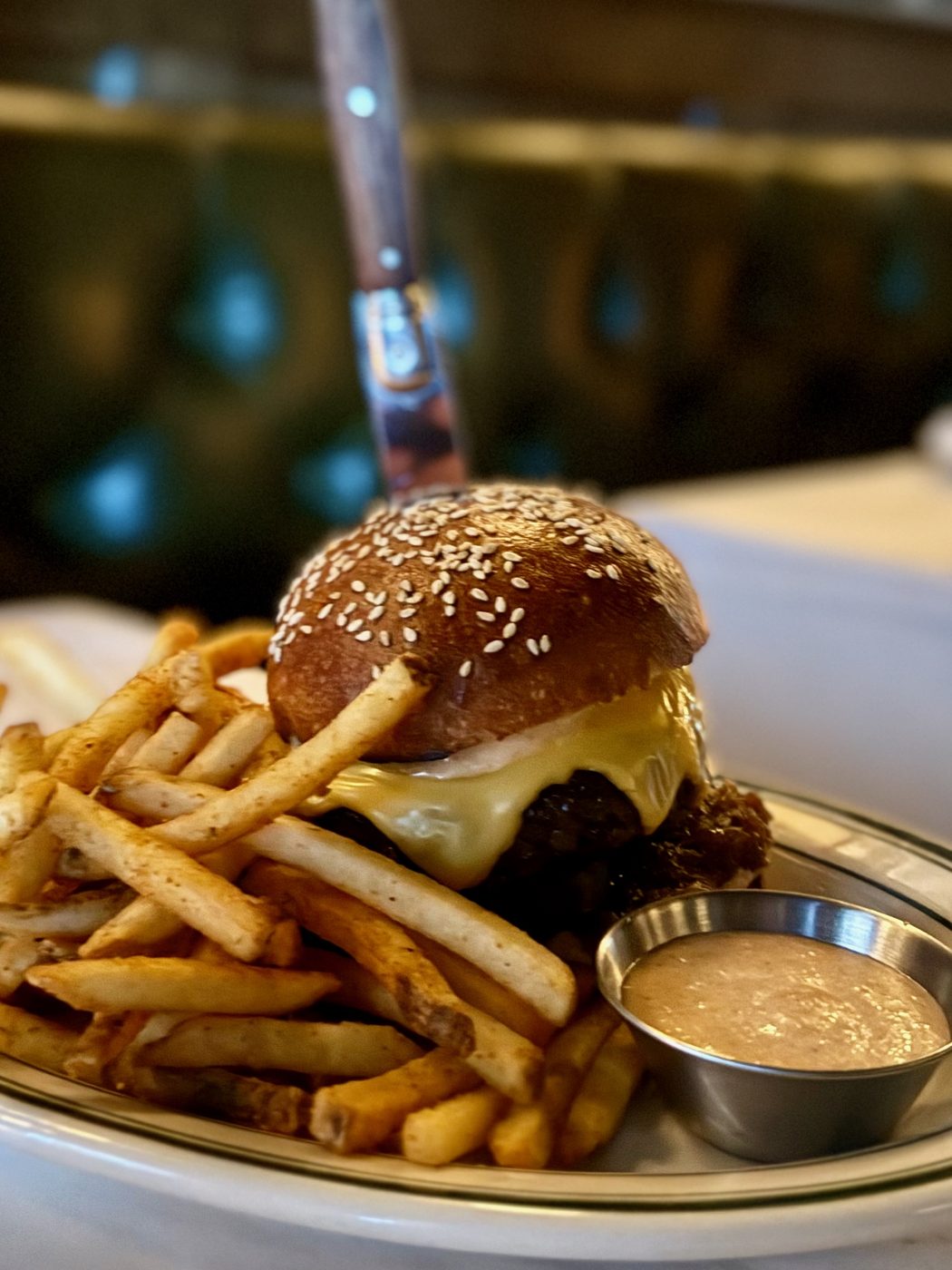
There are two honest ways to make a burger. One is thin and flat and cooked hard, so the edges go lacy and crisp — the smash burger, and I thoroughly enjoy it. The other is thick and rich and juicy and asks you to eat it with both hands and some humility. The Chef's Burger is emphatically the second kind, and it is the dish the restaurant is known for. The beef is a wagyu-cross raised by a Sturgeon County dairy farm north of Edmonton. The cheese, which I could not place at the table, turns out to be a house-made mock American — comté, gruyère and Quebec cheese curds melted into something that behaves like a processed slice and tastes like none of them alone. Caramelized onions, a house remoulade, and cooked medium, which is how I prefer it.
The part I keep thinking about is the duck fat, which does the same job twice. It replaces the oil in the bun, and it replaces the oil on the grill where the patty cooks. You taste it before a single topping registers — a silkiness through the meat, and a savoury depth beef does not give you on its own. What I wanted to know, and could not find out, is the blend: which cuts of beef, in what proportion. It is published nowhere. I took that personally for about a week before realizing it is not secrecy so much as what a New York tavern does — the Black Label burger at Minetta has kept its blend to itself since 2009. The blend is the part you are simply not told.

The Calabrian Fried Chicken was meant as a contrast and turned out to be the better piece of cooking. My wife has a recent obsession with hot honey and ordered it partly on that basis. I had half a burger and a very rich bone marrow behind me by then, and had decided one piece would do me. While vaguely calculating the calories I was ingesting, my mind was thinking of salad. My palate was not. It is brighter than the burger — pickled green tomatoes, sliced jalapeños, chili aioli — and the sweetness and heat land on top of a crust that stays crisp. That last part is the real achievement. Fried chicken usually surrenders at the table: steam pushes out from the meat, oil stays trapped in the batter, and within a few minutes the crust has gone soft and slightly greasy. This one did not, and it was wearing hot honey while not doing it, which is the hardest version of the test. A wet sauce on a crust is normally how you lose the crust.
Which is the argument for two people and one of each. Split the burger, share the chicken, and you will have eaten very well and slightly less than you ordered.
I took one glass of red from the several they were pouring, and I chose it against my own habit. With a burger this rich and a bone marrow richer still I would normally reach for a Syrah, and I wanted something else. The 2021 Bhilar comes from Elvillar, up in Rioja Alavesa, farmed biodynamically — Tempranillo for the structure and the dark fruit, a little Garnacha for juicier red fruit, and about five per cent Viura. It gave me dense black fruit, morello cherry and blackberry, with black pepper over the top and a herbal edge I read as thyme, clove and rosemary, then a refreshing acidity and a long finish. Viura is a white grape, and aroma is mostly what it is there for — the old Rioja practice of a little white in among the red, which also deepens the colour and softens the tannins on the way through. Which means I had turned away from Syrah and ordered a wine doing exactly what Côte-Rôtie does when it puts Viognier in with its Syrah, for exactly the same reasons. The list named two of the three grapes. The one it left out was the one worth talking about.
So Penny Crown was right about itself, and I was slow. Ordering the bone marrow and the burger without knowing any of it, I had managed to order the two dishes the form was built around — which is either luck, or evidence that a tradition works on you before you can name it.
Order this: the Chef's Burger, because it is what they do, and the Calabrian Fried Chicken alongside it if there are two of you — and let the bread come, whether or not you thought you wanted it. And there is a good chance that whoever is looking after your table knows your order better than you do.



The Newsletter
New pieces, plus what’s on my table next. Every few weeks.

An error has occurred somewhere and it is not possible to submit the form. Please try again later or contact us.


