


Hong Kong, Between Flights: Arrive Early, Then Earlier

Jacob Ung
May 8, 2026

12 min read
A layover built on purpose — eighteen hours and forty minutes between Vancouver and Manila, most of it spent eating, walking, and standing in line.
Most long layovers are something that happens to you. This one I built. There are plenty of flights between Vancouver and Hong Kong and more than plenty between Hong Kong and Manila, so the gap in the middle was a decision rather than a consequence — I had not been to Hong Kong in a while, and a routing is one of the few things left in travel that you still get to choose for yourself.
On the third of May I landed at 5:35 in the morning off a fourteen-hour flight from Vancouver and left for Manila at a quarter past midnight. Eighteen hours and forty minutes on the ground. Take off the airport at either end and it comes to about fifteen hours in the city. I spent most of it eating and walking, and a surprising amount of it standing still.

Carrie met me at the airport. She had not planned a day so much as a few places she thought I should see. One of them was a bakery, picked because she knows Karen loves egg tarts. We took the Airport Express into Central and were walking around the area before most of it was awake. It was a Sunday, which is part of why the streets were quiet and mostly empty.
We got to Bakehouse at 7:43 for a bakery that opens at eight. The street was empty. Rather than stand there we wandered the few streets around it, which is how we came past Bar Leone — shuttered at that hour, and completely unbothered about sitting at the top of The World’s 50 Best Bars list. There was no version of this day that included a drink there.
We came back to the Bakehouse a little before the doors opened to find a line already going. A short one, luckily.
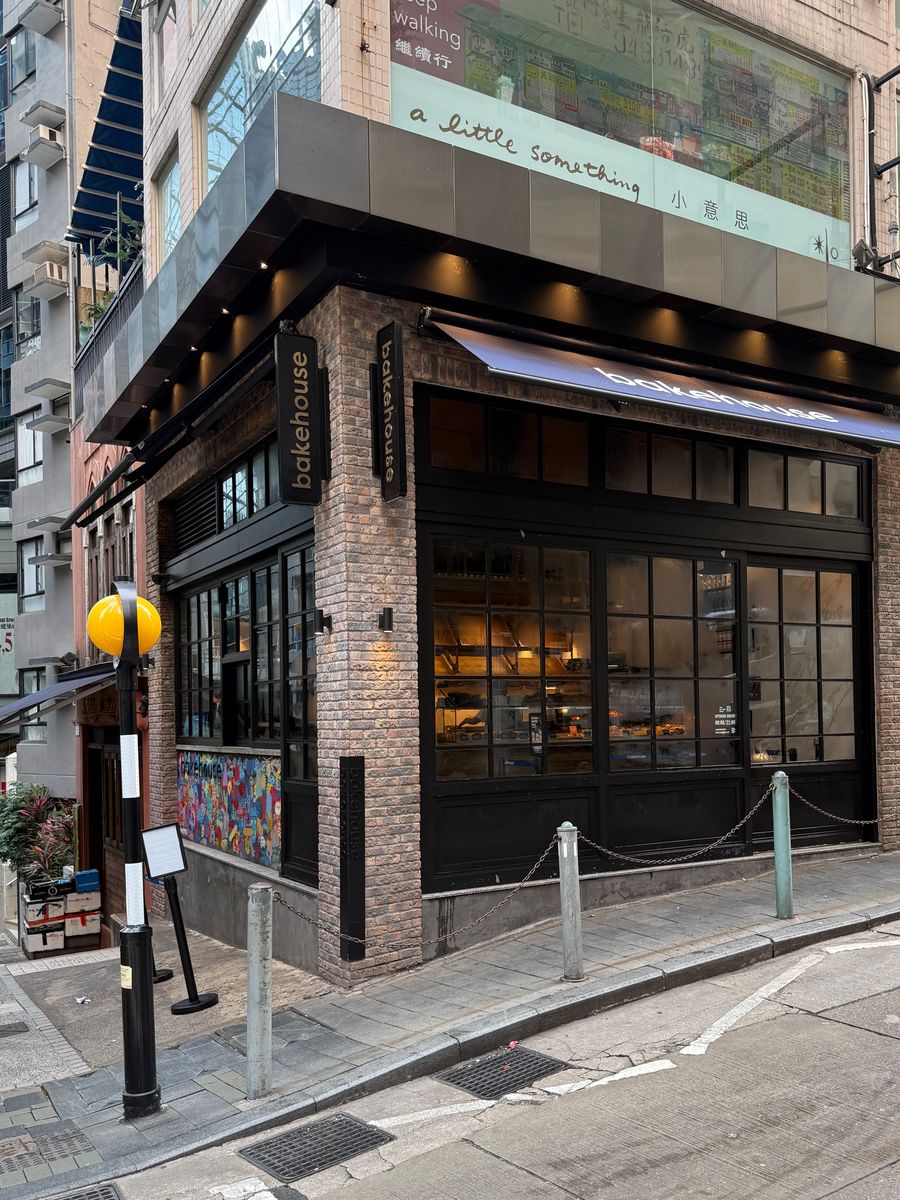
By six minutes past eight we were at the counter. What everyone comes for is the sourdough egg tart — the pastry is flaky and properly buttery in a way shortcrust and puff both are not, and the top is caramelized rather than left glassy, so the whole thing sits closer to a Portuguese pastel de nata than to the version I grew up thinking of as a Hong Kong egg tart. The custard underneath is silky and only just sweet. I bought a few to eat, and several half-dozen boxes to take back to my family in Manila.
We had coffee at Café Lavande, a small low-key French place that serves its hot drinks in china, and ate our own tarts before the morning was properly under way — which is the only sensible thing to do with fresh pastries in Hong Kong in the heat of May.

A good part of that morning went on the Mid-Levels escalator. Singular, because it is one system running one direction at a time: downhill from six in the morning until ten, to carry the neighbourhood down to work, then uphill from ten until midnight to carry it home again. Before ten, going up means walking up the steps alongside it while the thing itself slides past you the other way. It was already hot by then, and humid the way Hong Kong is in May, which turns a climb that looks trivial on a map into a decision. Carrie knew the schedule without having to think about it, which is most of what having a local with you is worth.
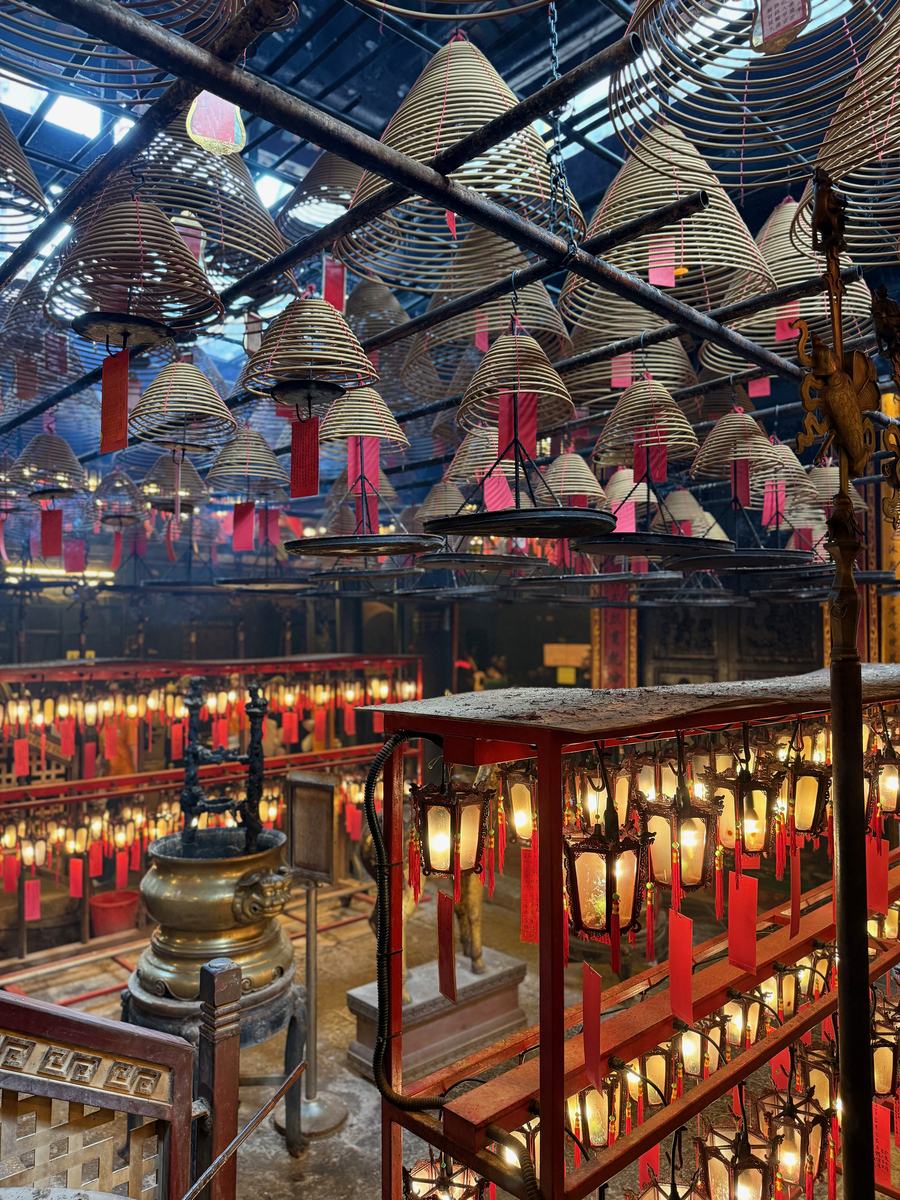
Man Mo Temple was next, back down the hill. It was built between 1847 and 1862 and is one of the oldest in the city, dedicated to the god of literature and the god of war. I am not Taoist, so I was there as a visitor to an old building rather than as anyone with business inside it. The incense coils hang from the ceiling in spirals the width of a table and burn for days. There is a brass deer near the entrance that has been touched smooth.
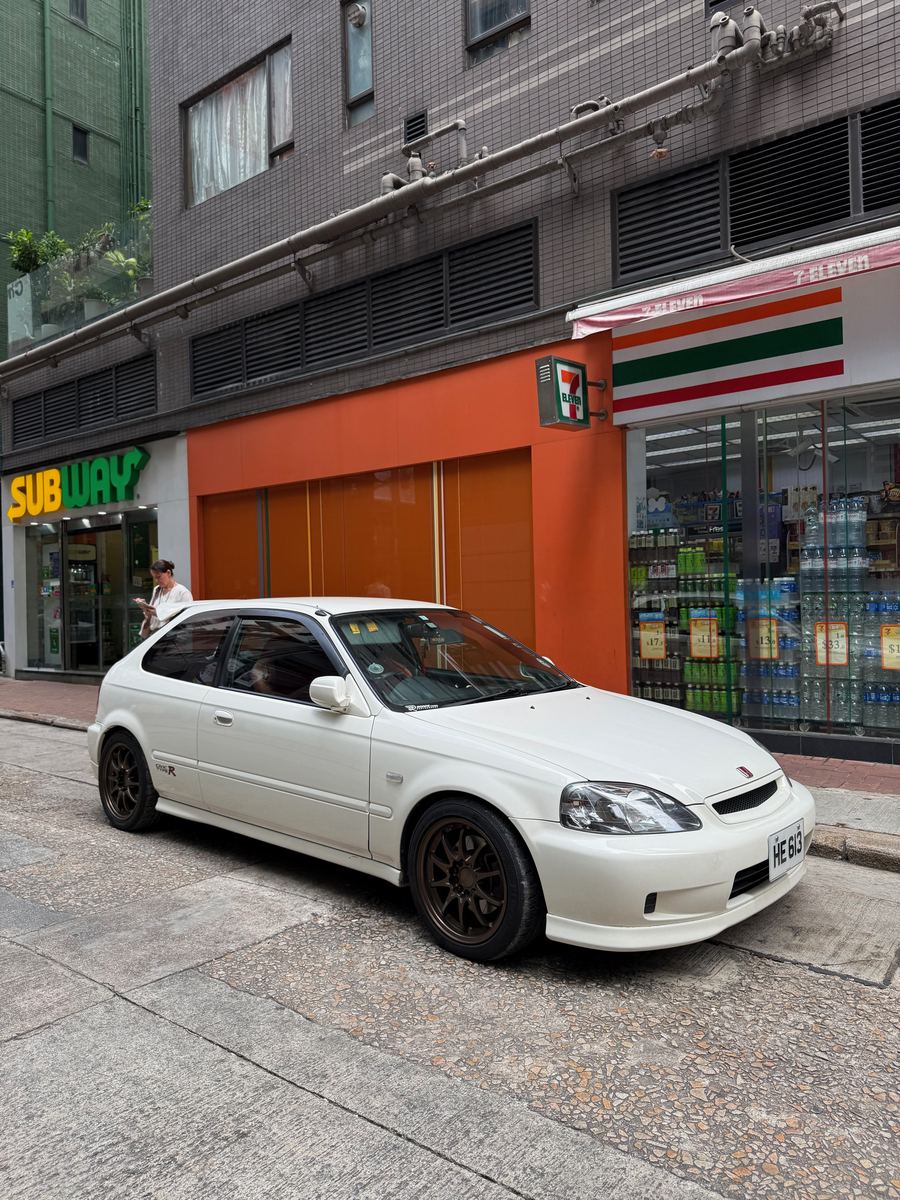
On the way down we passed a Honda Civic EK9 Type R parked at a 7-Eleven, immaculate, on a street where it had no reason to be. It was the first Civic to wear the badge, a 1.6-litre B16B, and it was never officially sold outside Japan. It is a quarter-century old. I stood in front of it long enough that Carrie had to rush me on.
We sat down for dim sum at Luk On Kui before ten. It was not on any list — almost nothing that day was, once the bakery was behind us. Ten in the morning is early by local habit — Hong Kong eats dim sum as a midday meal, roughly eleven to two, even though traditional yum cha hours run from seven in the morning. So this was breakfast number two, and I had assumed we would be ahead of the room.
The room was already near capacity. We were seated with four strangers. Sharing a table is common practice in Hong Kong, and worth knowing about before it happens to you — you eat your own meal an elbow away from people eating theirs, and nobody at the table finds it worth remarking on.
Birdcages on the wall, red lanterns, fluorescent tubes, hand-written menu strips, regulars who were mostly older than us, and staff moving steamer stacks through all of it at speed. We had Siu Mai and Har Gow, which are about as traditional as dim sum gets and the first two things worth ordering anywhere that takes it seriously. Then Ham Sui Gok — deep-fried glutinous rice dumplings with a savoury pork filling, three to a saucer and blistered gold. Sin Zuk Gyun, seasoned meat and vegetables rolled up in tofu skin and steamed. And Ngau Yuk Cheung Fun, beef and coriander inside steamed rice sheets thin enough to read through.


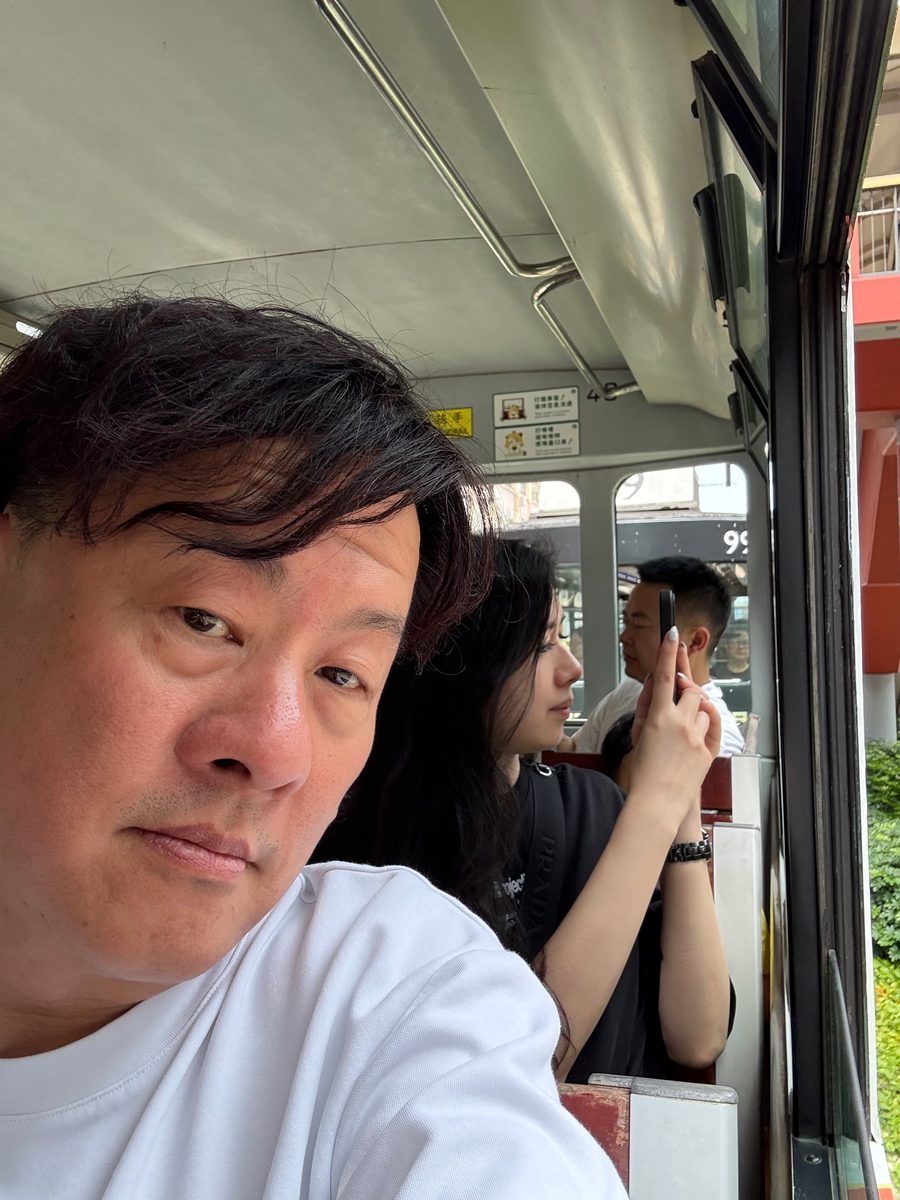
Then we got on a Ding Ding. Nobody local calls them trams — the name is the sound of the bell the driver rings at anything in the way, which is most of Hong Kong Island. The double-deckers have run along the north shore since 1904, they are still the cheapest way to cross the city, and the best view is upstairs at the front. We were further back than that, but upstairs with a window each and the windows open, letting in a breeze that was warm and cooling at the same time, heading east toward Wan Chai. Carrie sat behind me photographing the street going by, which is what I was doing too.
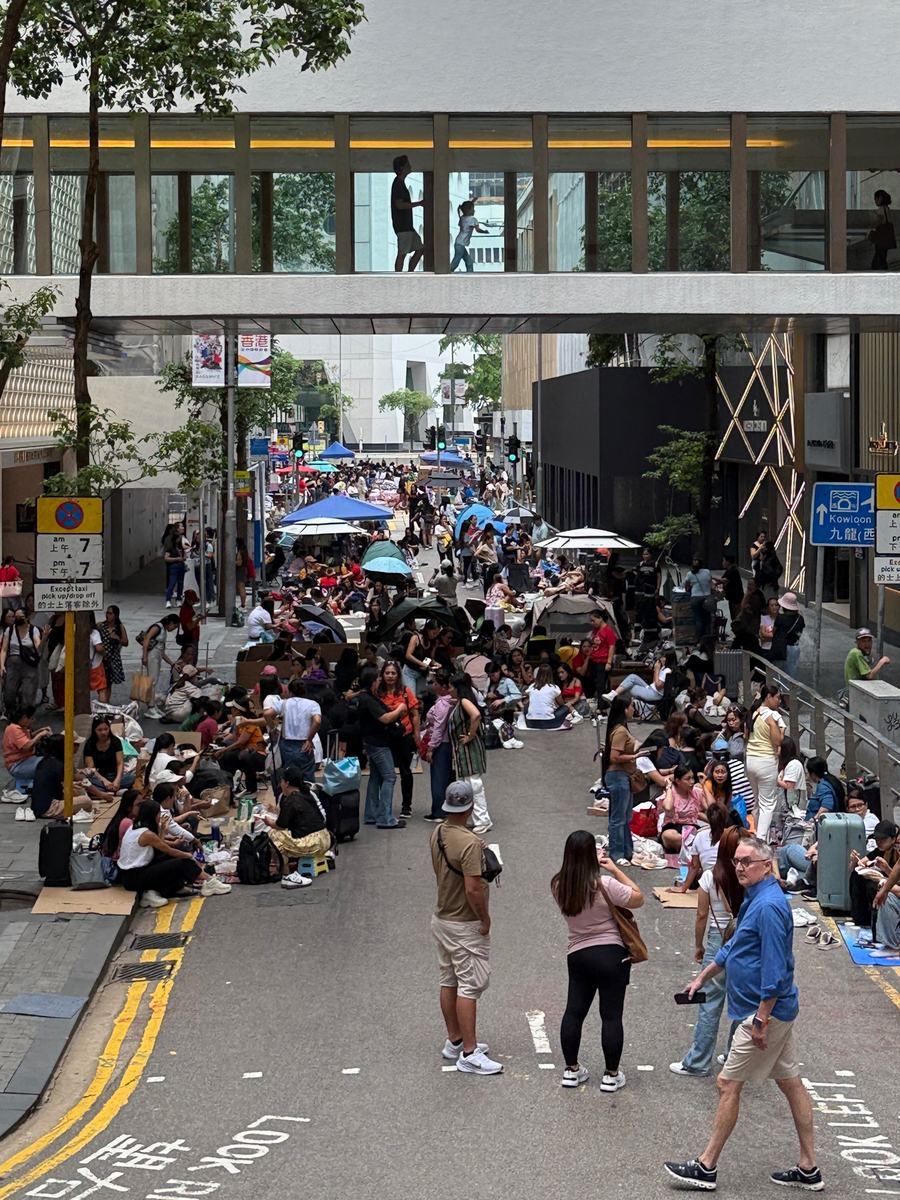
The Ding Ding is also how you see what Sunday does to Central. By late morning the corporate offices are shut, some streets are closed to traffic, and thousands of people take over the pavements, the closed roads and the pedestrian overpasses — sitting on flattened cardboard, unpacking food, sometimes standing the cardboard up into low walls to give one group a little separation from the next. Most of them are Filipino women working as domestic helpers, and Sunday is the day they get. If you have been to Hong Kong you already know this happens. It is the single most Filipino sight in the city, and it happens on the same square kilometre as the banks.
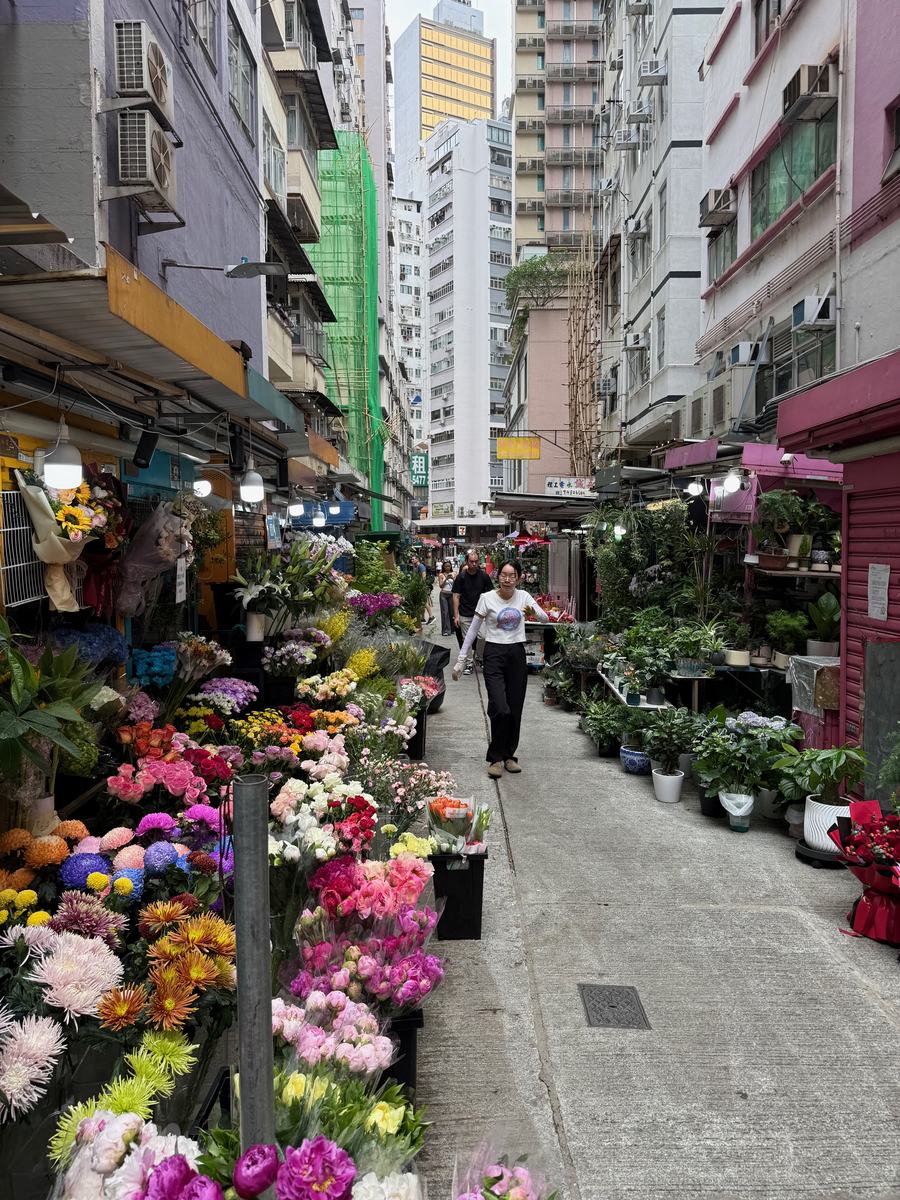
In Wan Chai we went looking for Fat J Char Siu, which does the kind of Cantonese roast meats people plan a day around, and we got there more than half an hour before it opened. Nobody was outside. Not one person. So we walked around the corner to Gresson Street, which is a narrow lane lined end to end with flower shops — chrysanthemums, peonies, hydrangeas stacked on one side, potted greenery on the other, awnings closing in overhead and the towers of Wan Chai showing at the far end like a slot of sky. It is not a flower market. It is a street that happens to be full of flowers — beautiful, colourful flowers.
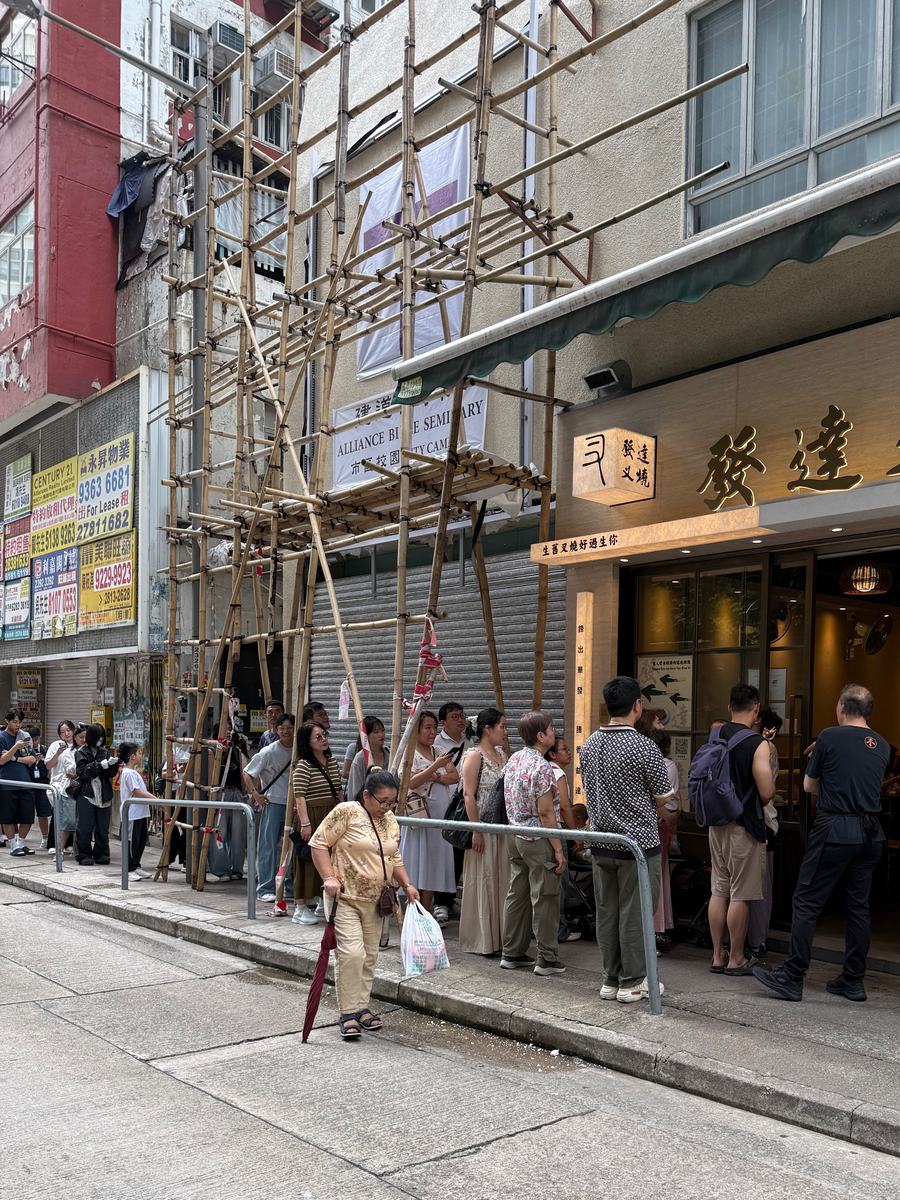
Twenty minutes. That is how long we were gone. When we came back the queue ran down the block and around the railing, and we waited another half-hour to sit down.
We had done exactly this at the bakery four hours earlier. Arrived early, got restless, wandered off, came back before opening — and it cost us nothing, because the line was six people long. So the mistake was not wandering. The mistake was assuming the two places would behave the same way.
A roast-meat shop that people plan their day around gets its whole day’s demand at the door in the ten minutes before it opens. Being early is not a number you can carry from one place to the next. It is a guess about how early everybody else intends to be, and I guessed wrong by about twenty minutes.
The shopfront carries a line in gold: 生舊叉燒好過生你. It translates as “better to give birth to a piece of char siu than to you,” and it is not a joke, or not only one. It is what a Cantonese mother says to a child who has disappointed her, worn smooth by a few generations of repetition into something people now say with affection. A roast-meat shop putting it over its own front door is very funny.
We ate Maotai Soy Sauce Chicken, laid over choy sum with the skin lacquered to a deep amber; Char Siu with Double Ranou Egg with Rice, the two yolks barely set and the whites gone lacy and crisp at the edge; and Roast Goose, sitting in its own juices with the skin blistered almost to mahogany.
What the house does is affordable premium, which is a harder trick than either half of it on its own. The char siu is honey-glazed and made with chestnut-fed Spanish pork — leaner than the classic half-fat cut, and extremely tender for it. The chicken was fragrant and every bit as tender, and the Maotai carries it well past a rice-wine-marinated soy chicken without ever tipping over into boozy. The goose was juicy, with most of the fat rendered out.
It was worth the half-hour. On the way out the line was as long as when we joined it, maybe a little longer.

Fourteen minutes later we sat down again.
Lai’s Kitchen belongs to the same group as Fat J — Flower Drum, who have built a business out of taking cha chaan teng staples and cooking them with far better ingredients than the format usually gets. That is also why a plate of char siu had arrived at the other place with eggs on it. Close enough to walk between, and we ordered the Lai’s Trio Claypot Rice — 海陸空煲仔飯, which reads literally as “sea, land and air,” the ordinary Chinese term for the armed forces, used here for abalone, cured meat and chicken. It arrived lidded, and set into the hole in the lid was a small hourglass with blue sand in it.
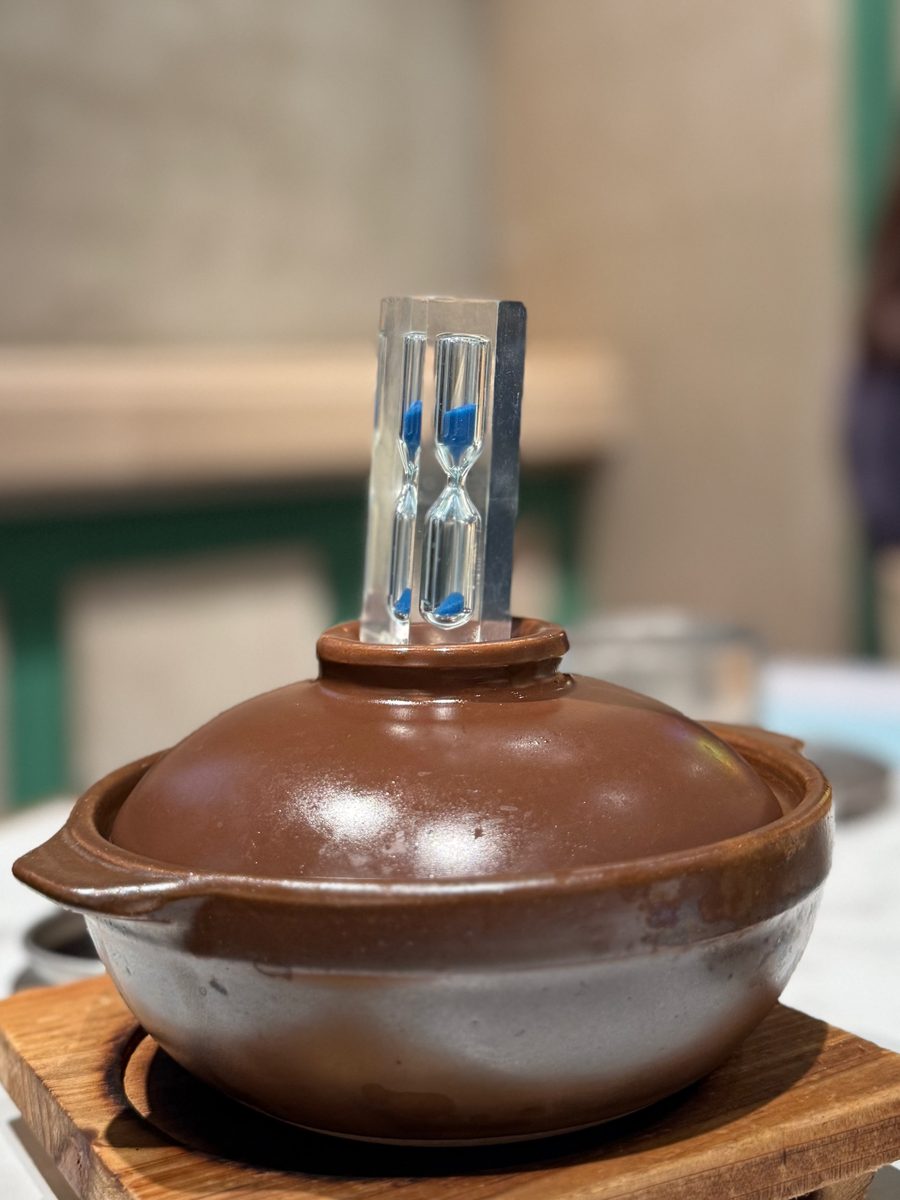
That timer is not decoration. The rice is cooked to order, and the point of the dish is what happens at the bottom of the pot. Faan jiu — scorched rice — is the crust that forms where the grain meets hot clay, and the timer is there to make sure it develops properly. The restaurant has taken the decision out of your hands and put a clock on the table instead. I photographed it, waited, and photographed it again not quite two minutes later: the abalone in the centre on top, cured pork sliced translucent and fanned across one side, sausage and goji, chives over everything, chicken underneath. I drank a Lime Sugarcane Gin Slush with it, which was frozen and sharp and did more work against all that preserved fat than I expected it to.
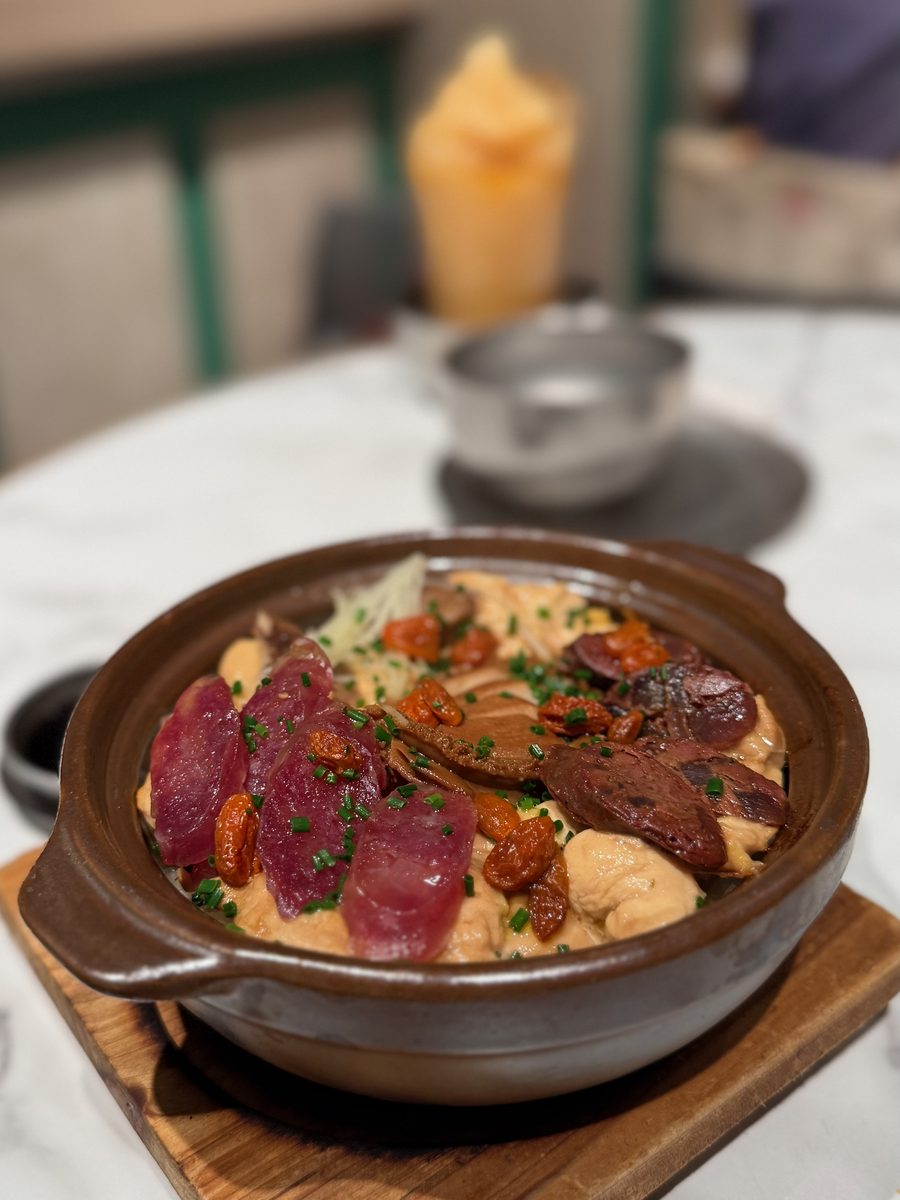
On the wall there was neon: 明火慢煲, slow-cooked over an open flame. 街坊必嗒, a neighbourhood must-eat. And 回憶從這裏開始 — memories start here — which is a lot to claim, and which I am quoting and also endorsing.
Then we walked for an hour to work off two breakfasts and two lunches.
We ended at the Canal Road Flyover, which everyone calls Goose Neck Bridge, where under the motorway a row of elderly women run stalls doing 打小人 — villain hitting. You give a practitioner the name of someone who has wronged you. She writes it on a paper effigy and beats it flat with a shoe, and then there are offerings and prayers to settle the matter. The banners advertise fifty Hong Kong dollars a go; one of them renders that in English as “Beat 50 yuan the villain,” which is a better line than anything I could write. Set into the railing in the middle of it all is a heritage marker showing the Wan Chai coastline as it stood between 1890 and 1930. The flyover is built on reclaimed land. The women are sitting on what used to be water.
Out of respect, I only took a photo from the street, before we went in.

We went back to Central after that to do some shopping, and a sudden heavy downpour came through. We ran into an Adidas store for shelter. The rain lasted a good deal longer than it looked like it would, and I was in there long enough that I came out with a surprise present for Karen: an oversized denim jacket, Adidas, but fastened with Chinese button knot closures and cut with wide cuffs that show a lining like white patterned silk.
Then we took the MTR under the harbour to Kowloon for dinner. Rae Kung runs the Chinese Restaurant Awards, which I was part of as a taste advisor. She is originally from Hong Kong, lives in Vancouver now, and happened to be visiting at the time. She insisted on treating us for dinner, chose the restaurant and ordered for the three of us. Having a local or an expert order for you is the correct arrangement, and one I would recommend making for yourself whenever you can.
Ho Ho Chak is a Chiu Chow restaurant with a Bib Gourmand. The Michelin Guide’s own entry explains both the name and the kitchen better than I can:
“The apt moniker of this Chiu Chow restaurant is Ho Ho Chak, which means ’delicious’ in Teochew dialect. The three brothers who run the joint also wholesale seafood and fruit, so they have reliable access to the best ingredients. The signature steamed pork patty with mud crab is loaded with buttery roe while the pork is springy and finely textured.”
It came out in that order, more or less. First Poached Goose Liver in Chiu Chow Style Herbed Soy Sauce, sliced thick and pale rose, with the rest of the braise arranged around it under coriander. Then the Steamed Minced Pork with Green Crab that the Guide singles out — it says mud crab, the menu says green crab, and in Hong Kong those are the same crustacean — split and laid face-up on the pork, roe orange and tomalley green across the shell. Then the Fresh Oyster Omelette, a wide crisp-edged disc of it, oysters and fried shallot through the top. Last, Pan-Fried Chiu Chow Noodles and Yellow Chives — a flat cake of very fine noodles fried right to the edge of the plate, served with white sugar and aged black vinegar to dip into, which is a Chiu Chow convention and, the first time you meet it, a genuinely strange but tasty one.

As we were all going separate ways, I thanked Rae for a wonderful dinner and Carrie for spending the entire day with me being my guide and translator, then took the Airport Express from Kowloon and was standing in departures at 20:25, for a flight at 00:15. Nearly four hours. I had not expected the train to get me there that fast, and the allowance was for getting lost, or for a slow queue at security. I had been late twice already that day. What the extra time actually bought me was a short nap.
That is the thing about a layover you have chosen, and the reason I would tell you to build one into the next long routing you book rather than picking the shortest connection on offer. You cannot see a city in a day. What you can do is pick a small number of things and get to each of them before the people who live there do — and then be honest with yourself about which ones will have a queue, because that is the part I got wrong. Half an hour on a Wan Chai pavement bought me a street full of flowers, so I am not sure I would take it back.
Arrive early. Then be earlier than that at the places worth queueing for. And when a restaurant hands you an hourglass, let it run.



The Newsletter
New pieces, plus what’s on my table next. Every few weeks.

An error has occurred somewhere and it is not possible to submit the form. Please try again later or contact us.


