


The French Laundry, Yountville: What I Photographed in 2009

Jacob Ung
January 19, 2026

9 min read
Seventeen years on, the menu still reads like a manifesto. A record of the meal that reset what dining could be, assembled from a menu card and a handful of bad photographs recovered off Facebook.
Thomas Keller has owned The French Laundry since 1994, but the building goes back a good deal further than that — a saloon put up in 1896, then bought in 1920 by a man who ran a French steam laundry out of it, which is where the name comes from and why it has never needed changing. Sally and Don Schmitt turned it into a restaurant in 1978 and ran it for seventeen years before selling it to Keller. It has held three Michelin stars since the San Francisco guide started awarding them in 2006, and when we ate there in the fall of 2009 it was the only restaurant on the west coast of the United States holding all three.
Michelin’s own wording for that third star is exceptional cuisine, worth a special journey. My wife Karen was finishing a mini fellowship at Stanford that autumn, and her best friend Katherine and I flew down to meet her — so the journey part we took fairly literally, and the dinner was how we marked the end of hers. Karen got us the reservation. I have never worked out how, but Karen seems to have her ways.

I’ve written elsewhere about what that night changed for me, so I won’t do it twice. This is the other half — what was actually on the table, and what I can still prove was on it.
Two things to get out of the way first. The photographs are bad: taken in a very dark dining room on a third generation iPhone, by someone who had not yet worked out that photographing food is a skill rather than an instinct, and then recovered off Facebook seventeen years later. And my memory of how any of it tasted is close to useless — with one exception I’ll come to. What I actually remember is thinking, repeatedly and not very articulately, ooh, ah, this is amazing. So there are almost no tasting notes here. I’m not going to build them out of memories that have long since faded.
What the photographs did capture, even at that size, is the plating — and in a kitchen at this level the plating isn’t decoration, it’s part of what’s being said. So what follows describes what I can still see rather than what I can no longer taste.
What survived is from the menu, and the names and ingredients turn out to be more interesting anyway. Read back now it isn’t really a list of dishes so much as a statement of position. There were almost certainly other courses that evening I simply didn’t photograph, and I can’t tell you what order any of it arrived in — but this is what I have.
Oysters and Pearls — a “Sabayon” of Pearl Tapioca with Island Creek Oysters and White Sturgeon Caviar — has been on that card since 1994 and has never come off it, which on a menu that changes almost daily makes it less a signature than a thesis. A fluted white bowl, a pale sabayon flecked with chive, a dark quenelle of caviar sitting in the middle of it. Tapioca pearls, oysters, caviar: three things that are, in their way, all the same shape, and the joke is right there in the name — the kind of joke a kitchen only makes when it is completely sure of itself.

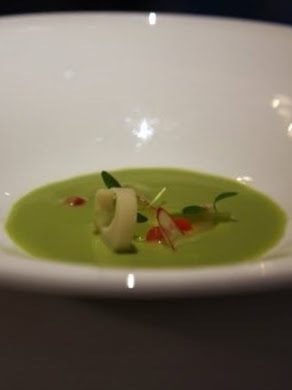
Garden Cucumber “Gazpacho”, with Hawaiian Hearts of Peach Palm, Green Grapes, Red Radish and Cilantro Shoots — a shallow white bowl of pale green soup with rings of peach palm at the centre, halved grapes scattered through, thin red radish, cilantro shoots. The garden in question is the restaurant’s own, across the road from the dining room, which is the whole reason the dish is named that way rather than just called cucumber soup.
Moulard Duck “Foie Gras en Terrine” arrived with Bing Cherry, Sicilian Pistachio, Celery Branch, Nasturtium and Andante Dairy Yogurt: a long bar of terrine, pale over a dark green layer, gels and a dark sauce drawn alongside it.

What I notice now, looking at that photograph, isn’t the plate at all — it’s the table around it. Nothing on it is where it is by accident. Everything has been placed, and everything has a purpose, right down to the salt, which sits in its own silver because the kitchen has decided you ought to season this course yourself, to your own taste. That tells you more about the place than the terrine does.
Sweet Butter-Poached Maine Lobster Tail, with Capay Farms Candy Stripe Figs, Cipollini Onions, Hazelnuts and Vanilla “Soubise”. Here’s the exception. If you had asked me at any point in the last seventeen years what I ate at The French Laundry — no menu, no photographs, just the question — this is the dish I would have given you, and it’s the only one I never lost. Though until I found the menu again I could not have told you a single thing that came with it.
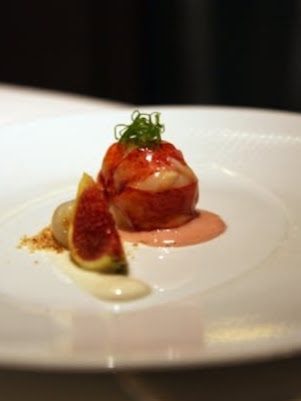
What stayed with me is the richness, and then — more than the richness — the texture. It wasn’t firm. It gave way immediately, soft the whole way through, and that is not what lobster did in my experience up to that point. Boiled is more or less what lobster was to me in 2009: boiled, or taken apart and fried hard in a Chinese kitchen in Vancouver, both of which tighten the meat and leave you that faint springiness you stop noticing because you have never had it any other way. Butter-poaching does the opposite. The tail goes into emulsified butter held well below a simmer and stays there, cooked slowly enough that the proteins never seize — none of which I could have explained at the table. I only knew that someone had done something to a lobster tail I had not understood was available to be done.
The fig in the photograph is the Capay Farms Candy Stripe. The pale cream pooled beside the lobster is the vanilla soubise — an onion purée, sweetened and perfumed, which is presumably why a dish I remembered simply as sweet actually was. That’s how memory works with food, in my experience: one element survives intact and everything arranged around it quietly dissolves.
Rouelle de Tête de Cochon came with Jacobsen’s Farm Peach, Beets, Pearl Onions, Frisée and Horseradish Crème Fraîche — head cheese, breadcrumbed and fried into a neat golden puck, set against beets, small orange dots of peach, pearl onions, frisée, and a spoon of horseradish crème fraîche.

I’d stay with this one a moment, because it’s the dish on this menu that argues hardest. Tête de cochon is a pig’s head, and this is the thrifty, nothing-wasted end of French cooking — the part of the animal that exists in the repertoire precisely because somebody couldn’t afford to throw it out. It has been given exactly the same attention as the caviar and the lobster, and then plated to look like a jewel. A kitchen that will do that to a pig’s head isn’t showing off; it’s telling you what it believes.
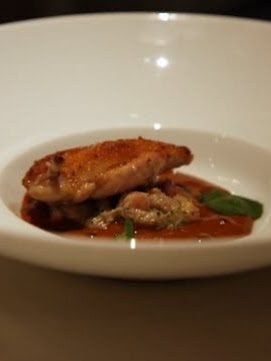
Wolfe Ranch White Quail, with Hobbs’ Bacon, Cranberry Beans and Blackstrap Molasses — a small burnished breast resting on the beans in a dark red-brown sauce, one basil leaf on top.
Wolfe Ranch and Hobbs’ are both named suppliers, and so are Capay Farms, Jacobsen’s Farm, Island Creek and Andante Dairy elsewhere on the same card. Six producers named on one menu, in 2009 — a good while before that became the reflex on every menu in North America. Reading it back, the sourcing isn’t decoration arranged around the dishes. It is the argument.
Snake River Farms “Calotte de Bœuf Grillée” closed it out, with Crispy Bone Marrow Pudding, Chanterelle Mushrooms, Potato Confit, Sweet Carrots, Spinach and “Sauce Bordelaise”: slices of beef rare through the middle, a crisp golden sphere of bone marrow pudding, glazed onions, chanterelles, and a dark bordelaise drawn across the plate.
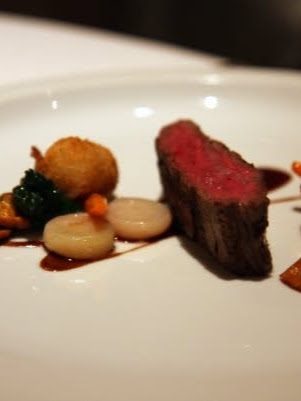
Calotte is the cap of the ribeye — the spinalis, that crescent of muscle around the outer edge which anyone who cooks steak seriously will tell you is the best part of the animal, and which almost every restaurant sells inside a whole ribeye without ever mentioning. Serving it on its own, named on the card, is a small and very confident act.
Here’s the part I find genuinely strange about my own memory of this meal. I can tell you about the lobster and nothing else; everything above I reconstructed this week from a menu card and a handful of bad photographs. But four years after the dinner, in 2013, I wrote about it on my old blog with none of that in front of me — and what I chose to praise, in order, was the menu that changed daily, the combinations, the obsessive attention to detail, the visual artistry, and then, last and most emphatically, the staff.
“I take my hats off to their exemplary staff that truly knows how to pamper their diners and complete the magical experience.”
— Jacob Ung, Premeditated Gluttony, October 2013
I thought at the time that I’d been impressed by the cooking. What I actually finished on was hospitality — and seventeen years later that is more or less the whole reason I write. It seems I worked it out in 2009 and then spent a decade not noticing.
In that same 2013 post I was really writing about somewhere else.
“Per Se is situated in the Manhattan, the most urban of urban settings and thus is the urban interpretation of French Laundry. Both restaurants have blue doors, serve the amazing Oysters and Pearls dish, and have the Michelin Three Star rating.”
— Jacob Ung, Premeditated Gluttony, October 2013
The blue door is a Keller signature, used deliberately across the group. I wrote that down in 2013 without once connecting it to the photograph of myself standing in front of one, taken four years earlier, leaning on the stone wall in Yountville with the restaurant’s name carved into the sign below me.
The post was titled Souvenir from Per Se, and I had never been to Per Se. My parents had. They went, and they brought me back the parting gift the restaurant hands out — a small tin with three shortbread cookie sandwiches inside, chocolate cream between them. I ate my parents’ souvenir from a restaurant I had never seen, wrote it up, and signed off: “Anyone want to take me to New York?”
I still have that tin. I also still have the wooden clothespin they gave us in Yountville. Everything else from those evenings I had to go and find.
Nobody took me to New York. Karen and I ended up going ourselves, more than once, and Per Se stopped being hypothetical — that’s a piece for another day, and I’d want to dig up what I can find first, because this week has taught me how much of my own record is sitting in places I had forgotten to look.
But Yountville in 2009 is still the meal everything else gets measured against. Not because it was the most expensive or the most decorated, though in 2009 it was both. Because of the thing I noticed on the way out and only understood much later: a room full of people had spent an entire evening making three strangers feel looked after, and had made it look like nothing at all.
Still on the menu: there are two tasting menus now, the Chef’s Tasting Menu and the vegetarian Tasting of Vegetables. Anyone who knows me knows which one I’m ordering. Oysters and Pearls hasn’t left that card since 1994, so of everything above it’s the one course you can still go and order. The rest of it will be whatever the kitchen has decided to cook that day, and my advice is to leave it alone. Barring a dietary restriction, a chef’s tasting menu should be taken as it comes — you are there for their judgement, not yours.



The Newsletter
New pieces, plus what’s on my table next. Every few weeks.

An error has occurred somewhere and it is not possible to submit the form. Please try again later or contact us.


