


Francine's, Calgary: The Seats Worth Asking For

Jacob Ung
September 9, 2026

10 min read
A French bar in Calgary's Chinatown, two seats at the kitchen counter, and the best way I know to find out what a room actually orders.
Every city you visit gets filed under something, and the filing tends to stick long past its expiry. My last visit to Calgary was over a decade ago, and if you’d asked me afterwards what I remembered of it, food would not have made the list. Nothing against the city — it simply wasn’t what I’d gone there for, and a place only gives you what you go looking for. So this time I went looking, and Francine’s is where I went.
It calls itself a French bar rather than a restaurant, which is a positioning choice more than a description, and it sits on Centre Street South — the spine of Calgary’s Chinatown. Garrett Martin, its Chef/Owner, opened it in January of this year after running it as a pop-up inside someone else’s sandwich shop for about six months in 2024. He wasn’t in the building the night we ate, which turned out to matter less than nothing, and I’ll come back to why.
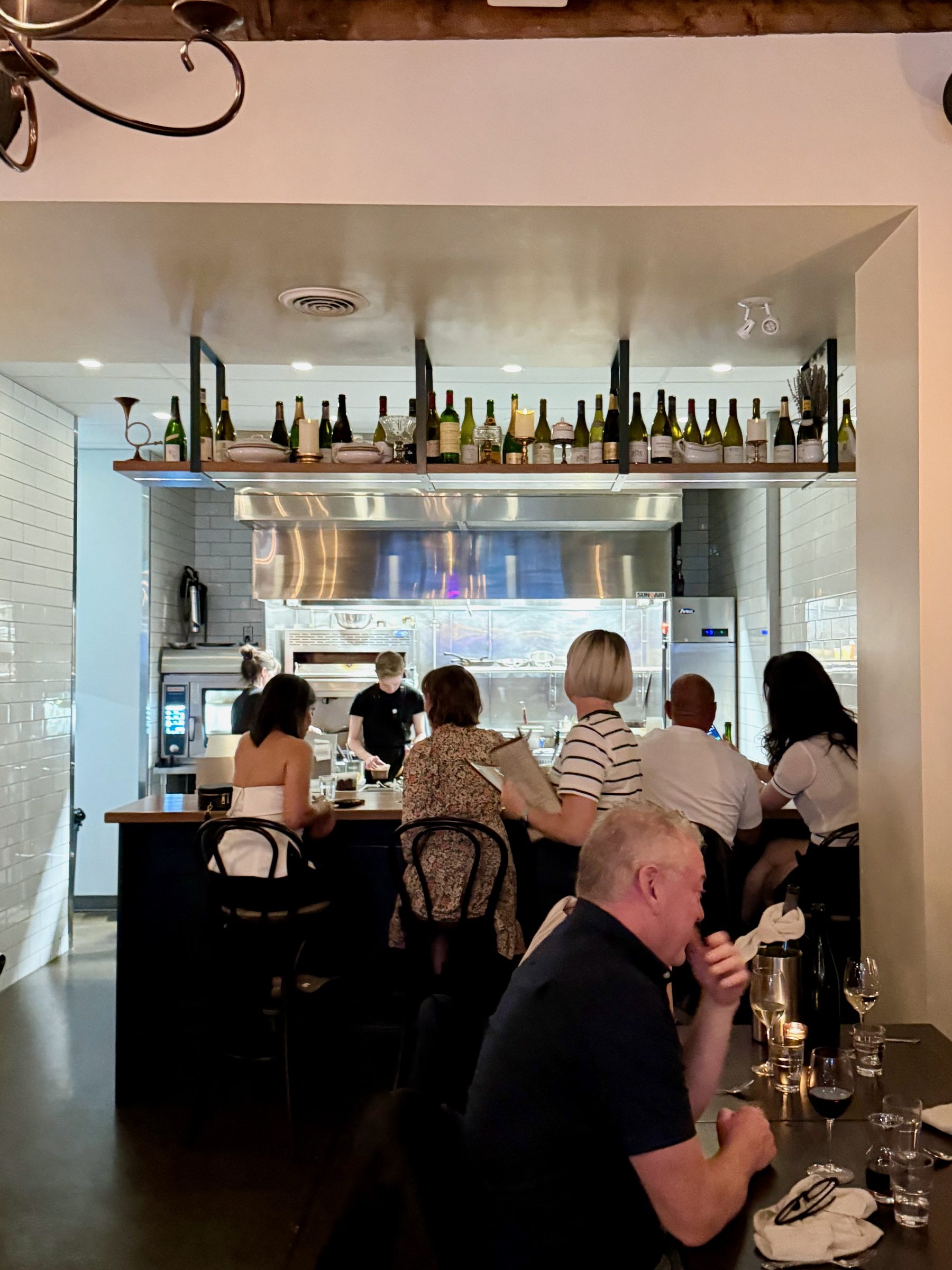
We were seated at a two-top with a partial view into the kitchen, and we ordered from there. A partial view is worse than none, in the way that half an overheard conversation is worse than silence. I took a photograph of the room while we waited, and I only noticed later what’s in it: at the left of the counter, two women with their backs to us, sitting where we would spend the rest of the night. They finished their dinner and left, and I asked our server whether we could take their seats — a counter seat is the one thing I’ll reliably ask for, and it almost never works out. It didn’t look like it was going to work out here either. Our wines arrived at the table. The Cheesy Puffs arrived at the table, and we ate them there, and they were superb. Then the Chicken Liver Parfait was set down in front of me and I was ready to dig into it when the hostess appeared to say she could move us.
I want to be accurate about what changed when we moved, because it wasn’t the food. The cooking was excellent at both tables and would have been excellent all night at the first one. What the counter gave us was everything around the food — and by the end of the evening I’d have traded a fair amount to keep it.
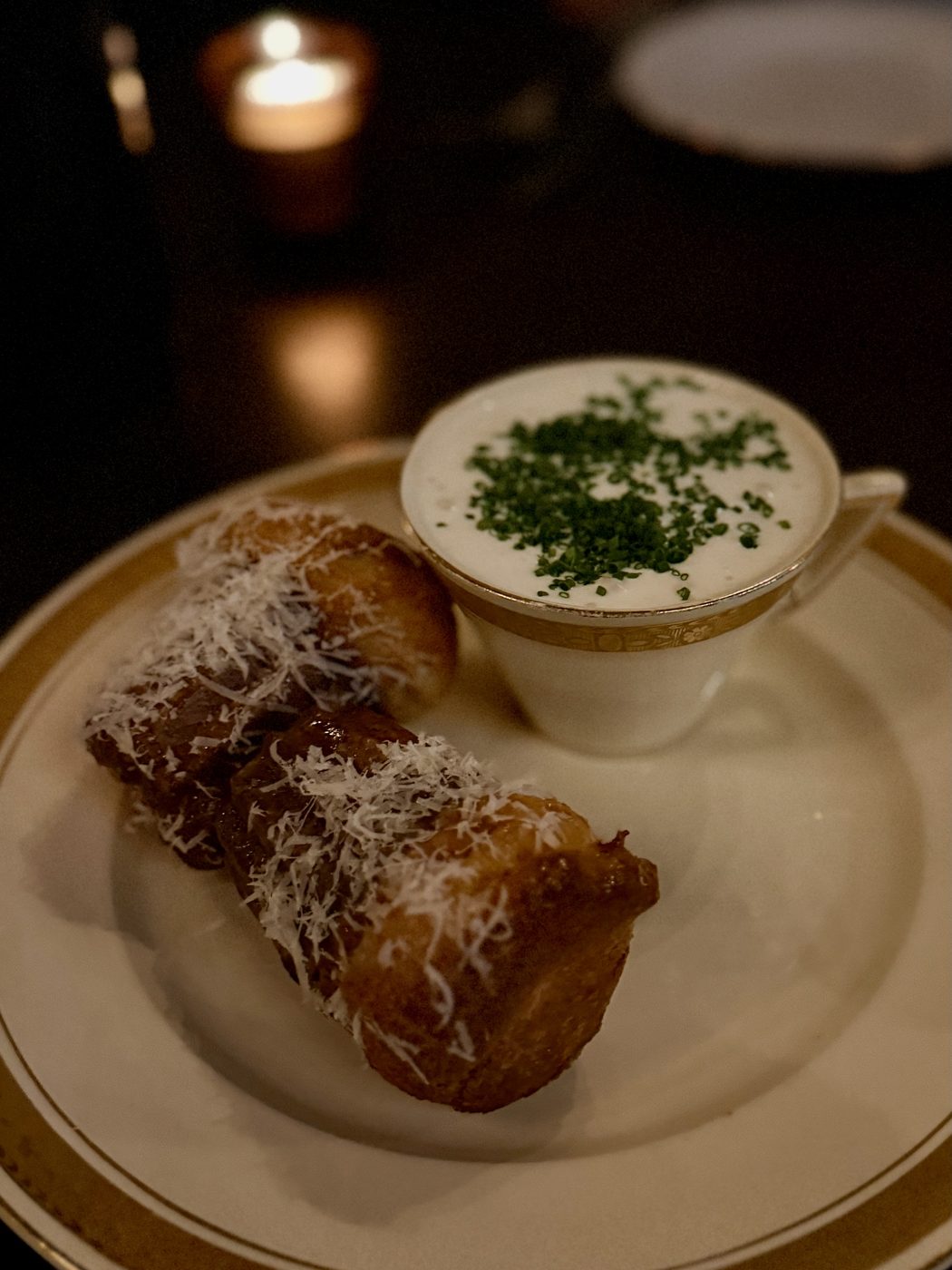
Start with the Cheesy Puffs, and I mean that as an instruction rather than a suggestion. They’re ordered individually, which turns out to be the correct policy, because you will not want to share yours. Each arrives under so much finely grated parmesan that the plate looks briefly like a mistake — brioche-ish, torn rather than cut — with warm parmesan mousse alongside in a gold-rimmed teacup, chives across the top. You tear, you dip, and the whole exercise becomes about how much mousse a single torn edge can physically carry. We had one each and got the cup down to nothing, which I’d describe as a well-run operation.
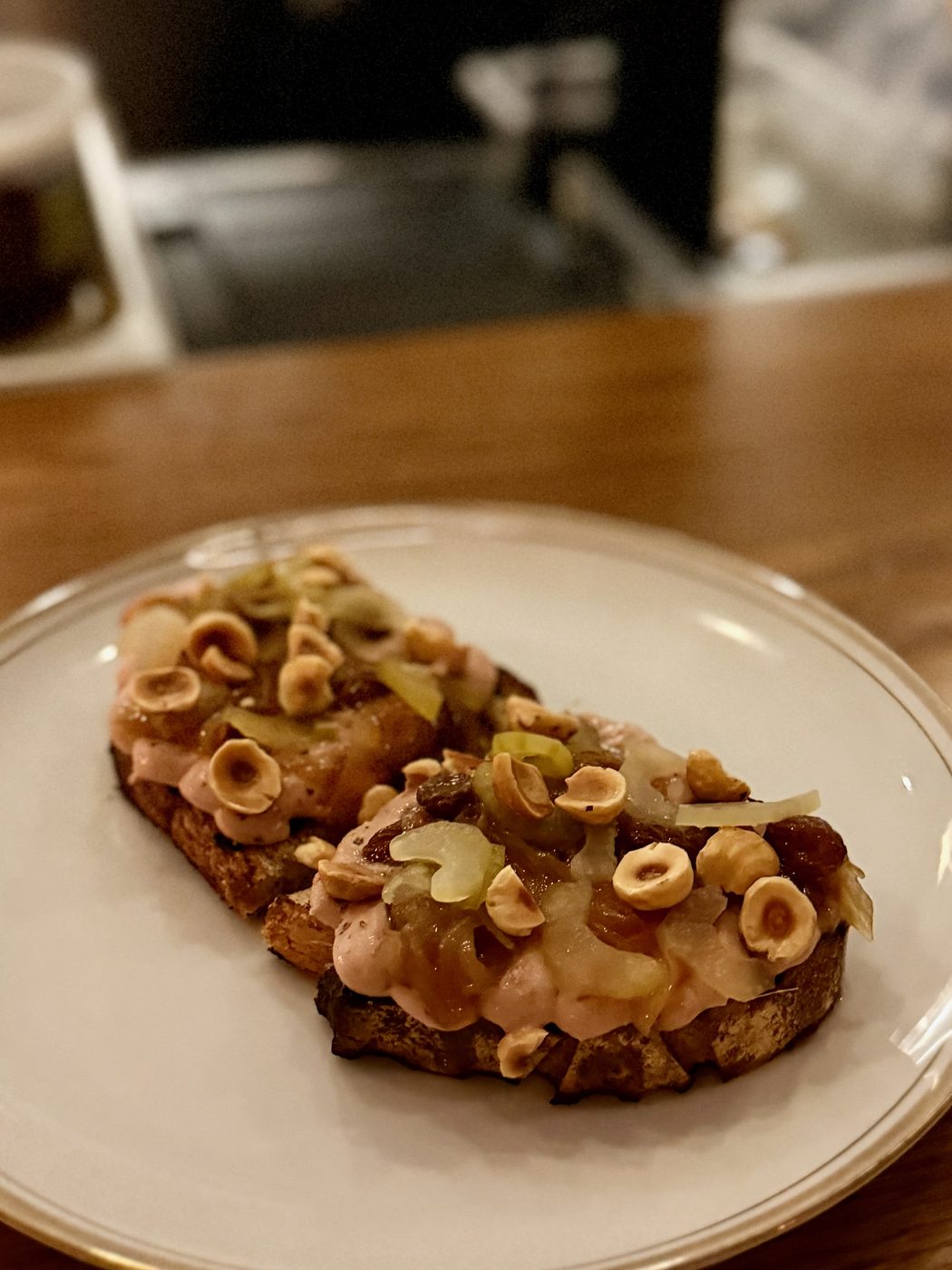
The Chicken Liver Parfait came on grilled sourdough, and it had been grilled in a searing cast-iron pan rather than dropped in a toaster — you can see the difference and I’d argue you can taste it. The parfait itself was excellent, but what lifted the dish was everything sitting on top of it: toasted hazelnuts, halved, scattered across the surface; raisin chutney bringing a low sweetness; and bread-and-butter celery, pickled sweet-sour, cutting back through the richness. I tasted the sweetness and the acid before I read the menu details and assumed both came from the celery. They come from two separate components doing two separate jobs, which is a more deliberate piece of cooking than I gave it credit for at the table.
It was here that Hasan became the first person to greet us at the counter. He is the garde manger, the chef who runs the cold station — which is exactly where a parfait comes from, though I didn’t put that together until later. He asked my wife, Karen, what she’d thought of it. She told him she doesn’t eat liver. “That’s too bad,” he said, “because that’s one of the dishes I make.” There is no recovering from that, and she didn’t try.
Karen’s aversion is real and long-standing — a childhood of being made to eat pork liver will do that — so I had the parfait to myself, which is the only sensible outcome anyway.
The Steak Frites is the reason I’ll be back. We both order it wherever it appears, and we’d recently eaten at a Vancouver restaurant that treats it as their specialty, so I had a fresh benchmark in my mouth. This wasn’t a step up from that. It was somewhere else entirely. The chef working the stove, the grillardin, was moving at a pace that seemed unsustainable, and I said so. We found out later it was her second day on that station. Two days in, she was quick and composed.
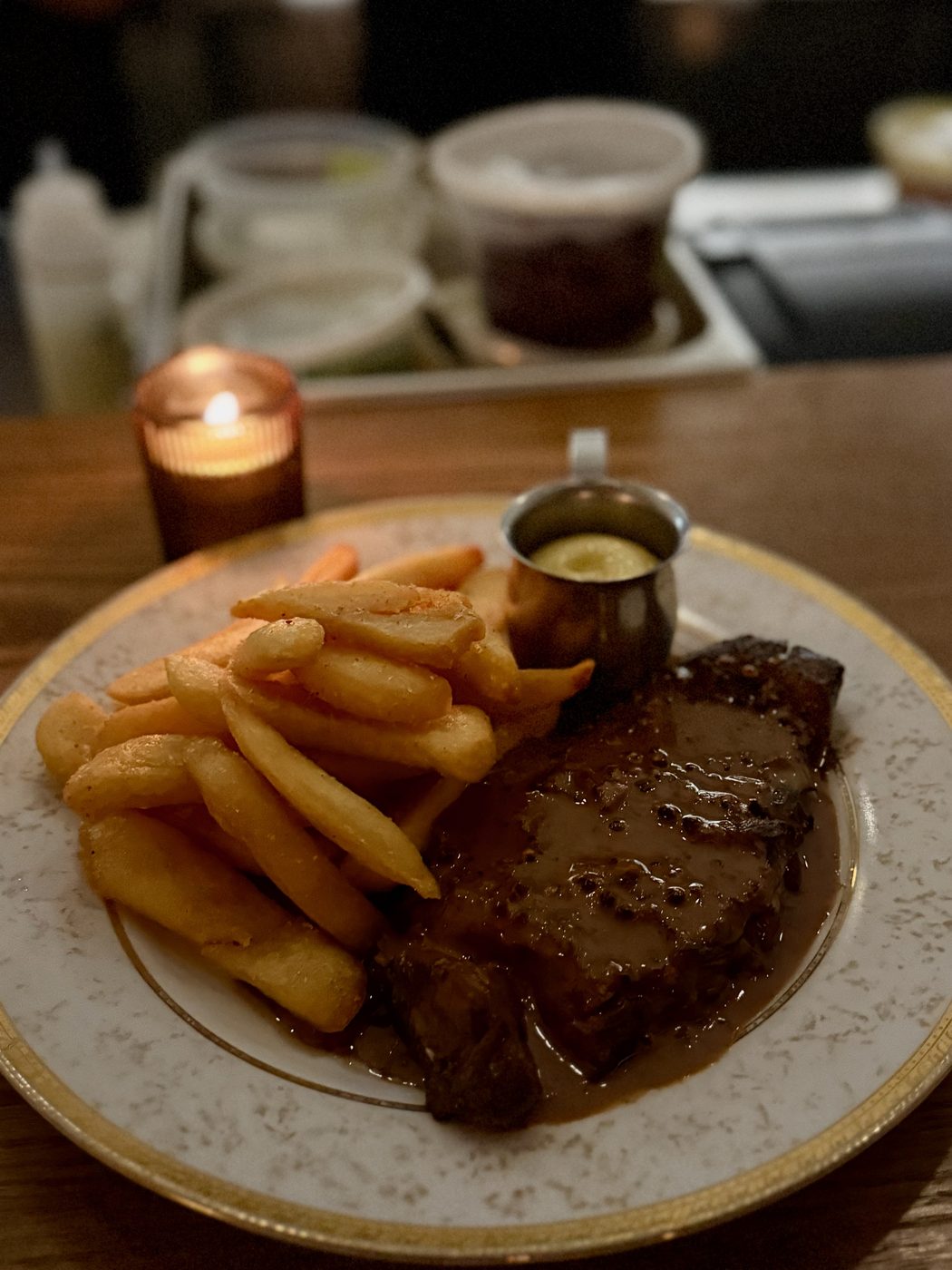
Seven ounces of butcher steak, cooked exactly to the medium rare we’d asked for, with enough char to add something and not enough to take over. The toasted garlic peppercorn glaze is the best thing of its kind I’ve had — peppercorn heat, real balance, and a sweetness underneath it I’d put down to a spirit somewhere in the reduction, a cognac or another brandy at a guess, though that’s my read and not something I confirmed. The fries were thick-cut and among the best I can remember, and from the counter you could see why: portioned in advance and held cold, so they hit the fryer shocked. That credit belongs to the friturier, the fry chef — a plate of steak frites arrives from more than one station, and the fries on this one were every bit as good as the steak. There was garlic aioli too, and it was properly garlicky, which is more than most garlic aioli manages. We barely touched it. The glaze had already won.
Here is the part nobody tells you about a counter seat, and it’s the best reason to want one. Sit in front of a kitchen for an evening and you don’t just watch your own dinner get made — you watch everybody’s. Plates leave the line in front of you all night, and after a while the pattern is unmistakable: the dishes that go out once, and the dishes that go out constantly. At Francine’s it wasn’t close. The Cheesy Puffs and the Steak Frites left that line more than everything else combined, over and over, to table after table. That’s a better recommendation than any I could write you, mine included. It isn’t a critic’s opinion or a chef’s favourite. It’s a whole room, ordering with its own money, on an ordinary night, and agreeing.
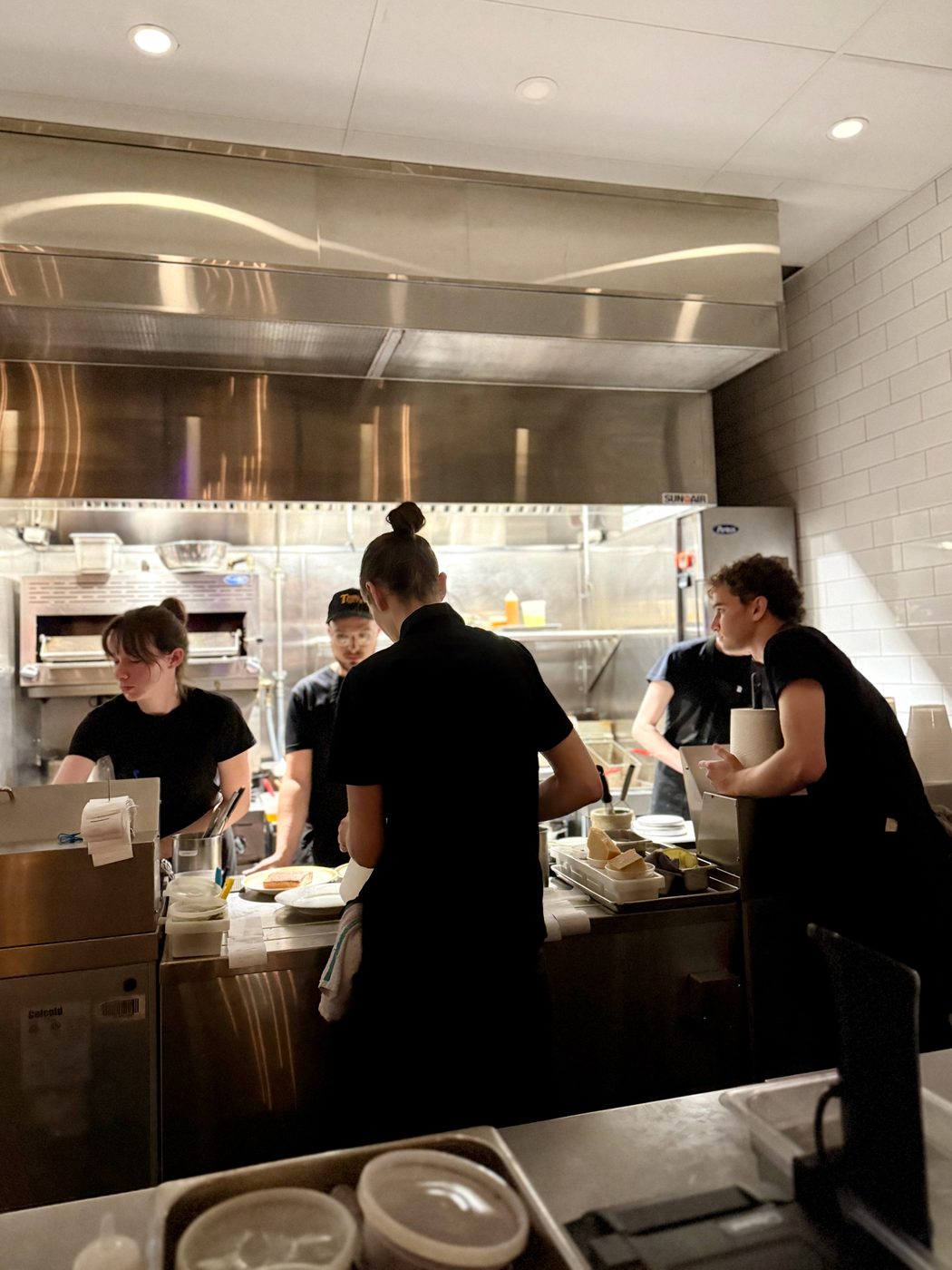
Laetitia Chrapchynski was running that kitchen, and she runs it visibly. Not loudly — visibly. Every chef on the line knew what they were doing and when, and the plates kept moving without anything ever looking rushed. What struck me first was how young the team was, and how little that showed in the work: the knowledge, the coordination, the sheer speed. I said as much to her when she came up to us to see what we thought of the Steak Frites. I also told her she’d just served me one of the best steak frites of my life, which she took the way people who are extremely busy take compliments.
She had, in the literal sense, served it. She brought the plate to the counter herself, and that turned out not to be a flourish for the two guests sitting closest to her: when the floor got busy, she and her chefs carried plates out into the room, and later in the evening, as service thinned, I watched her clear a few tables near us. There’s a line I keep coming back to between service and hospitality. Service is the job as written — take the order, bring the food, bring the bill. Hospitality is everything past the edge of it. A head chef bussing a table is firmly the second thing, and nobody was making her do it.
People have been telling me for years that I should cook professionally — a pop-up, a place of my own. I’ve always declined, and I’ve usually explained it by saying I have too much respect for how hard the work actually is to treat it beyond a hobby. Sitting at the edge of that kitchen for the rest of the evening was the clearest version of that answer I’ve had. I cook because it’s the one thing that occupies all five senses at once and quiets everything else down. What she was doing was not that. It was a job of extraordinary difficulty performed at speed, in front of an audience, with no room to stop and enjoy it.
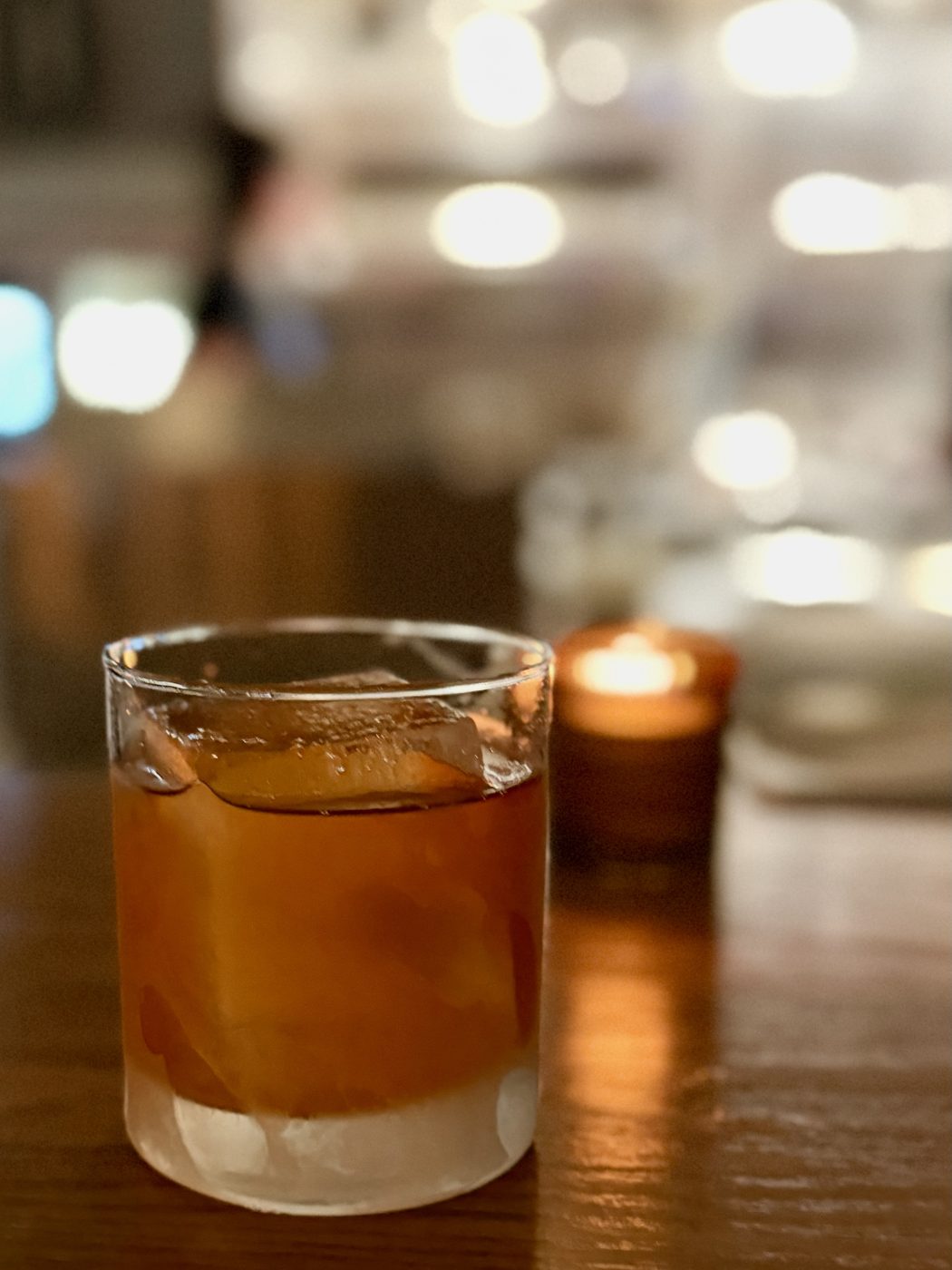
The drinks deserve their own attention. We had the Amélie & Charles Sparr “Cerisier en Fleur” 2023 from Alsace, a Riesling, Pinot Blanc and Muscat blend in the old Edelzwicker spirit, and the Sourdais La Bouchardière Chinon 2024, a young Cabernet Franc from the Loire. But the drink I keep thinking about is the Crêpes Suzette Old Fashioned, which takes a dessert apart and rebuilds it as a spirit-forward drink. Crêpes Suzette is butter, sugar, orange and orange liqueur, set alight at the table. Here the liqueur becomes calvados, so the sweetness arrives as orchard fruit instead of candied peel; bourbon does the structural work; orange and Angostura hold the shape. And the crêpe itself turns up as bread crumb butter, fat-washed through the whole drink. It’s a clever piece of thinking that never announces itself as clever, which is the harder version.
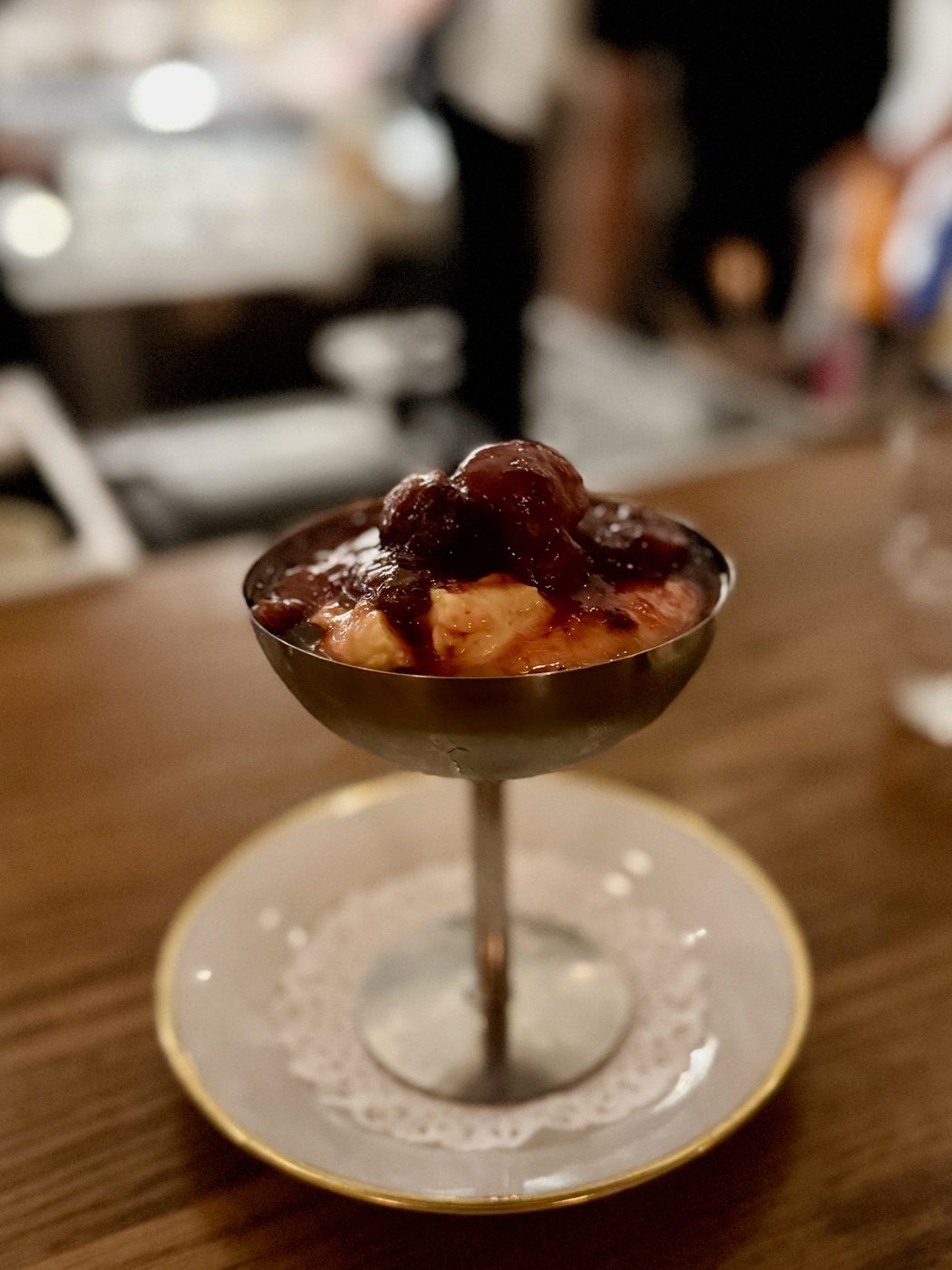
We ordered a half portion of the French Toast for dessert, on the recommendation of a woman working the floor. While we waited, the kitchen sent out something else — a dessert that wasn’t on the menu, cheese-based, with poached plums and olive oil, in a small footed coupe. Hasan told us it was Laetitia’s own creation and that part of it had been through the sous vide. It’s the only thing we ate all night that came from her rather than from the house menu, and it was the most direct read we got on how she thinks: fruit, cheese, olive oil, nothing sweet left standing on its own.

Then the French Toast. Cast-iron again, with just enough char at the edges to register. Honey caramel pooling underneath, honey ice cream, and 15-month Comté shaved into wide ribbons and piled on top in a quantity that no one would call restrained. I like a dessert with something savoury in it, and this is that idea taken as far as it will go without falling over.
Which is when the pattern finally showed itself. Parmesan in the first course. Raisin chutney answered by pickled celery in the second. A glaze reading sweet against pepper and toasted garlic in the third. Olive oil and cheese over plums. Comté over honey. And butter, of all things, washed through the whiskey. Five courses and a cocktail, and not one of them lets sweetness sit by itself — there’s always salt or fat or acid arriving to argue with it. That’s not a tic. That’s a house with a position, and the fact that it runs through the bar list as much as the kitchen tells you it’s shared rather than inherited.
Which brings me back to the owner not being there. The name on all of Francine’s opening coverage was somewhere else that night, and the room ran beautifully anyway — a head chef in full command, running plates and clearing tables when the floor needed it, a brigade that has clearly decided it’s good, and a grillardin two days into her station keeping up. Any restaurant can be excellent while the person whose idea it was is standing in it. What a place is on an ordinary Wednesday, with the founder elsewhere, is the more honest measure, and I think it’s the more interesting story too. Eight months in, this one holds.
One last thing I noticed only in the photographs afterwards: the plates. Mismatched, gold-rimmed, patterned, visibly not bought as a set — a teacup for the mousse, a footed coupe for the dessert, old china carrying a seven-ounce steak and a pile of fries. The room has no tablecloths and no interest in formality, and the tableware is quietly doing the opposite. It shouldn’t work together. It’s the most French thing in the building.
Order this: the Cheesy Puffs and the Steak Frites — not because they’re my picks, though they are, but because they’re what the whole room was ordering while I sat there counting. Get a puff each; they come individually and you will not want to share yours. The Crêpes Suzette Old Fashioned works as well before dinner as after. And ask whether anything has opened at the kitchen counter. Ask when you arrive, ask again if it doesn’t, and be prepared to carry your own wine glass across the room. You will eat just as well at a table — but you’ll leave knowing less.



The Newsletter
New pieces, plus what’s on my table next. Every few weeks.

An error has occurred somewhere and it is not possible to submit the form. Please try again later or contact us.


