


The Banff Springs, Banff: Three Dinners Without Leaving the Building

Jacob Ung
September 12, 2026

10 min read
Three nights at the Fairmont Banff Springs, three restaurants, and not once leaving the building: a French brasserie, an Italian room, and an Alberta steakhouse.
A hotel restaurant is a compromise you agree to in advance. You are tired, it is late, the room is downstairs, and you trade the meal you might have had for the one you do not have to leave the building for. We made that trade three nights running at the Fairmont Banff Springs and it never once felt like a trade.
Part of that is the building’s own doing. The hotel counts twelve restaurants, pubs and bars, and with in-room dining on top of them you could stay a week without eating in the same place twice. Three nights running meant three different rooms in three different moods, and by Saturday the run of them had started to look less like convenience and more like a small tour of what a kitchen brigade that size can do.
Thursday was the Vermillion Room, which the hotel calls French and which is a brasserie in the way that matters: onion soup and escargot on the menu, a long bar, and a rotisserie turning somewhere behind it. We were not hungry. We had checked in that afternoon, eaten the cheeses in the room and then the hors d’oeuvres in the lounge, and arrived at dinner in the state the whole weekend would keep returning us to — interested rather than hungry. So we ordered one item.
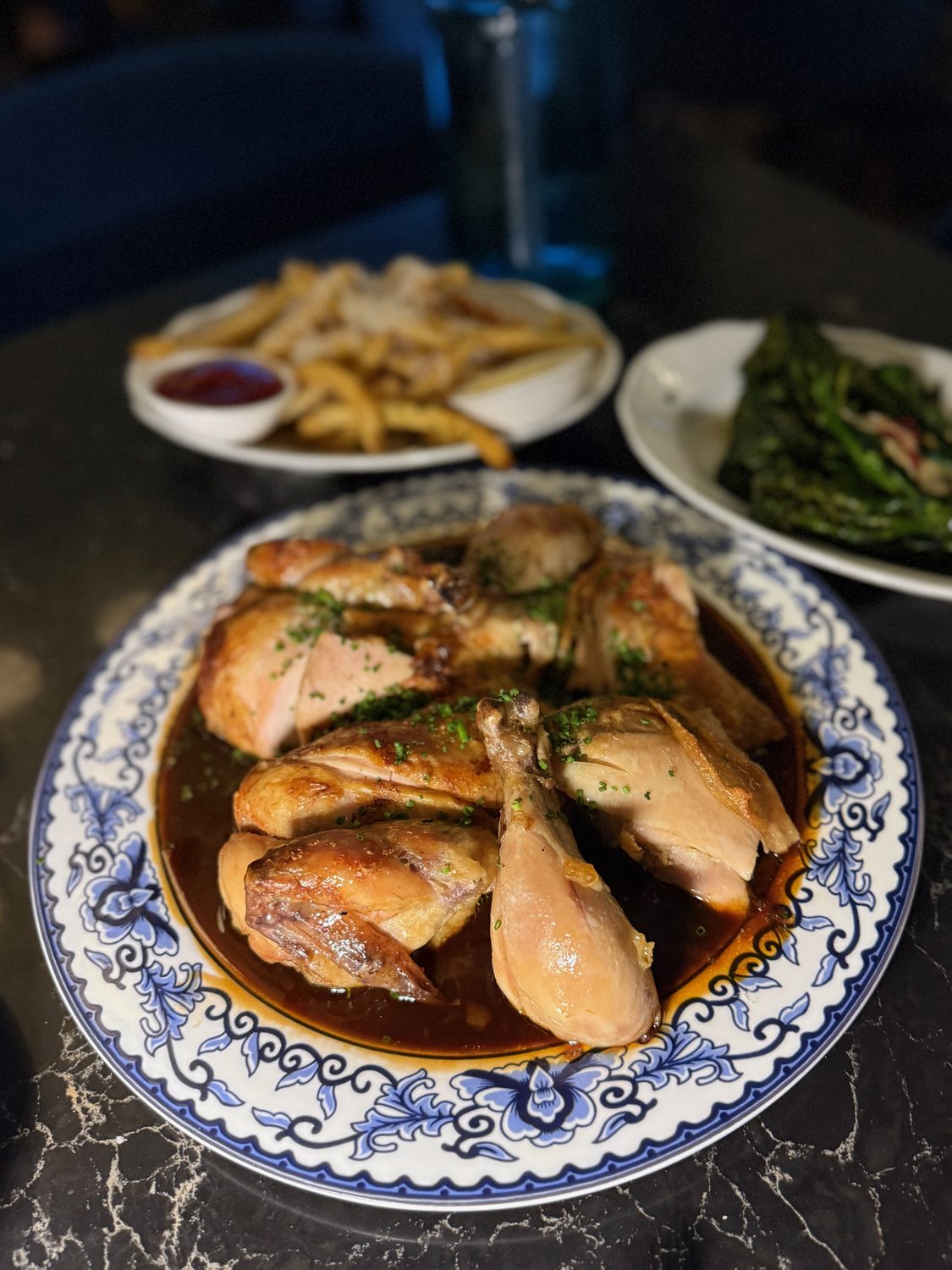
The one item was the Rotisserie Free Range Chicken, which is served family style, and family style here means most of a bird. It arrived carved: the breast off the bone in two halves, the drumsticks, thighs and wings still on theirs, all of it in a pool of dark glossy jus with chives through it. It is a lot of food. It is made for more than two people, unless you are two very hungry people, which we emphatically were not. Karen asked to swap the pomme purée that comes with it for the Truffled French Fries, which arrive with garlic aïoli and a ramekin of ketchup. Fries are one of her kryptonites, and not being hungry has never had much bearing on that. We took the Grilled Broccolini with fresno, butter and lemon as it came, charred at the edges.
The jus is where it got interesting. It is made with Pernod, and it tasted to me almost Asian — definite star anise, and what I read as coriander, with other herbs behind them. I said so at the table without much confidence, because it is the kind of thing you can talk yourself into. It turns out Pernod is built from distillates of star anise and fennel married with fourteen herbs, and coriander is one of them. I have rarely been so pleased to be told I was not imagining something.
And then there is the platter, which I noticed before I tasted anything: blue and white porcelain with a scrolling floral border, the kind of plate you would expect in a cabinet rather than under a brasserie chicken. A French dish that tastes faintly of star anise, served on a plate that looks like it came from somebody’s grandmother — I am not going to claim the restaurant meant anything by it. But I ate the whole thing thinking about it.
It also turned out to be the closest thing to an Asian dish I ate all weekend inside the hotel. For all the choice in that building there is no Asian room among the twelve, and I noticed it more than I expected to. That may be a complaint that says more about me than about the hotel.
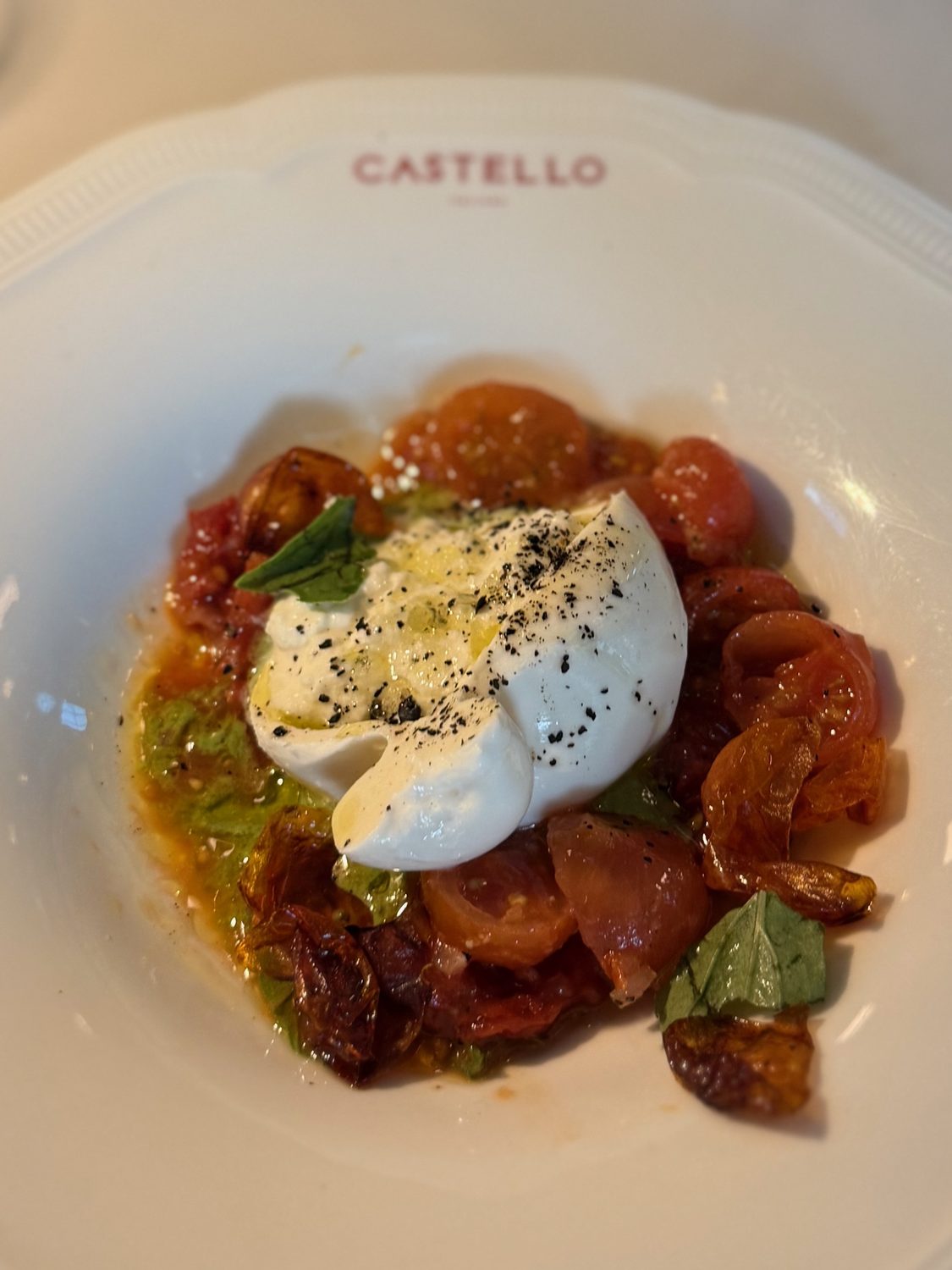
Friday was Castello Italiana, which promises rustic and authentic Italian food and wine. Almost every Italian restaurant says some version of that and almost none has to defend it. The room makes no such claim for itself — twinkling lights, modern décor, unmistakably a hotel dining room — but the plates did the defending. We went early, before half past seven, and started with the Burrata.
Burrata is a dish we order a lot and make at home often enough that I have opinions about it. Mine is cherry or grape tomatoes and fresh basil, and the secret, which is not much of a secret, is the quality of the olive oil — the whole thing is a contrast between something rich and milky and fatty and something bright and sweet and acidic, and cheap oil collapses one side of that. Castello builds it differently: preserved tomato rather than fresh, basil, and urfa chili. Preserving concentrates the sweetness where fresh tomatoes bring acidity, and the urfa puts a low smoky warmth underneath. It is the same argument as mine, made in a deeper register.
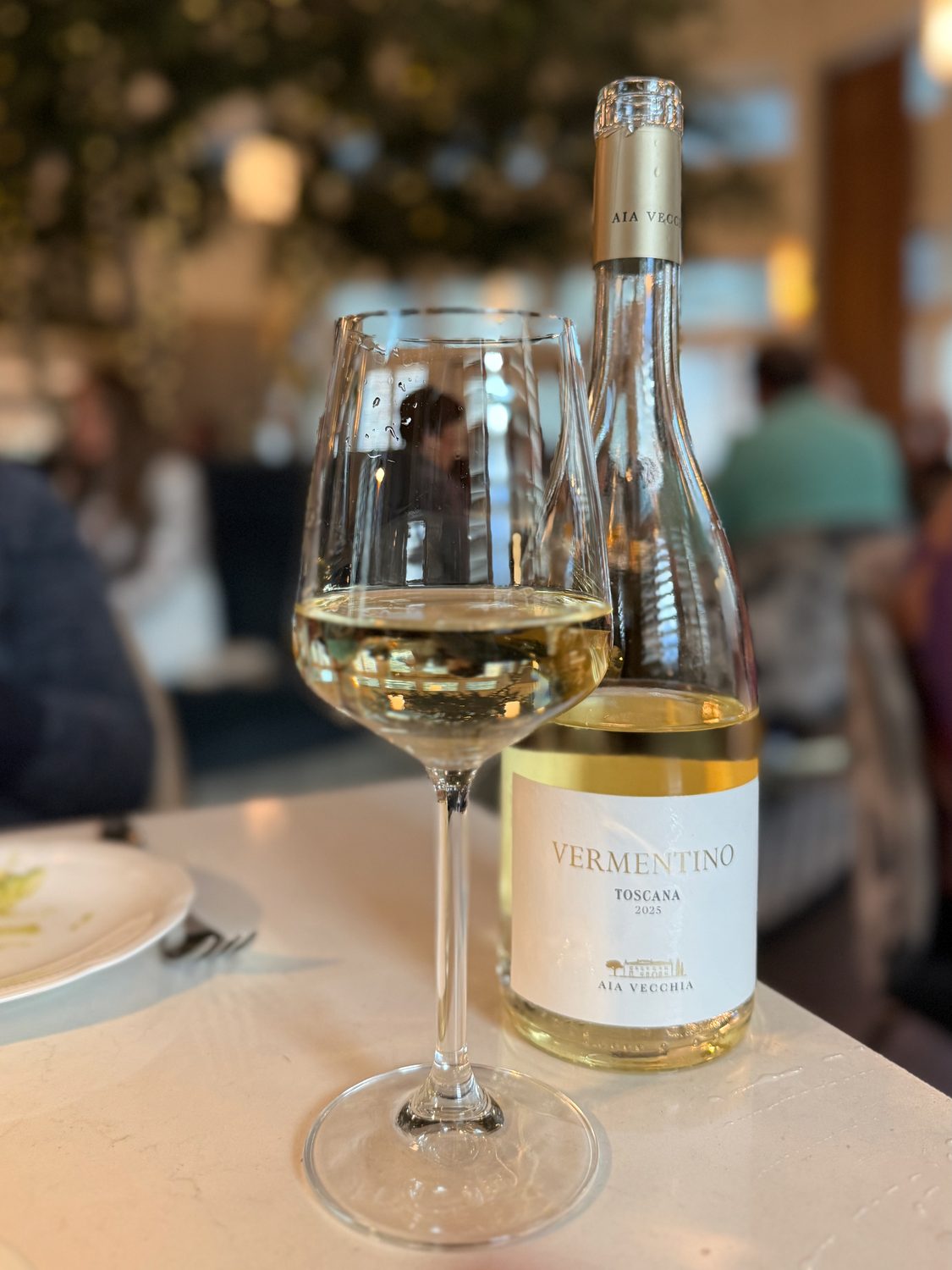
The wine came after the starter, which I mention only because the following night it arrived first and that turned out to matter. Karen chose it, as she chose the wine the following night. She has learned wine through experience, by paying attention to it for years, and I stopped offering second opinions some time ago. It was the Aia Vecchia Vermentino Toscana 2025 — the Pellegrini family, ninety-five per cent Vermentino with five per cent Viognier, from their vineyard in the southern Maremma rather than the Bolgheri property the name is usually attached to. High, bright acidity and a creamy mouthfeel at the same time, green apple and perhaps grapefruit, a saline finish. I liked it before the food arrived and understood it afterwards.
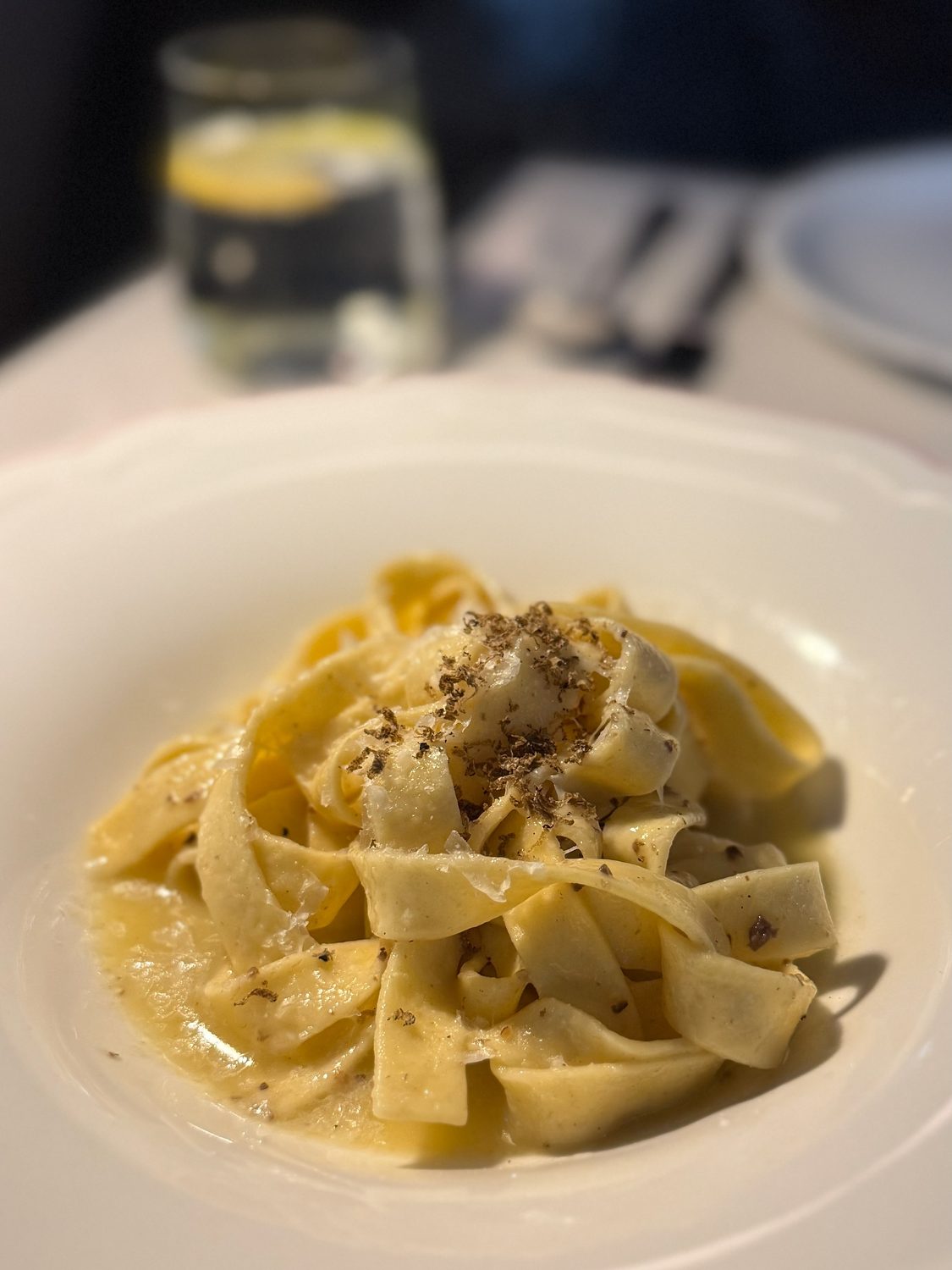
Both pastas came together. The Truffle Cacio e Pepe is tagliatelle with pecorino romano and black pepper, and I love cacio e pepe to a degree that probably disqualifies me as a judge of it — my current favourite potato chip is a cacio e pepe flavour Miss Vickie’s made with Ask For Luigi in Vancouver, which tells you where on the spectrum I sit. The honest comparison is with Ask For Luigi themselves, where on one visit they offered to shave fresh truffle over the pasta at the table. That version is still the better one, and the reason is simply the fresh shavings. Castello’s was close, and close with noticeably less truffle in it, which is arguably the harder achievement. Truffle elevates the dish; it does not rescue it. What has to be right underneath is the balance — the sharpness of the pecorino against cracked pepper — and that was right.
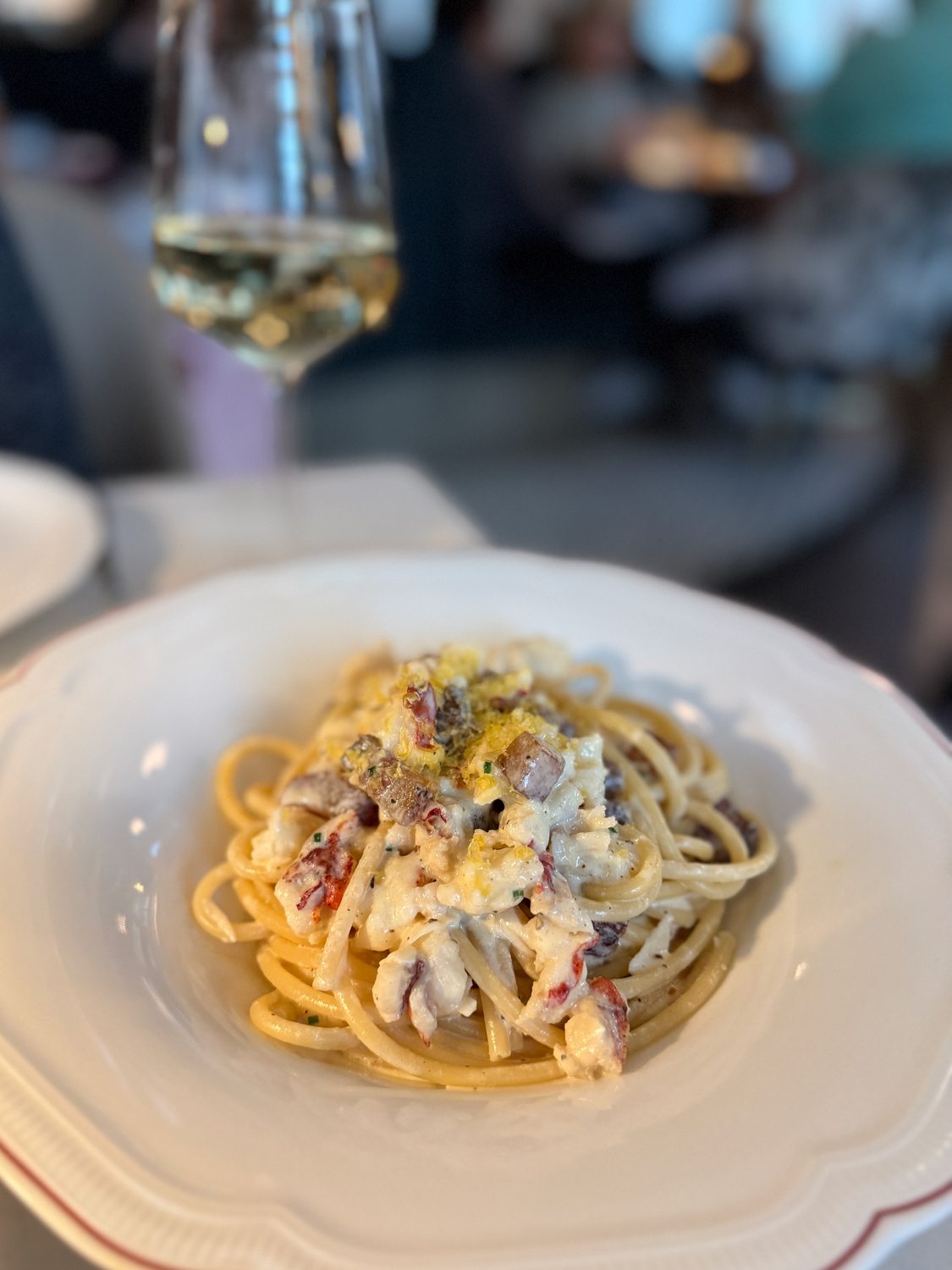
The Lobster Carbonara is bucatini with guanciale, parmigiano-reggiano, egg yolk, bottarga and chive, and it was really good. I love guanciale generally, and not only in pasta, but I had not thought about it against lobster before. It works: the cured pork fat and the sweet shellfish are doing different jobs and neither gets in the other’s way. It is also rich and decadent to the point of being difficult, and this is where the Vermentino stopped being a nice glass and started being necessary.

Saturday was 1888 Chop House, which is named for the year the hotel opened — a detail I liked more than I expected to, having spent the previous afternoon on the hotel’s history tour learning what happened in 1888. It is the dressiest of the three rooms and the most straightforwardly about beef.
The wine arrived first, before any food at all, which is not how the previous night had gone and turned out to be the whole difference. We had a half bottle of López de Heredia Viña Tondonia Reserva 2013 — a traditional Rioja, mostly Tempranillo with Garnacha and a little Graciano and Mazuelo, grown on a meander of the Ebro in Rioja Alta and aged no less than six years in old American oak. It was harvested in a cool, wet year, bottled in 2021 and not released until 2025, twelve years after the harvest. The house was founded in 1877, eleven years before the hotel it was being drunk in.
I tasted it to check it was sound, and it was decanted immediately. Karen had chosen this one too, and I had one worry going in. This is a medium-bodied wine, not the full-bodied, oak-heavy Cabernet a steakhouse trains you to reach for. Its tannins are finer and its weight lower, and what it gives you in return is nuance — none of which sounded like a match for twelve ounces of Wagyu. Decanting is the answer to that worry, and I am a believer in it for older bottles: it opens a tight wine and takes the edges off, and it separates out any sediment that has formed along the way. Dried blackberry and cherry, leather, a hint of tobacco, earth from the old oak, and high acid running under all of it.

The Sungold Lamb Tartare arrived shortly after the wine, with lemon verbena, buttermilk and prairie grains. What reaches the table is a smooth dome of white buttermilk foam, dusted dark, a golden crumble of grain at one edge, and not a trace of the lamb showing. You are meant to mix it yourself — the reverse of the steakhouse convention, where a server assembles your tartare in front of you. It presents beautifully unbroken, and the first spoonful is yours to build. I enjoy tartare generally and this was no exception. Lamb can come out gamy and this did not, and it was clean enough that you could pick out the things in it rather than tasting one blended idea. The prairie grains are sun-dried, and they put a crunch through all that softness.
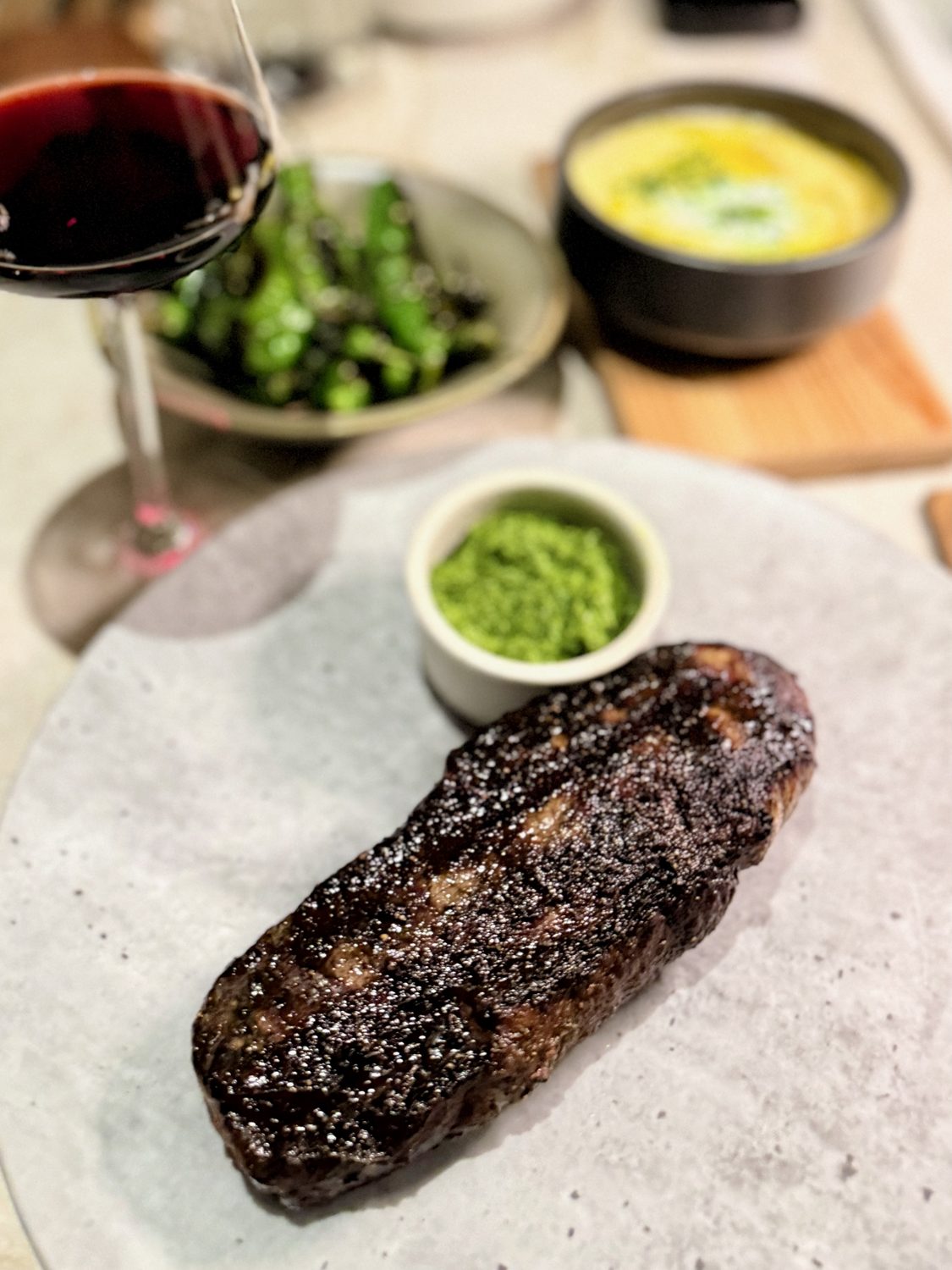
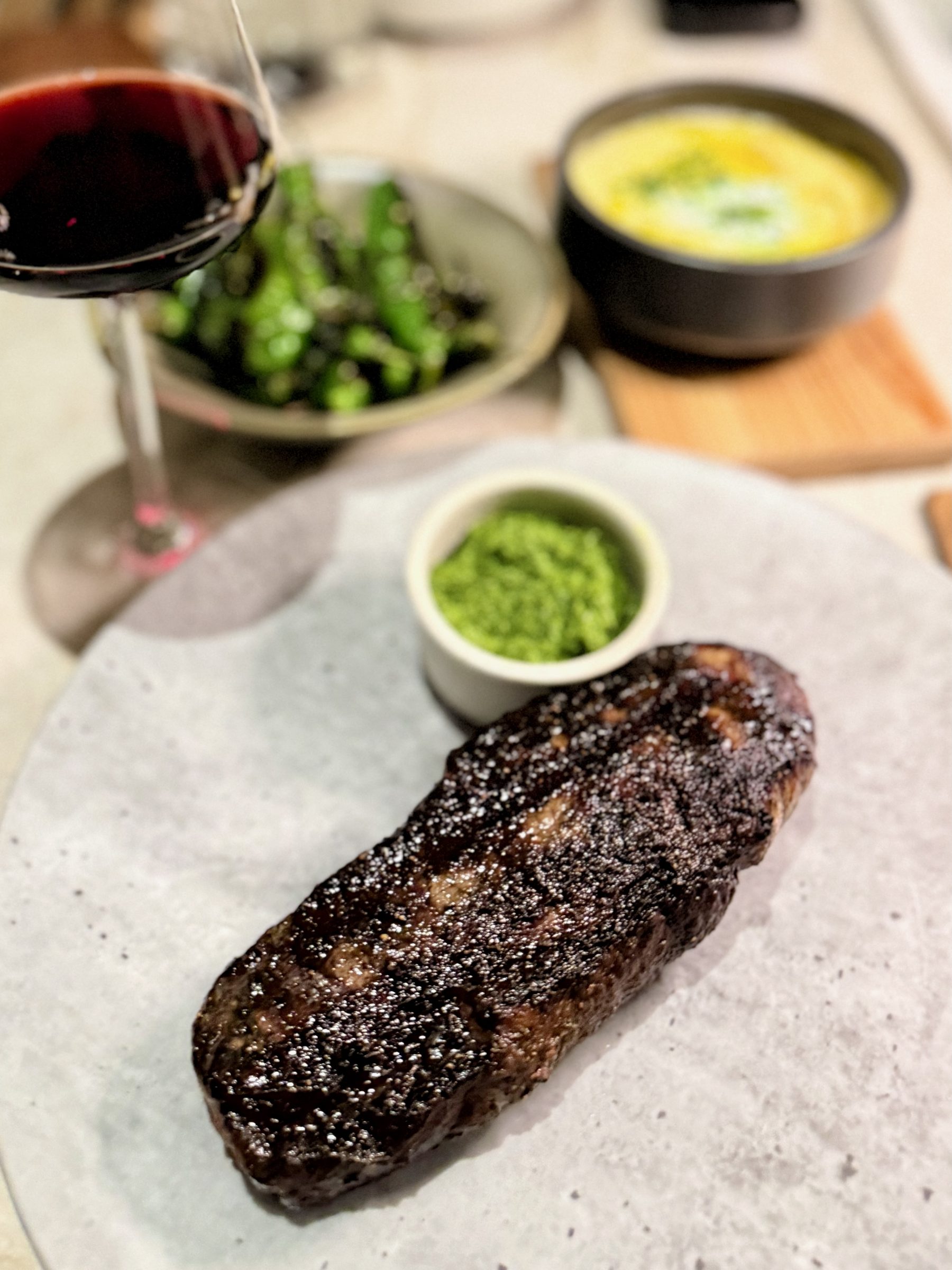
About twenty minutes later the mains came together, which gave the wine that long a head start in the decanter. Mine was the 12oz Wagyu Striploin from Brant Lake Wagyu — High River, Alberta, an hour or so from where we were sitting, Wagyu crossed onto Black Angus and grain fed, from a herd started in 1993.
I order and cook striploin more and more these days, and so does my eldest son. It has a deeper, beefier flavour than other cuts; it stays tender because the muscle sits along the spine behind the ribs and does very little work; the fat cap renders down over the grill and keeps the whole thing juicy; and per ounce it is better value than ribeye or tenderloin. That is the argument, and this was the best evidence for it I have had in a while. Cooked exactly to the medium rare I asked for, with a crust that had clearly met extremely high heat at one end of the process or the other, and everything Brant Lake Wagyu is known for in the middle. Beefy. Good. Amazing, in the order those words arrived.
I ordered it with chimichurri, one of five sauces on the list — the others are bordelaise, béarnaise, whipped house butter and house A1. I chose it as insurance. If the steak came out richer than I wanted, chimichurri is the only one of the five with the acidity to cut through it; a bordelaise or a whipped butter would have been adding to the problem rather than solving it. In the event I never touched it. That is not a criticism of a sauce I did not give a chance; it is that the steak did not need a thing, and I was not going to put something between it and the wine. Which is the point I had been circling all evening: the pairing worked because the plate was unsauced. A savoury, high-acid, slightly austere old Rioja against a well-seared rich cut, with nothing in between to referee. It got better through the meal, too, the way decanted older bottles do. By the last few bites of the steak it had arrived exactly where I had hoped it would and doubted it could.
The sides were not an afterthought. The Whipped Potato, with cherry smoked butter and chives, is extremely rich and makes no secret of where that comes from: there is a lot of butter in it, about as much as I would use myself, which is more than anyone needs. Our waiter and I agreed without much discussion that it is the side to order. The Torched Shishito comes with soy, miso, citrus and sesame, and it is a dish I order out often and cook at home in nearly the same way. The citrus came through clearly, which is the whole job it has on a plate like that one.
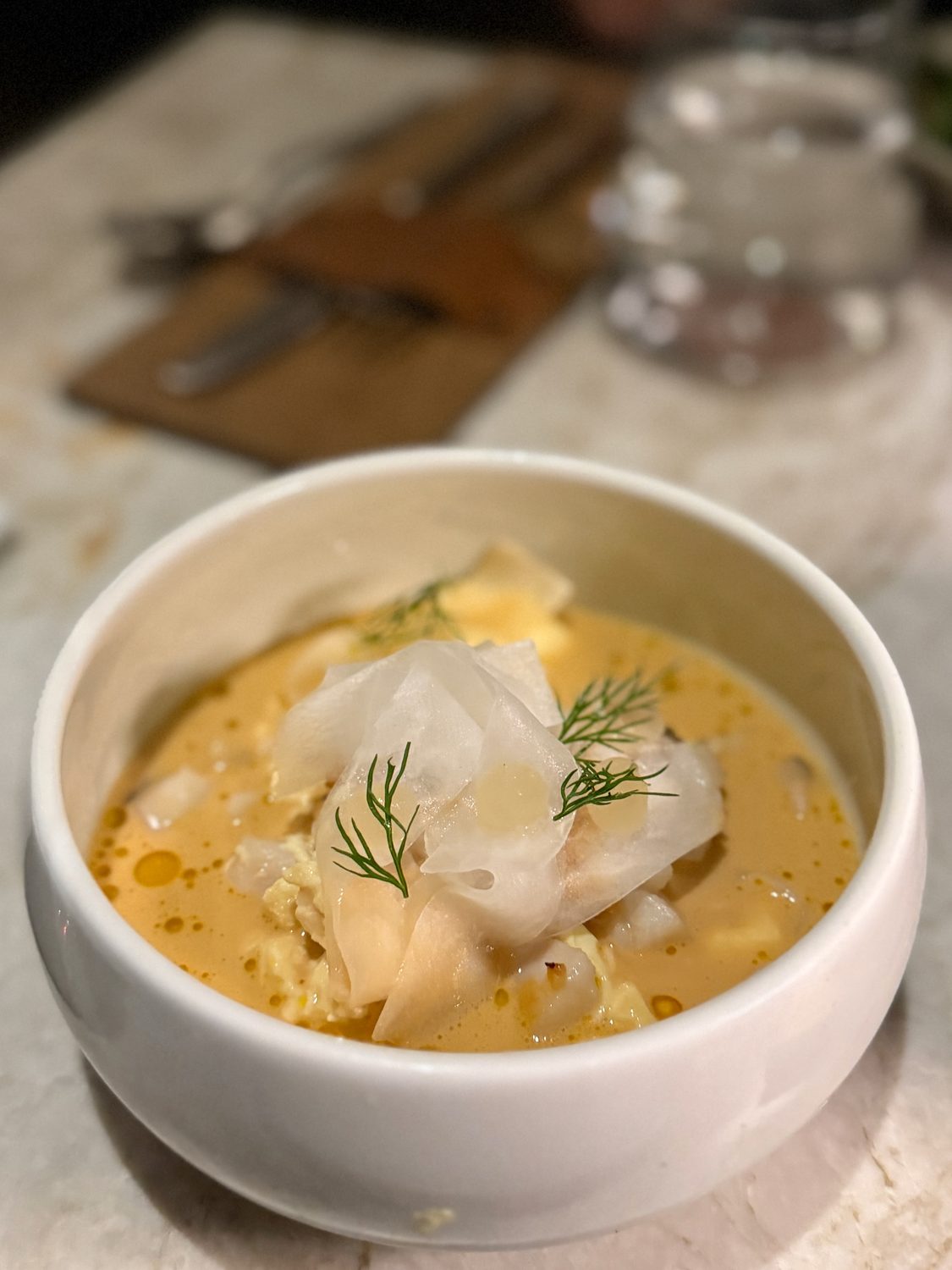
Karen, still full from the lounge for the second time that weekend, had the Haida Gwaii Sablefish with crème fraîche, daikon and yuzu — white fish in a golden, broken-cream broth beaded with orange oil, under translucent shavings of daikon and dill. It reads as a broth bowl rather than a seared fillet, and it was the lightest plate to reach our table all weekend, which on that particular night was a decision rather than a compromise.
Something I only noticed writing this down: nearly everything on that menu is named for where it came from. Brant Lake, Haida Gwaii, prairie grains, SunGold lamb out of Innisfail. A steakhouse in a railway hotel built to bring people west, putting the names of Western Canadian producers on its own card. That is not marketing. You can tell it was deliberate, and it is how a kitchen guarantees what it serves — commit to named producers and you know exactly what arrives at the door every morning, which is the only reliable way to know what leaves it.
Three nights, three rooms, and the thing that connects them is not just the hotel. It is that twice — Friday and Saturday — the meal came down to a rich plate and a bright glass, and both times the glass was doing the harder work. A Vermentino cutting a lobster carbonara and an old Rioja cutting an Alberta striploin are the same idea in two languages. I did not plan either one.
So let me revise what I said at the start. A hotel restaurant is usually a compromise. In a hotel like this one it is not. These are restaurants worth booking on their own terms, and the fact that we happened to be sleeping upstairs was incidental to all three of them. The convenience was real. It was never the reason.
Although I should declare my bias before you take any of this as advice: I will order cacio e pepe pretty much any time it appears on a menu, wherever I happen to be dining.



The Newsletter
New pieces, plus what’s on my table next. Every few weeks.

An error has occurred somewhere and it is not possible to submit the form. Please try again later or contact us.


